


Concrete Curing: Key to Strong, Durable Structures

Concrete is the most widely used construction material in the world. Almost every modern building, from a simple house to a giant bridge, uses concrete as its main element. However, the quality of concrete does not depend only on the mix of cement, sand, gravel, and water. There is one important stage that is often overlooked yet largely determines the final result: concrete curing.
Curing is the process of caring for concrete after it is cast so that cement hydration can proceed optimally. Without proper curing, concrete can lose strength, crack easily, and lack durability. This article takes an in-depth look at concrete curing, from its definition and purpose to methods, influencing factors, and best practices in the field.
Definition of Concrete Curing
Concrete curing is the process of maintaining the moisture, temperature, and environmental conditions of freshly cast concrete so that cement hydration is completed. Hydration is the chemical reaction between cement and water that produces strong bonds, allowing the concrete to harden and gain strength. If water evaporates too quickly or the temperature is not right, hydration stops before it is complete, leaving the concrete brittle and short of its design strength.
Main Purposes of Concrete Curing
- Keeping the concrete moist Water is a vital component of hydration. If concrete loses water too quickly, the hardening process is disrupted.
- Increasing compressive strength Well-cured concrete can reach the design strength set out in the structural calculations.
- Reducing plastic shrinkage cracking Cracks often appear because water evaporates too quickly. Curing prevents this.
- Improving resistance to extreme weather Dense, fully hydrated concrete better withstands rain, heat, and aggressive environments.
- Extending the life of the structure Properly cured concrete has low porosity, making it more resistant to reinforcement corrosion and chemical attack.
Concrete Curing Methods
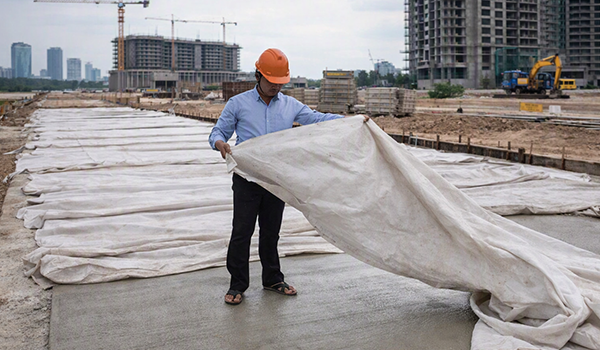
There are various curing methods to choose from depending on project conditions:
1. Water Curing
- Spraying the concrete regularly.
- Ponding the surface with water.
- Covering it with wet burlap sacks. This method is simple and effective, suitable for small to medium-sized projects.
2. Curing with Plastic Sheets or Membranes
- Covering the concrete surface with waterproof plastic. This method reduces evaporation without constant watering and is very effective in dry or windy areas.
3. Curing with Chemical Compounds (Curing Compound)
- Sprayed onto the concrete surface. It forms a thin film that retains moisture. Practical for large areas such as highways or factory floors.
4. Steam Curing
- Used for precast concrete. It speeds up hardening with controlled temperatures. Effective for mass production.
Curing Duration
The duration of curing largely determines concrete quality:
- At least 7 days for normal concrete.
- 14 days for concrete with pozzolan cement.
- 28 days is the standard for concrete to reach full strength.
In practice, the longer curing continues, the better the quality of the concrete.
Factors Affecting Curing
- Cement type Ordinary Portland cement hardens faster than pozzolan cement.
- Ambient temperature Ideally between 10–30°C. Excessively high temperatures speed up water evaporation.
- Air humidity Dry air accelerates water loss.
- Thickness of the concrete element Thin slabs lose water faster than thick beams or columns.
Effects of Improper Curing
- Early cracking on the concrete surface.
- Low compressive strength that does not meet the design.
- High porosity, making the concrete easily penetrated by water and chemicals.
- Reinforcement corrosion due to water and air penetration.
- Short structural life, which increases maintenance costs.
Best Practices in the Field
- Start curing promptly once the concrete begins to set (about 2–4 hours after casting).
- Use a method suited to the project conditions: water for small projects, curing compound for large areas.
- Monitor moisture and temperature regularly.
- Cure for at least 7 days even when the project is under time pressure.
- Use modern technology such as moisture sensors to make sure curing is optimal.
Case Studies
- Highway Project Used a curing compound because the area was large and manual watering was difficult.
- High-Rise Building Used wet burlap sacks on columns and beams to retain moisture.
- Precast Plant Used steam curing for fast production and consistent quality.
Conclusion
Concrete curing is not just an extra step but a crucial stage that determines the final quality of a structure. Well-cured concrete is stronger, more durable, and less prone to damage. By choosing a curing method suited to the project conditions, we can ensure optimal, long-lasting construction results.
Concrete Curing Solutions from PT. Petra Nusa Elshada
To support optimal concrete curing, PT. Petra Nusa Elshada supplies high-quality geotextile that is ideal as a concrete curing cover. Our geotextile helps keep the concrete surface moist, prevents water from evaporating too quickly, and ensures hydration is completed.
Advantages of Our Geotextile
- High absorbency and permeability.
- Resistant to UV rays and extreme weather.
- Suitable for road, bridge, and concrete pavement projects.
- Available in various sizes and thicknesses to suit project needs.
Contact PT. Petra Nusa Elshada for consultation and orders of concrete curing geotextile: Phone/WhatsApp: 6282123834360
Other Articles

Special Geosynthetic Properties and MARV Values
The following are the special physical and performance geosynthetic properties required in the design described. These properties must be stated as Minimum Average Roll Values (MARV) with the required test methods. MARV is the smallest average value obtained from each roll tested. Rolls must have average values greater than the recommended value for a given […]

