


Geomembrane: Functions, Types & Applications in Indonesia

Have you ever seen a shrimp pond whose base is lined with a black material that looks like thick plastic, Petra friends? Or perhaps you have wondered how giant landfills manage to hold back leachate so it doesn’t pollute the surrounding groundwater? The answer lies in one remarkable material innovation: Geomembrane.
In an era of increasingly rapid infrastructure and industrial development in Indonesia, the need for construction materials that are environmentally friendly, strong and durable has become crucial. You have probably heard the term geosynthetics many times, and geomembrane is one of the “main stars” in that big family of materials.
As a professional, engineer or project owner, understanding the ins and outs of geomembrane is no longer just an option, but a must. This material is not just an ordinary plastic sheet. It is a protector, a barrier and a guardian of the environment against various potential contamination from hazardous waste.
In this comprehensive article, we will cover everything you need to know about geomembrane. From its basic definition and main functions in the field to the types available on the market and how the material is actually applied across various industrial sectors in Indonesia. Let’s get started!
What Exactly Is a Geomembrane?
Before going further, we need to get on the same page about what a geomembrane is. Simply put, a geomembrane is a watertight membrane layer (with very low permeability) made from synthetic polymer materials. It is designed specifically to control the migration of liquids (or gases) in a man-made project, structure or system.
Unlike the conventional plastics you encounter every day, geomembrane is produced with advanced technology by adding various additives. These additives include carbon black, antioxidants and UV (ultraviolet) stabilizers. It is the addition of carbon black that makes most geomembranes on the market jet black. The purpose? Of course, to make the material resistant to direct exposure to intense sunlight (UV rays), especially in a tropical climate like Indonesia’s.
Geomembrane is generally manufactured using two main methods: the blown film method (blown into a giant bubble and then cut) and the flat die extrusion method (extruded into flat sheets). The result is a material sheet that is very strong, flexible, resistant to extreme chemicals and hard to tear.
Main Functions of Geomembrane
Why should we bother using geomembrane at all? Isn’t soil or concrete enough? Here are the main functions of geomembrane that make it irreplaceable:
- As a Watertight Barrier
The most basic and most important function of this material is to act as a watertight barrier. The permeability of geomembrane is extremely small, almost zero. This means water cannot pass through it. In projects such as artificial lakes or water retention ponds (embung), geomembrane ensures the stored water doesn’t seep away into the ground. - Preventing Environmental Pollution
This is a vital function in waste management. Industrial liquid waste or leachate (the toxic liquid that drains out of piles of garbage) is very dangerous if it seeps into the groundwater reserves that communities rely on. Geomembrane acts as a protective shield that keeps these toxic liquids within a safe, controlled containment area. - Material Separation
In some construction cases, geomembrane is also used to separate two different materials so they don’t mix. For example, separating a wet subgrade layer from a dry fill material layer. - Protection Against Erosion
Although its main function is to hold back water, installing geomembrane on dam slopes or irrigation channels also automatically protects the soil beneath from scouring by flowing water, minimizing the risk of erosion and landslides.
Geomembrane Types on the Market
Not all geomembranes are created equal. Manufacturers formulate various types of polymers to suit specific field requirements. If you are planning a project, you must know the differences between the following types:
1. HDPE Geomembrane
HDPE stands for High-Density Polyethylene. It is the favorite and the most widely used type in the world, including in Indonesia. Why is it so popular?
- Strength: HDPE has a high polymer density, making it very stiff, strong and puncture-resistant.
- Chemical Resistance: HDPE is exceptionally tough against many kinds of harsh chemicals, acids and alkalis.
- UV Resistance: Excellent for applications exposed to direct sunlight for decades.
- Drawback: Because it is somewhat stiff, HDPE requires more careful installation techniques, especially when folded at sharp corners.
2. LLDPE Geomembrane
LLDPE, or Linear Low-Density Polyethylene, is a “sibling” of HDPE, but with a molecular structure that makes it far more flexible.
- Flexibility: Because it is very pliable, LLDPE is easy to shape to uneven ground contours or areas prone to settlement (differential settlement).
- Applications: Often used for land capping projects or areas that need a material able to stretch without tearing.
- Drawback: Its chemical resistance is slightly below HDPE, and it is more vulnerable to punctures from sharp objects than HDPE of the same thickness.
3. PVC Geomembrane
Made from Polyvinyl Chloride, this material is known for being very pliable thanks to added plasticizers.
- Advantages: Very flexible, and its jointing process (seaming) is relatively easier.
- Drawbacks: The plasticizers in PVC can evaporate over time, making the membrane brittle. In addition, PVC is less environmentally friendly and vulnerable to UV rays unless given an extra protective layer.
4. Other Types (EPDM, EVA)
Besides the three main types above, there is also EPDM (Ethylene Propylene Diene Monomer), which is based on synthetic rubber, highly weather-resistant but fairly premium in price. There is also EVA (Ethylene Vinyl Acetate), which is very flexible and resistant to extreme cold, although it is rarely used in tropical Indonesia.
Geomembrane Applications in Indonesia
With its vast landscape and diverse industrial sectors, Indonesia is a very large market for geosynthetics. Where can you find geomembrane applications across the country? Let’s break them down one by one.
1. Shrimp and Fish Ponds (Aquaculture)

The fisheries sector, especially vannamei shrimp farming, is booming in Indonesia. In the past, farmers used only ordinary earthen ponds. The problem is that earthen ponds collapse easily, the water quickly turns murky, and diseases (shrimp viruses) easily take hold in the mud at the pond bottom. By using HDPE geomembrane, the pond’s base and walls become clean, watertight and very easy to clean after harvest. This drastically increases the shrimp survival rate and makes water quality (pH, salinity) easier to control.
2. Landfills (TPA)

Municipal waste management is a critical issue in major Indonesian cities such as Jakarta, Surabaya and Bandung. Modern landfills must implement a Sanitary Landfill system. This is where geomembrane plays a crucial role. Geomembrane is laid at the base of the landfill to contain all the leachate. The leachate is then piped to a Wastewater Treatment Plant (IPAL), so it doesn’t seep out and poison residents’ wells around the landfill.
3. Mining Sector
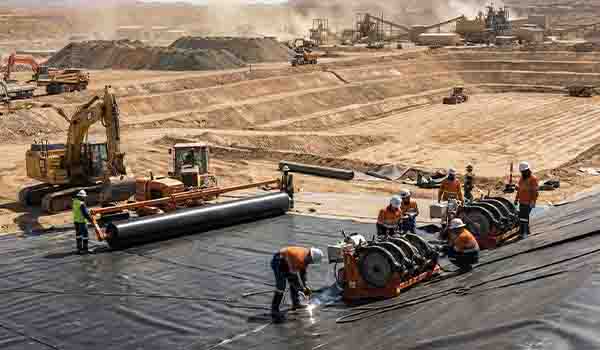
Indonesia is one of the world’s largest mining producers (gold, nickel, copper, coal). In mineral extraction, mines use hazardous chemicals such as cyanide. Geomembrane is used as an impermeable liner for Heap Leach Pads (areas where piles of ore are leached) and Tailing Dams (dams that store residual mine waste). Without geomembrane, the risk of ecological disaster from leaking mine waste would be extremely serious.
4. Building Retention Ponds and Reservoirs

The government is currently building retention ponds (embung, rainwater storage ponds) in villages across the country for agricultural irrigation. Often, the soil at these sites is porous (absorbs water easily), such as sandy soil. Geomembrane is a fast, effective solution so the pond can hold water throughout the dry season, ensuring farmers can still irrigate their rice fields.
5. Industrial & Palm Oil Waste Management

Palm oil mills generate liquid waste called POME (Palm Oil Mill Effluent). POME holding ponds need a geomembrane lining so the waste doesn’t seep into the ground. Interestingly, many palm oil mills now use geomembrane not only as a base liner, but also as a pond cover to capture the methane gas produced by the waste. This methane is then converted into electrical energy (biogas). A truly eco-friendly solution!
Benefits of Using Geomembrane
You might ask, “It’s fairly pricey, so is it worth it?” The answer: absolutely. When calculated on a Lifecycle Cost basis (the cost over a project’s life cycle), geomembrane actually delivers outstanding efficiency. Here’s why:
- Much Faster Installation
Compared with pouring concrete or compacting clay in layer after layer, laying geomembrane saves a great deal of time. In construction, speed is money. - Environmentally Friendly
It prevents damage to soil and groundwater which, once polluted, can cost hundreds of billions of rupiah to restore (remediation). - Long Service Life
Quality geomembrane (especially HDPE) protected from extreme weather can last 50-100 years underground. Even when exposed directly to the sun, it can last for decades. - Design Flexibility
It can adapt to all kinds of site sizes and shapes. No site is too large or too curved to be lined with this material. - Easy Maintenance
Especially in aquaculture ponds, the time needed to clean leftover feed sludge becomes very short, so harvest cycles can turn around faster.
A Guide to Choosing Geomembrane
You can’t just pick the cheapest geomembrane. You have to match the material specifications to field conditions. If you are unsure, follow this guide:
- Determine the Thickness
Geomembrane thickness is measured in millimeters (mm) or mil. In Indonesia, commonly used thicknesses range from 0.3 mm to 2.5 mm.
- 0.3 mm – 0.5 mm: Suitable for shrimp ponds, fish ponds or small retention ponds with a low risk of puncture.
- 0.75 mm – 1.0 mm: A medium standard, often used for artificial lakes, irrigation channels and light liquid waste.
- 1.5 mm – 2.5 mm: Required for high-risk projects such as hazardous and toxic (B3) waste landfills, mining and heavy industry. The thicker it is, the more puncture-resistant.
- Choose the Surface Type (Smooth vs Textured)
HDPE geomembrane is available with two surface types:
- Smooth: The most common and more affordable, used on flat ground or gentle slopes.
- Textured (Rough): Has small protrusions on its surface. The purpose is to increase friction (friction angle). This material must be used on steep slopes so the cover soil above it doesn’t slide down easily.
- Check Specifications and Certification
Make sure the product you buy complies with recognized international standards, such as GRI-GM13 (for HDPE) or GRI-GM17 (for LLDPE) issued by the Geosynthetic Institute. These standards guarantee the geomembrane’s tensile strength, tear resistance and UV stability.
Geomembrane Installation Steps
Even perfect geomembrane quality will be wasted if installation is careless. These are technical stages that must be carried out by certified experts (applicators). Here is a brief overview of how installation is done in the field:
- Subgrade Preparation
The soil must be compacted and cleared of sharp stones, tree roots or debris that could puncture the membrane. - Geotextile Installation (recommended)
Often, non-woven geotextile is laid over the soil first as a protective cushion so the geomembrane doesn’t rub directly against coarse soil. - Deployment
Geomembrane rolls, which can weigh tons, are lifted by excavator and rolled out according to a precisely designed panel layout. Installation must take wind direction and air temperature into account. - Welding
This is the most crucial stage. Geomembrane panels are joined to one another. There are two main methods:- Hot Wedge Welding: An automatic, self-propelled heating machine melts the two edges of material and presses them together. This method produces two weld tracks (double seam) with an air channel between them.
- Extrusion Welding: Uses molten polyurethane/HDPE welding rod to patch corners, pipe penetrations or small leaks.
- Testing (Testing)
Once welded, seams must not simply be left alone. They must be tested! An air pressure test is carried out in the channel of the double seam to make sure no air leaks out. There is also the vacuum box test and the destructive test, in which a small sample of the weld is cut out and pulled with laboratory testing equipment.
Field Challenges & Solutions
Applying geomembrane in Indonesia certainly comes with its own challenges. A tropical climate with high rainfall can be the main enemy during installation. Geomembrane must not be welded in the rain or when the material is wet, because moisture will damage the quality of the weld. The solution is for contractors to schedule panel deployment smartly and weld immediately before the rain comes, or to use protective tents.
Another challenge is thermal expansion. Black geomembrane expands under the hot midday sun, so it looks wrinkled and wavy. At night, however, cool temperatures make it contract and tighten. Therefore, the engineer must account for this expansion and contraction by leaving a little slack during daytime installation so the membrane doesn’t tear when pulled tight at night.
The Importance of Working with Geosynthetic Experts
Given geomembrane’s crucial functions, from holding billions of liters of water to keeping toxins from polluting our planet, this is not an area where you can compromise on quality. Geomembrane failure (geomembrane failure) caused by cheap material or amateur installation can lead to environmental disaster, lawsuits and massive financial losses.
That’s why you should always involve distributors and applicators with a trusted track record, who can not only sell products but also provide technical solutions, design and a workmanship warranty.
Conclusion and the Best Solution
Geomembrane has revolutionized the way we build hydraulic infrastructure and manage the environment in Indonesia. From boosting the productivity of national shrimp farming and securing landfills against leachate leaks to supporting environmentally responsible mining operations. Understanding the right functions, types and installation techniques is the key to long-term project success.
So, if you are currently planning a small project or a giant one that needs premium-quality geosynthetic materials, entrust your needs to professionals.
As a smart marketing specialist or member of a procurement team, you surely want to work with a company that can provide international-standard products as well as end-to-end service. Petra Nusa Elshada is here as a strategic partner for complete geosynthetic solutions in Indonesia. Visit us to consult directly and find the best type of geomembrane for your project’s success!
Need a Consultation for Your Project?
If you are planning a water infrastructure or soil reinforcement project, or need the best geosynthetic solution for civil construction, infrastructure safety starts with choosing the right material!
Feel free to consult the Petra Nusa Elshada team. We supply a wide range of high-quality geosynthetics ready to ship throughout Indonesia. Let’s discuss your project needs now!
Check our catalog: Click here
Chat on WhatsApp Now: Click here
Remember Geosynthetics, Remember Petra!
Other Articles


Geotextile Tube (Geotube) and Its Functions
A geotextile tube, or geotube, is made from non-woven or woven geotextile, in either polyester (PET) or polypropylene (PP), and shaped like a very large sack. To understand geotube functions, start with its size: geotextile tubes vary, reaching 15 to 30 metres as required, and can be filled with aggregate, sand or soil. Geotextile tubes […]