


Geotextile Innovation Speeds Up Indonesia’s Toll Road Projects
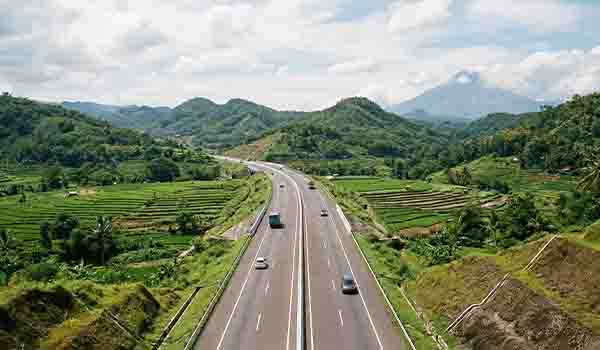
Toll road infrastructure development in Indonesia continues to be accelerated at an extraordinary pace. From the expanding Trans-Java Toll Road network to the pioneering Trans-Sumatra Toll Road, the government is targeting efficient logistics connectivity in a short time. However, behind the race against deadlines and the wave of inaugurations lies a crucial technical challenge that often escapes public view: how do we ensure that concrete roads built at lightning speed don’t crack, sink or break up before the end of their service life? The answer lies not only in cement quality, but in a quiet process called concrete curing , and in how a revolutionary material called geotextile is changing the game for construction across the country.
The Importance of Curing Concrete Structures
For civil engineers and construction practitioners, pouring concrete is not the end of the job, but the start of a decisive chemical phase. When cement mixes with water, an exothermic reaction called hydration occurs. Hydration is what binds stone aggregate and sand into the solid mass we know as concrete. For hydration to proceed optimally and the concrete to reach its designed compressive strength, the mix must not lose its internal moisture too quickly.
This process of maintaining the moisture and temperature of concrete after pouring is defined as curing. If concrete is left to dry on its own under the hot sun, the water in the mix evaporates before hydration is complete. The consequences are severe: the concrete undergoes plastic shrinkage, which causes hairline cracks on the surface, reduced structural strength and increased porosity that makes it vulnerable to weathering. Concrete curing is therefore essential, especially on massive infrastructure projects such as toll roads that carry heavy tonnage every day.
Limitations of Traditional Concrete Curing
Historically, Indonesia’s construction industry has relied on several conventional concrete curing methods. The most common are water ponding, continuous sprinkling, plastic sheeting and wet burlap sacks. Although these methods can work well in theory, implementing them in the field, especially on toll roads stretching tens to hundreds of kilometers, presents enormous logistical and technical challenges.
Ponding and continuous sprinkling require extraordinarily large volumes of water. On the Trans-Sumatra Toll Road project, which often cuts through dry plantation land or remote areas, access to clean water is very limited and transport costs balloon. Meanwhile, plastic sheeting can reduce evaporation, but plastic tends to trap heat from hydration and sunlight. This heat buildup creates an extreme temperature gradient between the core and surface of the concrete, which actually increases the risk of thermal cracking.
Wet burlap sacks, on the other hand, are a better alternative because they absorb water. However, conventional burlap dries out very quickly when exposed to strong wind and high temperatures in open areas such as toll roads. This forces construction workers to re-wet them every few hours, day and night, which ultimately drains labor resources and reduces the time efficiency of project completion.
The Non-Woven Geotextile Solution
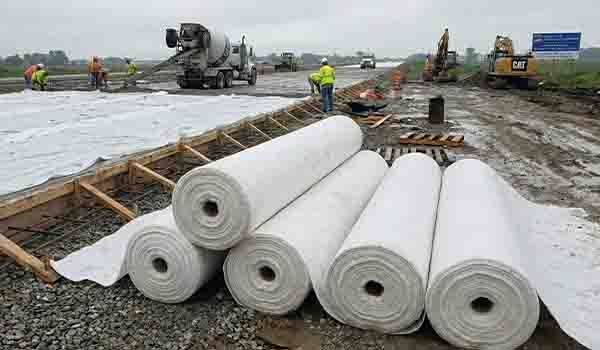
To overcome the technical deadlock of traditional curing methods, the modern construction industry is now turning to geotextile, specifically non-woven geotextile. Literally, geotextile is a material made from synthetic polymers (usually polypropylene or polyester) designed specifically for geotechnical and civil engineering applications. The non-woven variant is produced through mechanical, thermal or chemical processes that bond polymer fibers randomly, creating a fabric sheet that resembles a thin carpet or flannel.
Using non-woven geotextile as a concrete curing blanket offers a very elegant solution. The material has a microscopic pore structure that lets it absorb and hold a very significant amount of water, much like a sponge. At the same time, its synthetic fibers are extremely resistant to chemical degradation, ultraviolet (UV) exposure and mechanical wear, making it far superior to organic materials such as burlap.
How Curing with Geotextile Works

Geotextile is applied for toll road curing right after the concrete is poured and reaches final setting (when the surface is hard enough to bear light loads without damaging its texture). The geotextile sheets are then spread over the entire concrete surface and evenly wetted with water.
The material works on two main physical principles: moisture retention and thermal insulation. First, geotextile locks moisture onto the concrete surface very effectively. Its non-woven fiber structure prevents curing water from evaporating quickly, ensuring a constant, stable supply of water into the concrete’s capillary pores to support complete hydration.
Second, the material acts as an insulating layer that moderates temperature fluctuations. On hot days, a wet geotextile layer reflects part of the sun’s heat and uses evaporative cooling to keep the concrete surface cool. On cold nights, the geotextile blanket prevents a sudden loss of internal heat from the exothermic reaction. This temperature stability drastically reduces the risk of thermal cracking, a common problem in toll road rigid pavement construction.
Accelerating Toll Roads in Indonesia
The link between geotextile curing innovation and the speed of toll road construction in Indonesia is very close. National Strategic Projects (PSN) demand very tight deadlines. Contractors must finish one pouring segment quickly so they can move on to the next, or so the road can open for traffic trials as soon as possible.
By using geotextile, contractors can eliminate the need for workers standing by 24 hours a day just to water the concrete. Wetted geotextile sheets can generally retain moisture for a full 24 to 48 hours without re-wetting, depending on local weather. This is a monumental saving of time and labor when multiplied by toll road lengths of hundreds of kilometers.
Furthermore, optimal and precise curing with geotextile ensures the concrete reaches its maximum strength (usually measured at 7, 14 and 28 days) exactly on schedule, without compromising quality. Well-cured concrete has high structural density, minimizing the potential for repair work or demolition and rework caused by concrete failing quality tests. At the scale of a macro project, avoiding rework is the key to finishing toll roads ahead of conventional timelines.
Technical and Economic Project Efficiency
Although the initial purchase of geotextile may look like an increase in the Cost of Goods Sold (COGS) in the project budget compared with used burlap sacks, macroeconomic calculations prove otherwise. Non-woven geotextile is designed for high durability. It does not tear or rot easily, so one geotextile sheet can be washed and reused for up to 5-8 toll road pouring cycles, provided it is handled correctly.
High efficiency is also evident in water savings. Given that clean water shortages are often an issue in many parts of Indonesia during the dry season, a method that cuts water use by more than 50% compared with manual watering clearly provides a competitive advantage. Savings on water procurement, water tanker operations, reduced labor hours for watering crews and the absence of concrete crack repair costs cumulatively make geotextile a highly profitable technology investment for project contractors (state-owned construction companies and private firms alike).
A New Standard for National Infrastructure
Ultimately, Indonesia’s massive infrastructure development should not be measured only by the kilometers of road inaugurated, but by how long those roads can serve the public’s mobility. Using non-woven geotextile as a modern concrete curing method is not merely an optional extra, but should be seen as a mandatory operating standard to achieve infrastructure durability across generations.
Applying geosynthetic material technology is a tangible manifestation of the modernization of civil engineering in Indonesia. By combining speed of execution with high-level material quality assurance, the nation’s toll roads will not only be connected quickly, but will also stand firm over time, providing logistics certainty and sustainably driving national economic growth.
A Trusted Partner
Choosing the right geosynthetics supplier is no longer just a matter of procurement, but a strategic project investment. In Indonesia’s infrastructure landscape, PT. Petra Nusa Elshada stands out as one of the most trusted geosynthetic material suppliers for national project contractors.
Petra Nusa Elshada has built a golden reputation as a specialist distributor focused on geosynthetic product lines, including Non-Woven Geotextile, Woven Geotextile, Geomembrane, Geogrid and Geobag. With experience supporting mega-projects throughout the archipelago, the company acts not only as a seller, but as a technical consultant providing geotechnical engineering solutions in the field.
For toll road concrete curing, PT. Petra Nusa Elshada supplies Non-Woven Geotextile made from Polyester (PET) and Polypropylene (PP) in a complete range of weights, from 150 gsm to 400 gsm. Large stock availability and fast delivery to every corner of Indonesia ensure toll road projects never suffer delays from late materials.
Need a Consultation for Your Project?
Feel free to consult us about your geosynthetic material needs. We supply a wide range of high-quality geosynthetics ready to ship throughout Indonesia. Let’s discuss your project needs now!
Check our catalog: Click here
Chat on WhatsApp Now: Click here
Other Articles
Cut and Fill Process: Definition, Stages & Equipment
Hello, Petra friends! Have you ever seen a hilly plot of land suddenly turn into a flat, ready-to-build area within weeks? Or perhaps you are planning to build a property on land with an uneven contour? This is where a process called cut and fill plays a vital role. For those of you working in […]
Guide to Choosing Geopipe Material
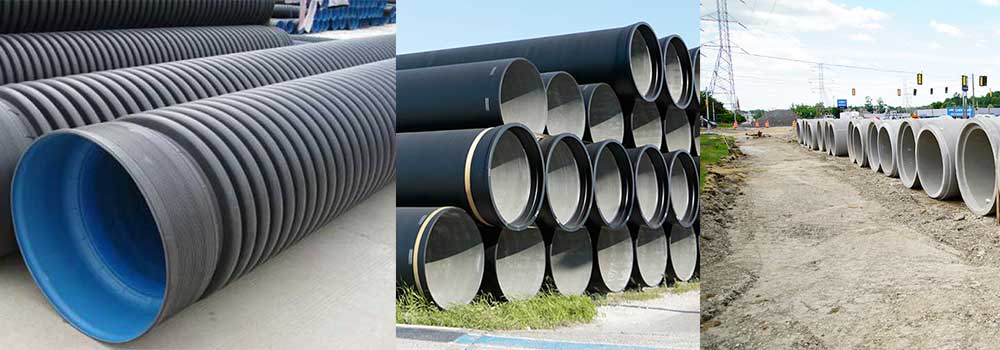
Most projects need a channel that can carry liquids such as infiltration water, wastewater, leachate and so on. Sometimes a protective layer is also needed for cables below the ground surface. These needs are usually met with pipes, which can be made from various materials such as plastic, iron and concrete. This guide to choosing […]