


Losing Your Favorite Beach to Erosion? Meet the Geotube!
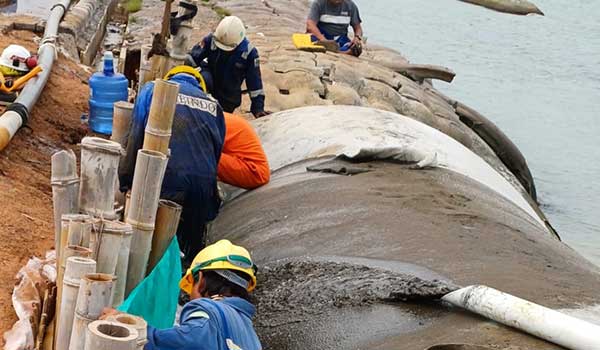
Have you ever visited a beach that used to have a huge stretch of sand, only to come back this year and feel like the shoreline has crept back toward the road or the buildings? If so, you are seeing the real impact of coastal erosion.
Honestly, climate change and rising sea levels are not just empty talk. In Indonesia, an archipelago nation, erosion is a serious threat that could sink small islands or wash away your favorite resort.
In the past, the classic solution was probably to build a concrete sea wall or pile up large rocks (gabions). But those methods are expensive, take a long time and, well, sometimes just do not look very nice. Now there is a game-changer technology in coastal civil engineering that is getting a lot of hype for how effective it is. It is called the Geotube.
So what is a Geotube? Why can it be a hero against erosion? Let us break it down in this article. Grab your coffee, let’s dive in!
What Is a Geotube? The Giant Sausage That Protects the Beach
If this is the first time you have heard the term, imagine a huge bolster or super-giant sausage lying along the beach. Technically, a Geotube is a wave-retaining system made of high-strength geotextile material formed into a large tube or bag.
This giant tube is then filled (filling) with wet sand that is pumped inside. Once the water drains out through the pores of the fabric (the dewatering process), the sand inside compacts and forms a solid, heavy and stable structure.
The Geotube works as a breakwater or sea dike. When big waves crash onto the beach, the Geotube “dampens” their energy, so the water that reaches the shoreline is calmer and does not scour away the sand.
Put simply: a Geotube is like the sandbags usually used to hold back floods, but a high-tech upgrade version, giant in size and specially designed to be “tough enough” to fight sea waves for years.
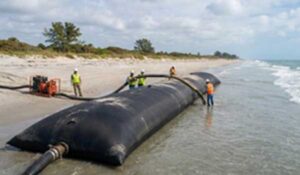
Here is an example of a Geotube being installed on the shoreline:
Why Choose a Geotube? Here Are the Main Benefits
You might be wondering, “Why not just use concrete? Isn’t it stronger?”
Well, concrete is strong, but the Geotube has plenty of advantages that make it the new favorite in coastal conservation projects. Here is why the Geotube is really worth it:
- Cost-Saving (Cost-Effective)
This is the most attractive point. Building a concrete wall requires cement, steel, formwork and a huge workforce. With a Geotube, the fill material (sand) is usually taken from the surrounding area. So contractors do not need to buy truckloads of river stone or cement from far away. This cuts construction costs significantly.
- Environmentally Friendly (Eco-Friendly)
Because it is filled with natural sand, a Geotube is friendlier to marine ecosystems than concrete. Over time, a Geotube can even be covered naturally by beach sand or planted with vegetation, so it blends into the natural scenery. No more rigid concrete walls ruining the beach vibes. Visually, too, a geotube looks more natural than a concrete structure.
- Super-Fast Installation
Compared with pouring concrete that has to cure for days, installing a Geotube is much faster. Just roll out the fabric, pump in the sand, wait for the water to drain, and voila! Your coastal protection structure is done.
- Flexible and Adaptive
Coastal ground is often soft and unstable. Rigid structures such as concrete often crack or subside when the ground beneath them moves. Because it is flexible, a Geotube can follow the ground contours without breaking.
A Look at Geotube Material: Not Just Any Fabric!
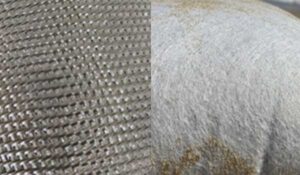
Do not imagine Geotube material as the ordinary fabric of the bedsheet on your mattress. Geotubes are made of woven geotextile or non-woven geotextile manufactured to high specifications.
Here is a close-up of the geotextile material used; notice its strong weave and pores:
Here are the characteristics of this “magic” material:
- High Tensile Strength: The fabric is designed not to tear when pumped at high pressure or when battered by storm waves.
- Permeability: This is the key. The material has pores of a very specific size. They are large enough to let water out quickly during filling, but small enough to hold back the sand grains so they do not escape. The sand is trapped inside and compacts.
- Resistant to UV Light and Chemicals: Because it will be exposed to the scorching beach sun and soaked in salty seawater, the material is coated with UV protection and resists chemical corrosion from seawater. So it does not deteriorate easily.
The main material is usually polypropylene (PP) woven with a special technique. The choice of geotextile also depends on the fill material used. If your fill material is clayey sand with a gradation of < 0.45 mm, choose non-woven geotextile for the geotube, because this material has relatively tighter pores, and vice versa.
How Is It Installed? (Step-by-Step)
Geotube installation involves pumps and large pipes. To give you an idea, here are the stages of Geotube installation in the field:
Step 1: Site Preparation
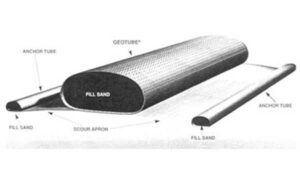
Before the “giant sausage” is rolled out, the beach area must be cleared of sharp debris, jagged coral or anything else that could tear the geotextile fabric. The construction team usually installs a base layer called a scour apron so the Geotube is not undermined from below by sea currents (scouring).
Step 2: Placement
The still-deflated Geotube is rolled out in its predetermined position. Its position must be precise, usually running parallel to the shoreline.
Step 3: Filling Process
This is the most crucial part. A mixture of water and sand (called slurry) is drawn from the seabed or the nearest source using a dredger or hydraulic pump. The slurry is then pumped through a pipe into the filling port on top of the Geotube.
Step 2: Placement
The still-deflated Geotube is rolled out in its predetermined position. Its position must be precise, usually running parallel to the shoreline.
Step 3: Filling Process
This is the most crucial part. A mixture of water and sand (called slurry) is drawn from the seabed or the nearest source using a dredger or hydraulic pump. The slurry is then pumped through a pipe into the filling port on top of the Geotube.
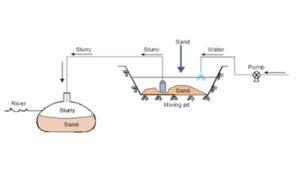
Step 4: Dewatering
As the sand and water flow in, the Geotube inflates. Because the material is permeable, water seeps out through the pores of the fabric while the sand stays inside. Over time, the contents of the tube become solid. This process is repeated several times until the Geotube reaches the desired height and shape.
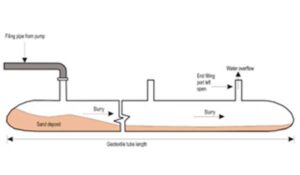
Step 5: Finishing
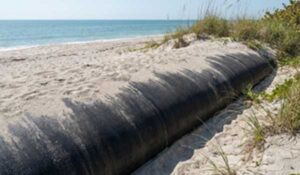
Once it is solid and shaped according to the design, the filling ports are closed. For extra protection and aesthetics, the Geotube is often covered with beach sand or planted with beach grass on top. The end result? A solid artificial sand dune protecting the land behind it!
See how natural the finished Geotube looks once it blends with
When Do You Need a Geotube?
This technology is not just for the government or state projects. If you own beachfront property, a villa, a shrimp pond or a resort business, a Geotube can be an investment that saves your assets.
Signs that you need this solution:
- The shoreline is retreating by more than 1-2 meters per year.
- Foundations of buildings near the beach are starting to be exposed to water.
- Plants or coconut trees along the beach are starting to fall because their roots are being washed away.
Conclusion: Let’s Protect Our Beaches!
Coastal erosion is a silent enemy that slowly but surely eats away at our land. Using technology like the Geotube is a smart, modern step to fight the forces of nature without damaging it further with massive concrete structures.
Besides being effective and cost-saving, using Geotubes shows that we care about more sustainable solutions. So if you see a solid “long mound” along the beach, you now know it is a land-protecting shield called a Geotube.
We hope this article helps you understand coastal protection technology better! Remember, protecting beaches is not just the job of civil engineers; it is everyone’s job to be environmentally aware.
Do you have a project near the coast that needs protection from erosion? Or want to know more about the technical specifications of Geotubes? Talk to Petra Nusa Elshada to discuss your needs further
Other Articles

Geotextile Distributor and Supplier
Non-Woven Geotextile As a geotextile distributor, we supply this non-woven type, which resembles a fabric carpet and is generally sold in white. Our local product is made from high-quality 100% polyester (PET) fibers. It is produced in a continuous process, in which the fibers remain unbroken throughout manufacturing, resulting in geotextile of good quality that […]


Geotube Protection Materials and Installation
The material that forms a Geotube is made of polymers that are not UV resistant, so geotube protection materials are needed.Geotube structures must also be protected against impacts from sharp materials such as driftinglogs or collisions with small boats. Taking into account the conditions of each sectionwhere the Geotube is installed, concrete mattresses are used […]