


HDPE Strip Filter Drain: An Easy Fix for Site Drainage
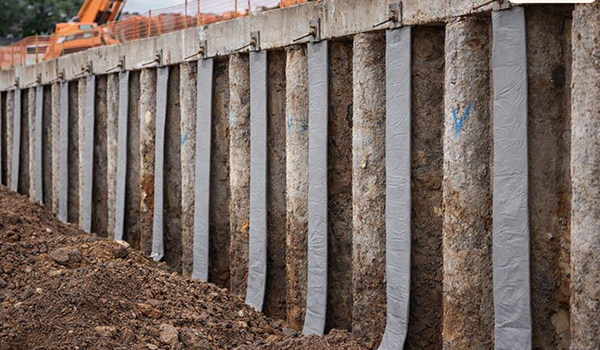
Drainage is one of the vital elements of infrastructure development. Without a good drainage system, rainwater or groundwater can cause many problems: ponding on road surfaces, damaged sports fields, excess moisture behind retaining walls, and even landslides on unstable slopes.
Traditional methods usually rely on aggregates such as sand, gravel, or crushed stone to build a drainage layer. However, this approach requires large quantities of material, wide trenches, and high transport and labor costs. Its effectiveness also often declines over time as fine particles clog it.
In response to these challenges, Global Synthetics introduced the Strip Filter Drain, an HDPE strip filter drain product that is prefabricated and designed to provide a more efficient, lightweight, and durable drainage solution.
What Is an HDPE Strip Filter Drain?
The Strip Filter Drain is a strip-shaped drainage composite with an HDPE (High-Density Polyethylene) polymer core wrapped in PP/PET geotextile. The geotextile layer acts as a filter that prevents fine soil particles from entering the drainage core, so water keeps flowing freely over the long term.
The product is a replacement for traditional aggregate-based methods. Thanks to its slimmer design, it can be installed in narrow trenches, reduces the need for additional material, and speeds up construction.
Key Advantages
The material offers a range of advantages that make it a preferred choice over conventional drainage systems:
- Lightweight and easy to install: no heavy equipment or large workforce is needed. The product can be transported and installed easily on the project site.
- Available in various sizes: adapts to project needs, whether for highways, sports fields, or retaining walls.
- Anti-clogging geotextile layer: prevents fine particles from entering the drainage core and keeps water flow optimal.
- Specially shaped core (dimpled core): allows high water flow capacity, even in saturated soil conditions.
- Strong and durable: compressive strength of up to 200 kPa, with mechanical properties that support long-term use.
- Economical: reduces the need for aggregate, transport costs, and installation time.
Strip Filter Drain Applications
The product can be used in many areas of construction and civil engineering, including:
- Roadside subsurface drainage: reduces ponding on the road surface, extends pavement life, and keeps the road comfortable for users.
- Sports fields: keep the playing surface dry and stable so it can be used all year round without rain disruptions.
- Retaining walls: installed behind the wall to reduce hydrostatic pressure from groundwater.
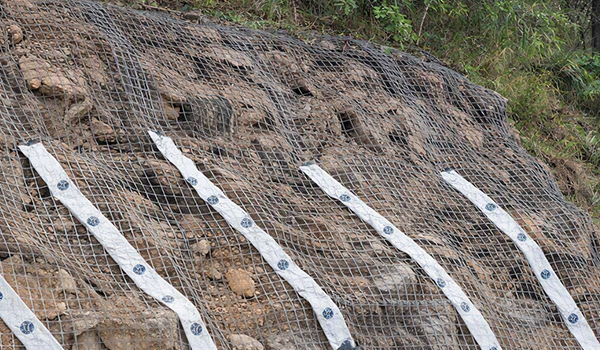
- Unstable slopes: helps control water seepage that can trigger landslides, improving slope stability.
Installation Method
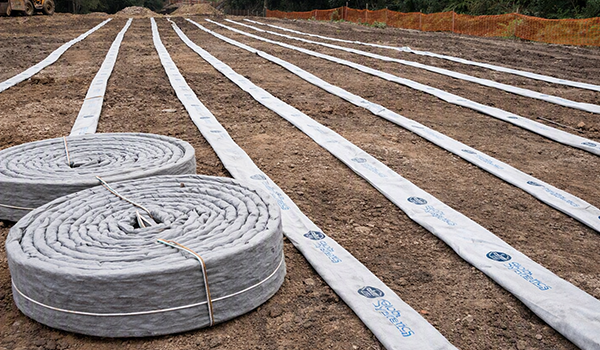
An HDPE strip filter drain can be installed vertically or horizontally using a relatively simple procedure:
- Vertical: installed against the soil face or cliff, which can then be covered with sprayed concrete (shotcrete). The top is closed with geotextile and sealed to stop fine particles from entering. The bottom can be connected to a collector drain.
- Horizontal: laid in a narrow trench (±100 mm) with a minimum slope of 0.5% so water flows freely. The trench is then backfilled with free-draining soil or sand. For heavy loads, no-fines concrete backfill can be used.
Another advantage is its flexibility: the HDPE strip filter drain can follow the direction of the trench without needing elbow joints.
Comparison with Traditional Methods
Compared with a drainage system using perforated pipe and aggregate:
- Traditional method: requires a wide trench, layered aggregate, and higher transport and labor costs. The risk of clogging is also higher.
- HDPE strip filter drain: needs only a narrow trench, installs faster, and performs more efficiently. As a prefabricated product, it delivers consistent, long-lasting quality.
Technical Specifications
The material is available in two main types:
- 20 mm core thickness.
- 40 mm core thickness.
Both come in a range of depths (100–500 mm) and standard roll lengths (25–50 m). The product has a compressive strength of up to 200 kPa and an infiltration area of more than 95%, making it very effective at draining water.
Hydraulic tests show high flow capacity across a range of hydraulic gradients, making it reliable in many field conditions.
Case Studies
- Highway project: the HDPE strip filter drain was used as an edge drain to reduce ponding. As a result, pavement life increased and maintenance costs dropped significantly.
- Football field: a drainage system using the HDPE strip filter drain kept the field dry even after heavy rain, so match schedules were not disrupted.
- Retaining wall in an urban area: installing the HDPE strip filter drain behind the wall reduced groundwater pressure, improved structural stability, and lowered the risk of cracking.
Sustainability and Efficiency
Beyond its technical advantages, the material also supports sustainability principles:
- Reduces the use of natural materials such as sand and gravel.
- Reduces carbon emissions because less material needs to be transported.
- Extends infrastructure life, reducing the need for repairs and replacement.
Conclusion
The Strip Filter Drain is a modern solution to drainage problems that have traditionally been handled with aggregate-based methods. Being lightweight, easy to install, durable, and cost-effective, it is ideal for infrastructure projects, sports fields, and slope control systems.
Other Articles

Why Is Geogrid Aperture Size Important?
Geogrid aperture size is critical when selecting a product because it directly affects the performance and effectiveness of the interlock system. Geogrid is used in civil engineering and geotechnical applications to reinforce soil and materials such as aggregate layers. The primary function of geogrid is to provide bearing capacity by distributing loads over a wider […]

Woven Geotextile: Functions and Applications
Woven Geotextile Woven geotextile is a geotextile material made by weaving on state-of-the-art machines. It is a permeable woven fabric that can be used with soil. Geotextile geosynthetics can reinforce, protect, filter and separate. The geotextile sold on the market today is made from polypropylene or polyester. Woven geotextile is one type; there is also […]

How a GCL (Geosynthetic Clay Liner) Works
A GCL (geosynthetic clay liner) is key to many containment projects. It is a material in which bentonite or another clay is bonded between two woven or non-woven geotextiles to slow seepage. Its main uses are in landfills and liquid containment projects. Bentonite is an absorbent aluminum phyllosilicate clay that helps create a low-permeability barrier, […]