


Prefabricated Vertical Drain: A Smart Soft Soil Solution
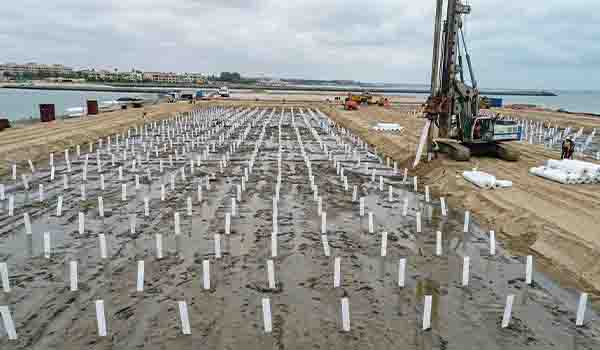
Have you ever seen a toll road project built over swampy or extremely soft-looking ground, Petra friends? You might wonder how such soft soil can support concrete and thousands of passing vehicles without sinking. The answer isn’t magic, but a civil engineering technology called a Prefabricated Vertical Drain, often abbreviated as PVD.
If you work in construction or geotechnical engineering, or are simply curious about how modern infrastructure works, understanding PVD is essential. This technology has become the backbone of infrastructure development in Indonesia, especially in areas with challenging ground conditions.
In this article, we will examine everything about PVD, from its basic definition and unique working principle to why this material is far more efficient than conventional methods. Read on to the end!
What Is a Prefabricated Vertical Drain (PVD)?
Put simply, a Prefabricated Vertical Drain (PVD) is a composite geosynthetic material that serves as an artificial drainage aid. PVD is installed vertically in soft soil to accelerate drying or the discharge of water from its pores. On projects, this material is also commonly known as a wick drain.
Physically, PVD resembles a long, flexible strip. It is not a single material, but consists of two complementary main components:
- Core: The inner section, usually made from polypropylene (PP) plastic. Its corrugated or grooved form creates a vertical channel through which water flows to the surface.
- Filter Jacket: The outer layer wrapped around the core, made from non-woven geotextile. Its function is crucial: it filters water into the core while holding back fine soil grains so they don’t enter and block the flow.
The combination of these two components creates a highly effective, durable drainage system capable of operating even under extreme soil pressure.
Why Does Soft Soil Need PVD?
Before discussing the technical details further, you first need to understand the main problem: Soft Soil.
Soft clay has low bearing capacity and undergoes substantial compression (settlement). Its biggest problem is its extremely low permeability. This means water trapped in the pores of clay is very difficult and slow to discharge naturally.
If you build a toll road or building on soft soil without soil improvement, the structure’s load compresses the ground. The pore water naturally tries to escape under pressure, and the soil settles gradually. The problem is that this “gradual” natural process can take decades! You certainly don’t want a newly opened toll road to suddenly sink 1 meter within the next 5 years, do you?
This is where PVD plays its role. It provides a shortcut through that long waiting period.
How PVD Accelerates Consolidation
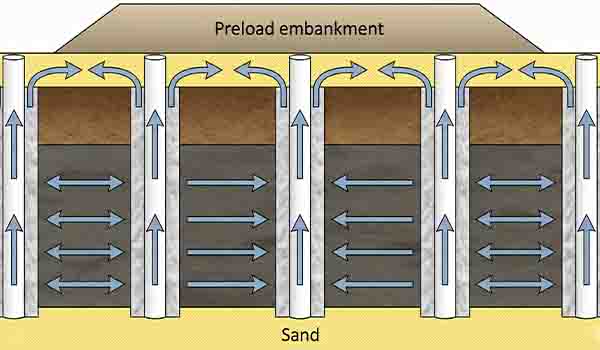
PVD works on a simple yet ingenious principle. In geotechnical engineering, the discharge of water from soil pores under loading is called consolidation.
Without PVD, water in the soil has to travel a long vertical distance to reach the ground surface. Because the distance is long and clay is dense, the water moves very slowly.
When PVD is installed, it acts as a “highway” for water.
- PVD is installed vertically at close intervals (for example, every 1 meter).
- The distance the water must travel becomes very short. Instead of rising 20 meters to the surface, it only has to move 0.5 meter sideways to the nearest PVD.
- Once water enters the PVD, it flows freely upward through the plastic core to the surface.
- At the surface, water is conveyed to drainage channels through a sand blanket or horizontal pipes.
By shortening the water’s travel distance, consolidation that would have taken 20 years can be accelerated to only 6 months to 2 years (depending on the design). This is called accelerated consolidation.
Stages of On-Site PVD Installation

PVD installation requires special heavy equipment called a PVD Rig. Here is an overview of the on-site installation steps:
- Site Preparation
The site is cleared and leveled. A working platform layer (usually sand) is prepared so the heavy equipment can move safely. - Setting Out Installation Points
Surveyors mark the points where PVD must be installed. The layout can follow a square pattern or triangular pattern, depending on the design consultant’s calculations. - Installation Using a Mandrel
The PVD is inserted into a protective steel casing called a Mandrel. The mandrel protects the PVD from damage as it is pressed into hard ground. - Installing the Anchor Plate
An anchor plate (usually a small steel plate or piece of reinforcing bar) is attached to the lower end of the PVD. Its function is to hold the PVD in the ground when the mandrel is pulled back up. - Penetration and Cutting
The heavy equipment presses the mandrel and PVD into the ground to the specified depth (which may reach 20-30 meters or more). Once the target depth is reached, the mandrel is pulled up. The anchor holds the PVD below. After the mandrel is fully withdrawn, the PVD is cut at the surface, leaving a short end for connection to horizontal drainage.
PVD vs Sand Drain: An Efficiency Contest
Before PVD became popular, the old method was the Sand Drain (sand column). It works on the same principle, creating a vertical hole and filling it with sand. But why have almost all projects now switched to PVD? Here is the comparison:
- Installation Speed
- PVD: Very fast. One rig can install thousands to tens of thousands of linear meters per day.
- Sand Drain: Slow. It requires large-diameter drilling and time-consuming sand placement.
- Material Quality
- PVD: Factory-made (prefabricated). Consistent core and filter quality is assured by factory Quality Control.
- Sand Drain: Highly dependent on the availability of clean, uniform sand. There is a significant risk of breaks in the continuity of the underground sand column during installation.
- Environmental Impact
- PVD: Minimal excavation. Very little soil is displaced because PVD is thin.
- Sand Drain: Requires a very large volume of sand (natural resource extraction) and generates excavated soil from drilling.
- Cost
In general, PVD is far more economical than Sand Drain, both in material price and heavy equipment operating costs because the work takes less time.
When Should You Use PVD?
PVD is highly recommended if your project site has the following characteristics:
- Thick Soft Clay:
Sites such as swamps, former rice fields or coastal areas (such as Java’s north coast). - Reclamation Projects:
Reclaimed land usually consists of fill over a soft seabed, so settlement must be accelerated before construction can begin. - Tight Deadlines:
When the road or building construction schedule cannot accommodate years of natural settlement. - High Embankment Areas:
Such as bridge approaches requiring high soil embankments, which carry a major settlement risk.
PVD Applications in Infrastructure Projects
In Indonesia, PVD technology has become a standard requirement in various National Strategic Projects (PSN). Applications include:
- Trans-Sumatra Toll Road:
Much of the route crosses peat and soft soil, so PVD is used extensively to stabilize the roadbed. - New Airports:
Airport runway construction in coastal areas such as YIA (Yogyakarta) or airports in Kalimantan often uses PVD to prevent an uneven runway later. - Industrial Estates & Ports:
Container stacking areas (container yards) require very stable, hard ground, so PVD and preloading are applied before the concrete slab is poured.
Conclusion
Applying Prefabricated Vertical Drain (PVD) technology is no longer simply an option, but an urgent necessity for ensuring the service life of Indonesia’s infrastructure. By investing in ground improvement at the outset, you prevent far more expensive road repair costs later.
Strong soil is the foundation of great construction. If you are planning a project on soft ground and need a reliable PVD solution, make sure you consult an expert to obtain the right fit-for-purpose specification.
Need a Consultation for Your Project?
Feel free to consult us about your geosynthetic material needs. We supply a wide range of high-quality geosynthetics ready to ship throughout Indonesia. Let’s discuss your project needs now!
Check our catalog: Click here
Chat on WhatsApp Now: Click here
Remember Geosynthetics, Remember Petra!
Other Articles

Geotextile Functions for Railways, Farming and Drainage
Just like road construction, railway construction certainly requires the application of geotextile. One of the key geotextile functions here is to act as a separation layer, or separator, between the soil and the underlying subsoil. The separator applied will certainly not disrupt groundwater circulation. Another advantage of this layer is that it effectively dampens the vibrations […]

Uniaxial Geogrid: Complete Guide and Benefits
The term geogrid may sound unfamiliar to laypeople. Geogrid is a perforated, raft-like sheet used to strengthen soil structure. There are two types of geogrid: uniaxial geogrid and biaxial geogrid. Uniaxial geogrid has an elongated shape and is manufactured as an integral unit. This type of geogrid is more often installed on steep slopes that […]

Geotextile as a Drainage Filter
Drainage is an important part of any construction project, and a geotextile drainage filter keeps it working. Drainage systems can be built in many ways; common types use perforated pipes and filter drains. A general weakness of drainage systems is that soil particles can enter along with the water. Aggregate can be used to deal […]