


Geocell Industrial Road for Heavy Loads in Batang

Project Challenges
The industrial estate in Batang is growing rapidly, and this geocell industrial road project shows a typical problem there: infrastructure is often built on less than ideal subgrade conditions. If crushed stone aggregate (base course) is spread directly over soft subgrade, several serious problems emerge over time:
- The aggregate mixes with mud from the subgrade (pumping effect).
- Deep wheel ruts (rutting) form due to repeated truck axle loads.
- Uneven settlement (differential settlement).
The client needed a pavement system that could not only carry the estate’s operational loads but was also efficient in installation time and long-term maintenance costs.
Technical Solution
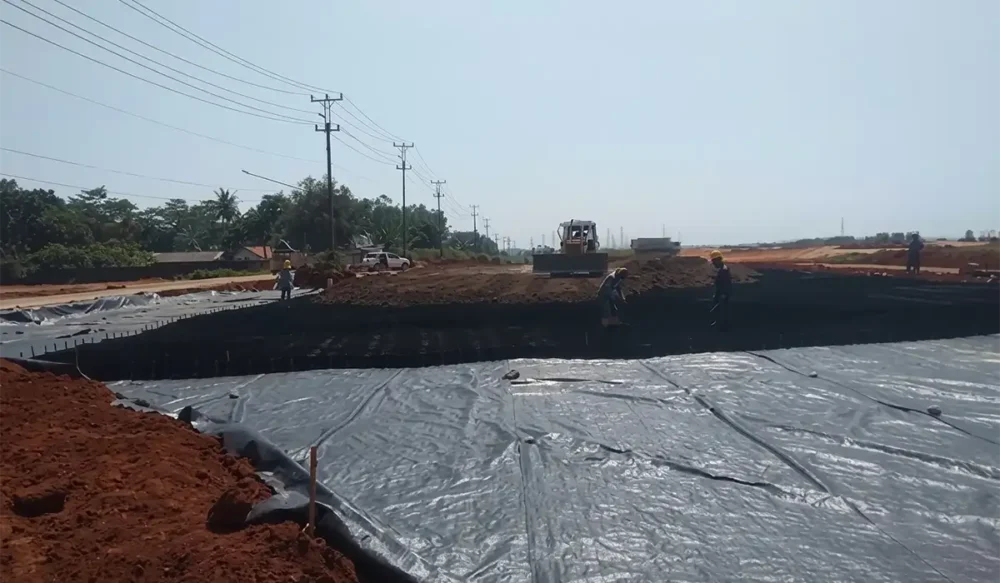
To solve these complex problems, the road design no longer relied on conventionally thickening the aggregate layer. The modern solution applied over 10,017 m² was a Cellular Confinement system using 15 cm high Geocell, combined with a separation layer of Woven PP Geotextile 200 gsm.
How does this system technically protect the road from damage? Let’s look at each function in turn.
1. Separation and Increased Bearing Capacity
Before the geocell was installed, sheets of Woven PP Geotextile 200 gsm were laid directly on the subgrade. Their main function is as a physical separator between the fine-grained subgrade and the coarse aggregate fill above.
With its high tensile strength, the woven geotextile acts like a membrane, providing a tension membrane effect that significantly increases the bearing capacity of the subgrade. The geotextile also keeps subsurface drainage working without the aggregate clogging with mud.
2. Lateral Confinement Mechanism
When the 15 cm geocell is stretched out over the geotextile, it forms a 3D honeycomb structure. When infill (aggregate) is placed in the cells and compacted, it becomes tightly locked.
Unlike conventional roads, where gravel can shift sideways under truck tyres, the geocell system ensures that the aggregate does not spread sideways easily. The cell walls restrain the aggregate laterally, so the infill stays locked in place, creating an exceptionally strong semi-rigid mattress.
3. Superior Load Distribution
This is the real strength of combining geocell and geotextile. When heavy truck wheels pass, the concentrated wheel load is not transmitted straight down. The geocell structure spreads vehicle loads over a wider area. Because the load is evenly distributed, the stress on the subgrade beneath drops drastically. As a result, the risk of subsidence is reduced significantly.
Results and Benefits
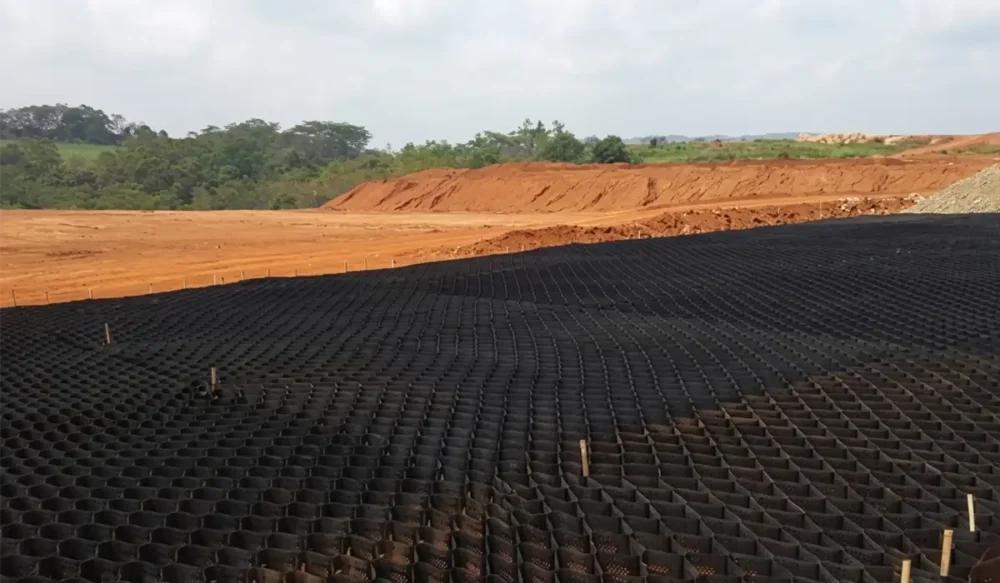
After the 10,017 m² installation was completed and the road came into service, this combination of geosynthetics delivered real technical benefits:
- Rutting-Free: The tightly locked structure successfully reduced wheel rut formation despite daily trailer truck traffic.
- Smooth Surface: The lateral restraint of the geocell keeps the road surface level and stable.
- Controlled Settlement: Because loads are evenly distributed, if soil consolidation occurs, settlement is more uniform, so the road does not become wavy or crack.
- Long-Term Performance: Ultimately, the road stays stable under heavy vehicles, leading to less need for routine maintenance. The client can save billions of rupiah in future patching or asphalt resurfacing costs.
If you are planning a mining road, plantation access road or industrial estate with heavy duty loads, this Batang case study proves that investing in geocell and geotextile technology is the smartest step towards a durable pavement.
Other Articles

Geocell Access Road Construction Project in Banten
Geocell access road project / Geocell project / road construction / geocell installation / geocell laying Geocell application: Access Road ConstructionLocation: BantenMaterial: Project description:

Geocell Slope Protection in Lebak Bulus
The Problem: Erosion Threats in the Heart of South Jakarta The project site in Lebak Bulus has sloping terrain that is quite vulnerable to surface soil movement, making it a clear case for geocell slope protection. The main problem facing slopes in tropical urban areas is scouring by rainwater (surface runoff). During heavy rain, water […]