


Kapuas Palm Oil Road Geocell Reinforcement
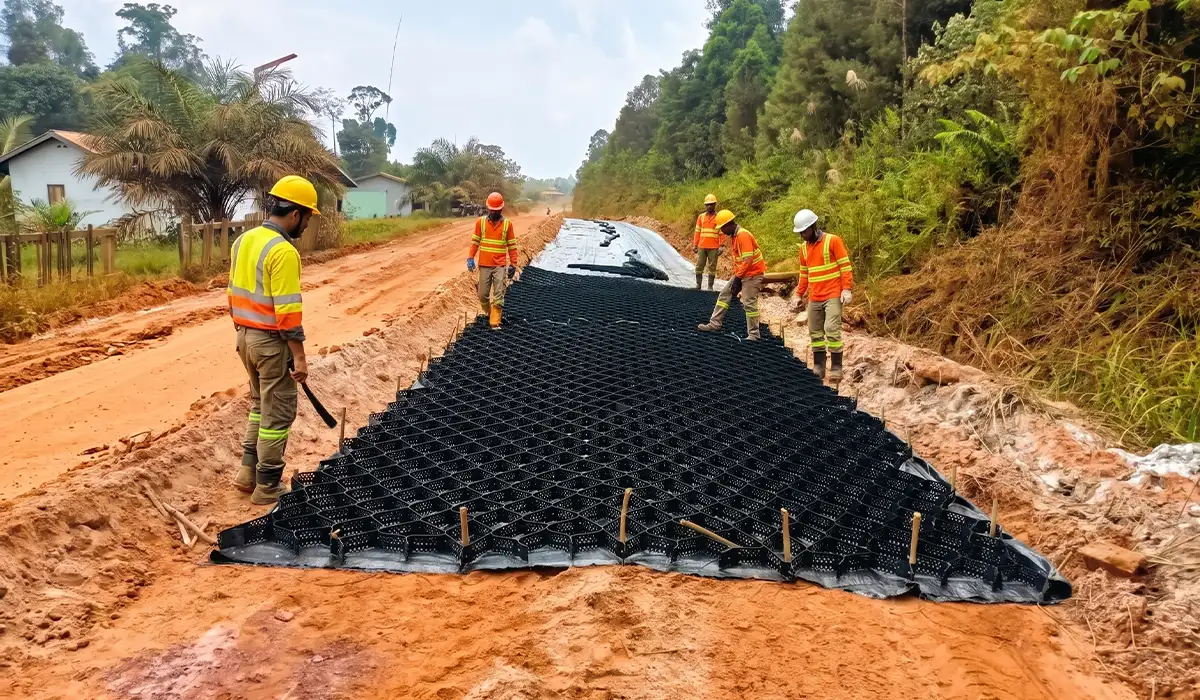
Background & Challenges: Soft Soil Under a Kapuas Palm Oil Road
Kapuas, West Kalimantan, is known for its fertile landscape, yet every Kapuas palm oil road faces a major infrastructure challenge: the dominance of soft soil with a very low California Bearing Ratio (CBR) value.
Under normal conditions, a dirt road on a soft subgrade is troublesome enough. But palm oil plantation roads carry far more extreme loads. Trucks carrying dozens of tons pass every day, putting dynamic, repetitive loads on the road surface.
Without proper reinforcement, the aggregate (crushed stone or gravel) placed on the road slowly “sinks” into the soft soil beneath because of the pumping effect as truck tires roll over it. The result? Deep wheel ruts (rutting) form, the road becomes wavy, and eventually it turns into impassable mud. The challenge: how do we build a road foundation that can carry these heavy loads without removing and replacing massive volumes of native soil?
Technical Solution: 7.5 cm Geocell & 250 gsm Woven Geotextile

To meet that challenge, our team recommended a composite geosynthetic system. We used not just one but two materials with complementary functions: Geocell with a height of 7.5 cm and 250 gsm Woven Geotextile.
So how do these two materials actually work on site? Let’s break them down one by one.
1. 250 gsm Woven Geotextile: The Separator and Tensile Load Carrier
Before the cellular layer is installed, 250 gsm Woven Geotextile is first rolled out over the soft subgrade. Made of woven polypropylene (PP) tapes, this material has two critical functions:
- Complete Separation: Woven geotextile works like a protective membrane that prevents the soft subgrade (mud or clay) from mixing with the good-quality fill material above it. Without this separation, expensive fill would be swallowed by the soft soil, damaging the integrity of the road structure.
- Extra Reinforcement: The high tensile resistance (tensile strength) of this 250 gsm material is crucial. When loaded truck wheels press on the road surface, the load is transferred downward. The geotextile resists this strain and distributes the stress (vehicle wheel loads) over a much wider soil area. Like wearing snowshoes on soft snow, the load is spread evenly so the road does not sink.
2. 7.5 cm Geocell: Three-Dimensional Confinement
Once the woven geotextile is in place, the 7.5 cm geocell panels are spread out on top. Geocell is a three-dimensional cellular containment system (cellular confinement system) shaped like a beehive (honeycomb). In soil mechanics terms, its function is remarkable:
- Locking the Infill (Confinement Effect): Imagine pressing a pile of sand with the palm of your hand; the sand will spread sideways (lateral displacement). Geocell prevents this. The geocell walls lock the aggregate or fill soil in place. The infill cannot escape anywhere, so it becomes stiff and stable like a solid foundation slab.
- Three-Dimensional Load Spreading: Because the aggregate is tightly locked inside the cells, vertical loads from heavy vehicle wheels are not just transmitted straight down but spread laterally to the surrounding cell walls. This mechanism drastically increases the overall load-bearing capability of the soil (bearing capacity). The stiffness modulus of a base layer with geocell is many times higher than that of an unreinforced road.
Results and Conclusion
The combination of 250 gsm Woven Geotextile and 7.5 cm Geocell on this Kapuas plantation road proved to be a brilliant value engineering solution.
This combination solves the root problem of plantation road infrastructure. The geotextile keeps the upper and lower materials from mixing and adds tensile strength, while the geocell locks the fill in place and spreads loads optimally. As a result, the required base thickness can be reduced, the road’s service life increases dramatically and, most importantly, palm oil trucks can now travel without obstruction, keeping the company’s harvest cycle and distribution at peak performance.
Other Articles


Geocell Hauling Road on Soft Soil in East Kalimantan
Project Background and Challenges A hauling road has one main enemy: concentrated vertical stress, which is exactly what a geocell hauling road is built to handle. When heavy truck wheels pass over a conventional road surface, the stone aggregate risks being pushed sideways (lateral displacement). On this East Kalimantan project, the contractor faced several critical […]

Geocell Cut Slope Protection in Cilegon
Project Background & Challenges This project in Cilegon involved a cut slope to clear land for a new industrial facility, which called for geocell cut slope protection. The problem was that the resulting slope was fairly steep, with surface soil of sandy clay that is very sensitive to water. In the rainy season, Cilegon often […]