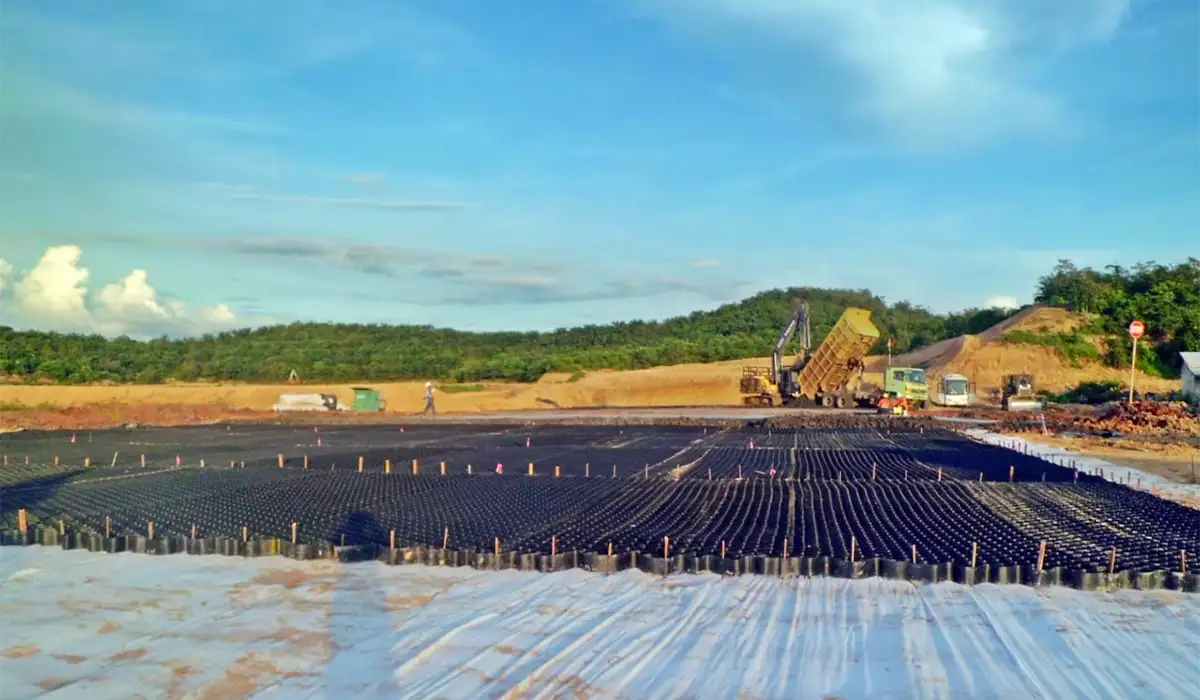
Geocell Slope Protection in Lebak Bulus

The Problem: Erosion Threats in the Heart of South Jakarta
The project site in Lebak Bulus has sloping terrain that is quite vulnerable to surface soil movement, making it a clear case for geocell slope protection. The main problem facing slopes in tropical urban areas is scouring by rainwater (surface runoff). During heavy rain, water flowing over the slope surface carries soil particles away, eventually triggering gully erosion and potentially causing shallow slope failure.
If you understand soil mechanics, you know that shear stress on a slope rises sharply when the soil is saturated. Without adequate protection, the topsoil layer will easily slide downhill. What is needed is a protection system that not only resists mechanical loads but also manages surface hydrology.
Technical Solution: Geocell Slope Protection with 10cm Cells
To tackle this, a geocell-based slope protection system with a 10 cm cell height was chosen. The project covered a sizeable area of 1,200 square metres.
Geocell is essentially a Cellular Confinement System (CCS): a three-dimensional honeycomb matrix made from ultrasonically welded high-density polymer strips (usually HDPE). A 10cm geocell is technically ideal for the slope angle at the project site, because it provides enough cell volume to hold the infill (aggregate soil/topsoil) and stop it from sliding under gravity.
When geocell panels are stretched out and anchored on the slope, they create a kind of “flexible formwork” that distributes loads laterally and vertically.
Technical Analysis: 6 Vital Functions of Geocell on the Lebak Bulus Project
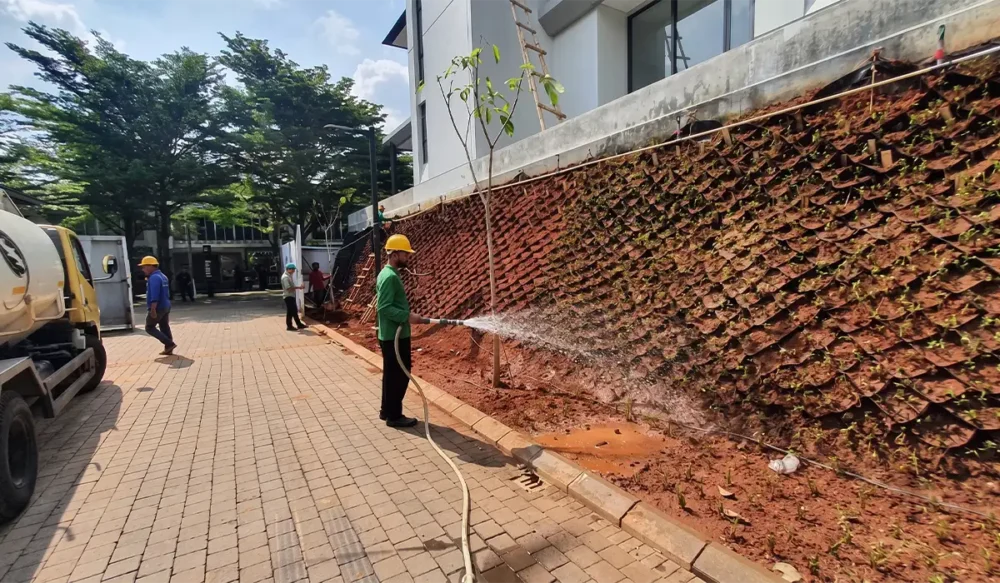
Installing 10cm geocell over 1,200 m² is not just rolling out a carpet. Technically, the system works through six main mechanisms:
- Surface Erosion Control (Surface Erosion Control)
Without protection, the kinetic energy of raindrops breaks up soil aggregates. The geocell walls mechanically confine the soil, so the kinetic energy of rain and the shear force of surface flow do not hit and scour the subgrade directly. - Reducing Surface Soil Movement (Mitigating Soil Displacement)
You know that gravity on an inclined plane always tries to pull material downhill. Geocell distributes that pulling force through hoop stress within its cells. This dramatically increases the shear resistance of the material and prevents the topsoil from sliding down en masse. - Holding Infill on the Slope (Infill Retention) This is the main advantage of a 3D structure. The infill, in this case fertile soil for vegetation, is placed into the cell pockets. The 10cm geocell walls lock the material in from all sides. This prevents the infill from degrading or suffering washout even during peak rainfall.
- Improving Overall Slope Stability (Enhancing Slope Stability)
Geocell increases the slope’s Factor of Safety / FS. By confining the infill, the geocell layer acts like a retaining slab that adds compressive and shear strength to the uppermost soil layer. It prevents the shallow failure that often precedes large-scale landslides. - Slowing Surface Water Flow (Hydraulic Flow Dissipation)
Hydraulically, the arrangement of geocell cells creates artificial surface roughness. The protruding cell walls act as a series of micro check-dams. The effect? Runoff velocity drops sharply, so the water lacks the hydro-mechanical energy to scour the material beneath. - Supporting Vegetation Growth (Long-Term Natural Protection)
This project’s approach considers not only man-made structure but also bio-engineering. The geocell is designed with perforations (small holes) in its walls. These holes are not only for internal slope drainage but also allow plant roots to grow sideways and interlock (root interlocking) between cells. Within months, the slope is not only structurally sound thanks to the geocell, but also naturally protected by a dense, green network of vegetation roots.
Conclusion
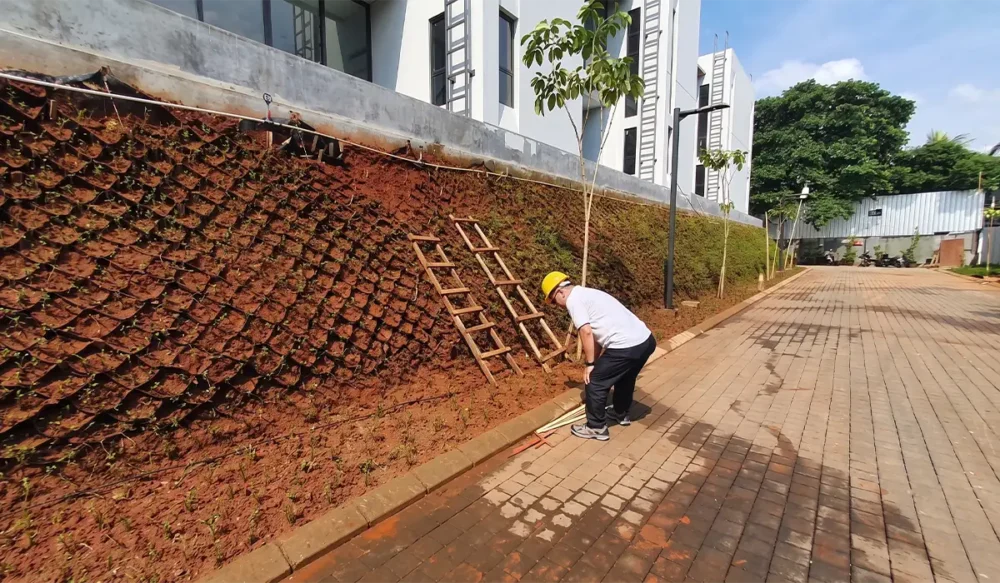
This 1,200 m² slope protection project in Lebak Bulus proves that conventional methods can give way to smarter, more environmentally friendly solutions. With 10cm geocell, the team not only solved the erosion problem immediately but also built a long-term slope defence ecosystem through bio-engineering.
Other Articles

Geocell Reservoir Base Reinforcement Project
Geocell reservoir reinforcement / geocell installation / geocell placement / geocell documentation / geocell project Location: Read Also Click here for product details

Geocell Channel Protection at Jakarta International Stadium
Project Background: Why Is Channel Protection So Important? As a stadium located in North Jakarta, an area close to the coast with fluctuating rainfall, JIS needs a very robust drainage and surface water channel system, which is why geocell channel protection was chosen. Water flowing at high volume and velocity carries destructive kinetic energy. Without […]