


Geocell Slope Protection and Roads at TMII Jakarta
Project Background & Challenges
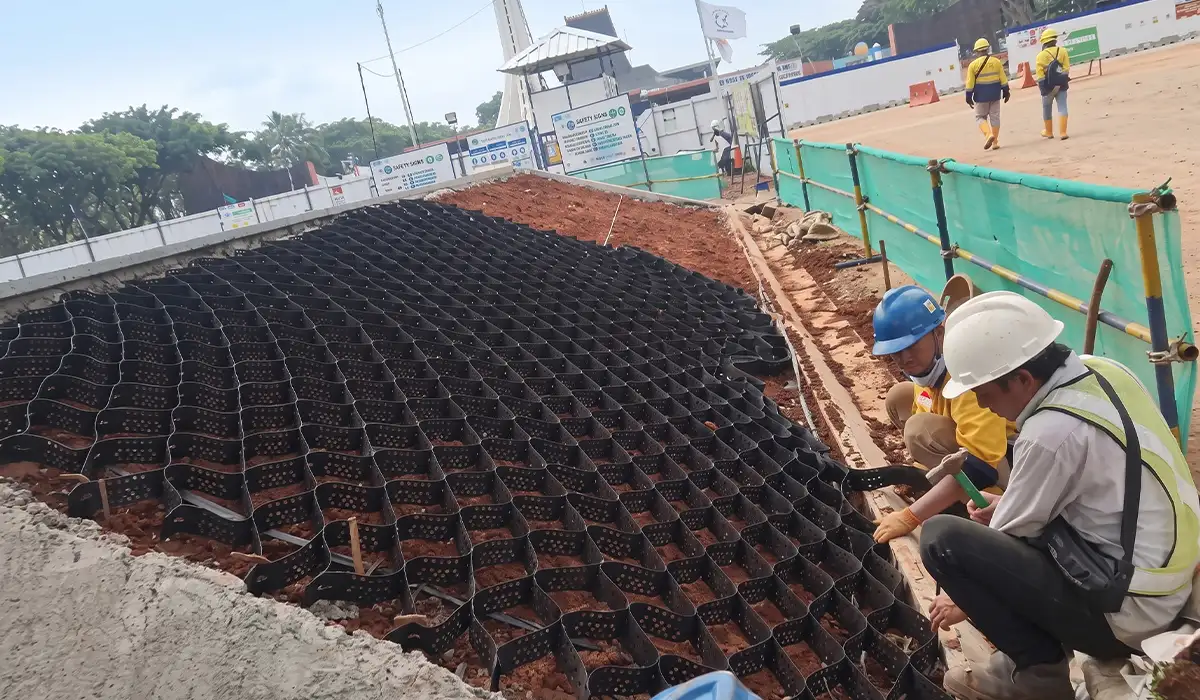
TMII (Taman Mini Indonesia Indah), one of Indonesia’s largest recreational and cultural icons, has a road network that winds through various man-made and natural landscapes. One of the main challenges on this 2,568 m² geocell slope protection project was a slope directly adjacent to road infrastructure.
Without adequate protection, the slope was highly vulnerable to:
- Soil Shear Forces (Shear Stress):
Dynamic loads from vehicles on the road are distributed laterally towards the slope. - Surface Erosion (Surface Erosion):
Rainwater runoff can scour the topsoil (fertile layer), forming erosion gullies that gradually bring the slope down. - Uncontrolled Hydrostatic Pressure:
Saturated soil loses cohesion and internal friction angle, increasing the risk of landslides or massive soil movement.
The challenge was to find a solution that not only resisted erosion mechanically but also allowed ecological recovery (greening) so the slope would look natural and blend with the TMII landscape.
Solution: Cellular Confinement System with 7.5cm Geocell
To solve this complex problem, 7.5cm Geocell was chosen as the slope protection solution. Geocell is a three-dimensional cellular confinement system shaped like a honeycomb, made from ultrasonically welded High-Density Polyethylene (HDPE) strips.
The 7.5cm cell depth is ideal and precisely calculated for moderate to steep slopes. It gives the infill, whether topsoil, gravel or concrete, enough space to lock in perfectly without adding excessive dead load to the slope.
How Geocell Works: Technical Functions
Once stretched out and filled with local soil, the geocell immediately delivered six main technical functions on the TMII project:
- 1. Controlling Slope Surface Erosion
The geocell walls act as a series of micro-check dams. When rainwater flows across the slope, the HDPE walls break up the kinetic energy of the water, so the soil is not washed away. - 2. Reducing Surface Flow Velocity
Runoff no longer has a free path to rush downhill. The cellular system slows the flow velocity, giving water extra time to infiltrate slowly into the soil without damaging the surface. - 3. Holding the Infill (Confinement Effect)
The 3D shape of geocell locks the aggregate or soil infill in place. Downward (vertical) pressure is converted into sideways (lateral) pressure, which is firmly resisted by the strain in the cell walls (known as hoop stress). This dramatically increases the apparent cohesion of the infill. - 4. Reducing Soil Movement on the Slope Surface
With interlocking between the cells and the infill, the topsoil does not easily slip (sloughing) due to gravity or vibration from the nearby road. - 5. Improving Overall Slope Stability
Geocell spreads loads evenly over a wider area. This prevents stress concentration points, which are usually where cracks or shallow slips on road slopes begin. - 6. Supporting Vegetation Growth (Long-Term Protection)
Because the cells are filled with fertile soil, plant roots can spread through the perforations (small holes) in the geocell walls. Over time, the roots and the geocell system bind together, creating a natural green armor that is mechanically strong and visually attractive.
Results: Combining Safety and Sustainability
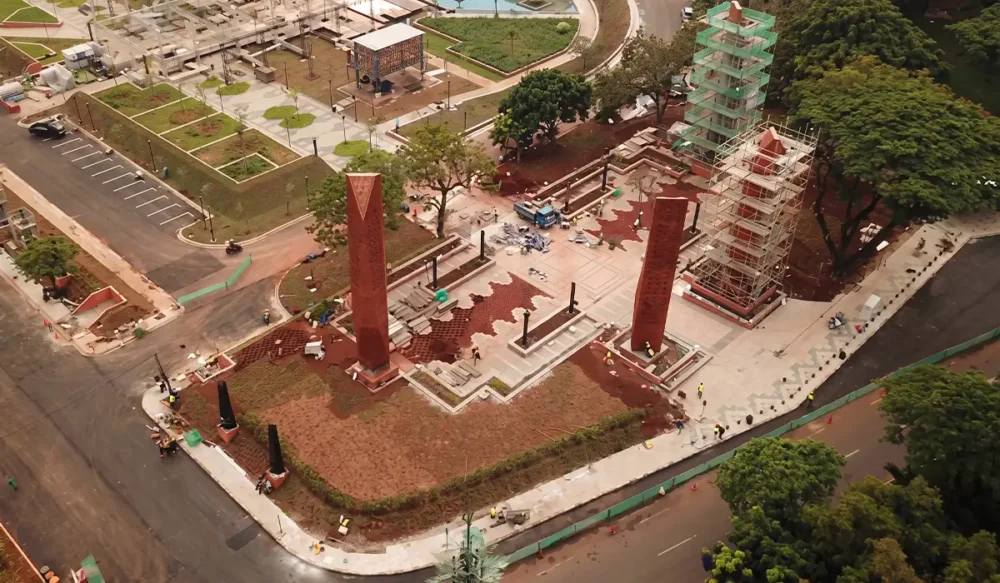
Covering a total of 2,568 m², the geocell installation at TMII went efficiently because the material is easy to transport folded and simply needs to be expanded on site.
Today, the slope at TMII is no longer just a landslide-prone mound of soil but a reinforced earth structure. Soil movement has been reduced to almost zero, loads from the road are distributed safely, and new vegetation proves that modern geotechnical engineering can work in harmony with nature.
Other Articles

Geocell Slope Stability to Protect a Retaining Wall in Duri
Project Background & Challenges The Duri area in Riau is known for dynamic soil conditions and challenging rainfall. On this infrastructure project, which became a geocell slope stability case, the site team needed to build a safe, solid and durable retaining wall. However, there was one major technical problem: the fill on the slope had […]

Geocell Access Road Construction Project in Banten
Geocell access road project / Geocell project / road construction / geocell installation / geocell laying Geocell application: Access Road ConstructionLocation: BantenMaterial: Project description:
Geocell Parking Lot and Paving Block Road in Bandung
Project Background & Challenges Bandung is known for fairly high rainfall and varied topography. On this geocell parking lot project, the team worked on an area to be turned into a car park and access road using paving blocks. However, there were major challenges on site: Soft Subgrade: The CBR (California Bearing Ratio) of the […]