


Geocell Slope Stability to Protect a Retaining Wall in Duri

Project Background & Challenges
The Duri area in Riau is known for dynamic soil conditions and challenging rainfall. On this infrastructure project, which became a geocell slope stability case, the site team needed to build a safe, solid and durable retaining wall.
However, there was one major technical problem: the fill on the slope had low cohesion and was highly prone to movement. Without additional reinforcement, gravity and rainwater infiltration would create extremely high active earth pressure on the retaining wall.
Without geotechnical intervention, the risks were severe. Rainwater flowing as surface runoff would quickly scour the topsoil. The result? Soil is gradually lost, the slope changes shape (deformation), and ultimately the retaining wall could suffer structural failure due to the loss of load balance.
Geotechnical Solution: Why 15cm Geocell?
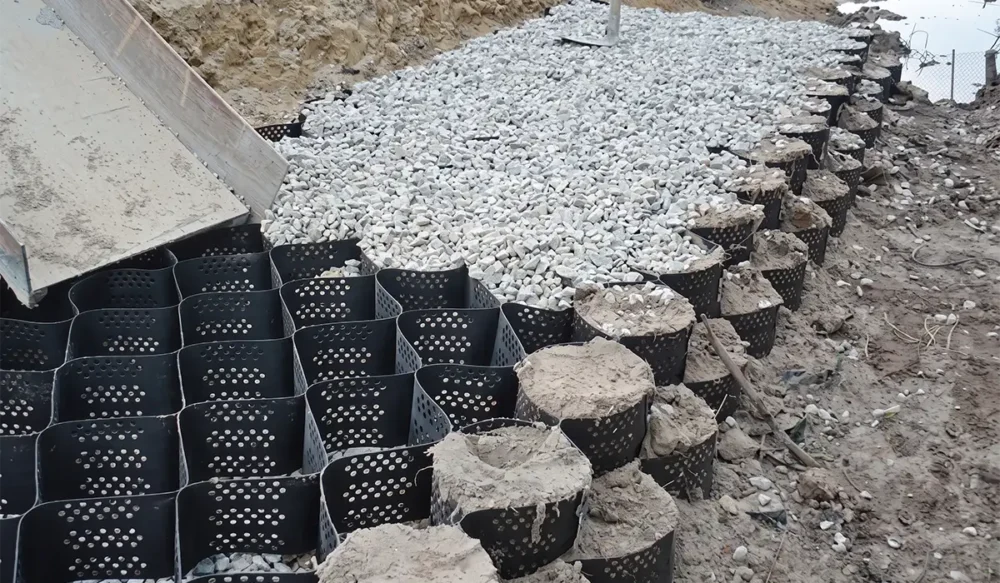
To overcome this complex challenge, it was decided that the retaining wall needed a reliable companion soil reinforcement system. The choice was Geocell with a depth of 15cm.
If you are not yet familiar with it, geocell is a 3D cellular confinement system made from high-performance polymer strips (usually HDPE). When stretched out, it looks like a honeycomb. The 15cm depth chosen for this project was crucial because it provides enough depth to lock the infill (aggregate or soil) while providing optimal counterweight (ballast).
Technical Details of How Geocell Works on Site
Once the 15cm geocell is laid on the slope and filled with soil, soil mechanics start working in its favour. Here are the technical functions by which this material saved the slope in Duri:
- Locking Movement and Reducing Soil Displacement
Thanks to its 3D cell structure, geocell confines the soil on all sides. This confinement drastically reduces soil particle movement. When loads are applied from above, the cell walls distribute them over a wider area, so the soil does not “escape” sideways. - Increasing the Shear Strength of the Fill
Loose soil inherently has poor shear strength. With geocell confinement, however, soil particles become interlocking. This artificially increases the cohesion and shear strength of the fill, making the slope far more structurally stable. - Reducing Lateral Pressure on the Main Structure
This is the most crucial point for the retaining wall. Because the soil mass behind and above the wall is held and stiffened by geocell, it behaves like a single stable block. As a result, the lateral earth pressure pushing on the retaining wall is drastically reduced. The wall no longer works alone, which raises the safety factor of the whole structure. - Preventing Long-Term Deformation
Hoop stress in the geocell walls resists soil strain. This ensures the slope does not undergo extreme settlement or change of shape despite constant exposure to weather and static loads.
Results and Benefits on Site
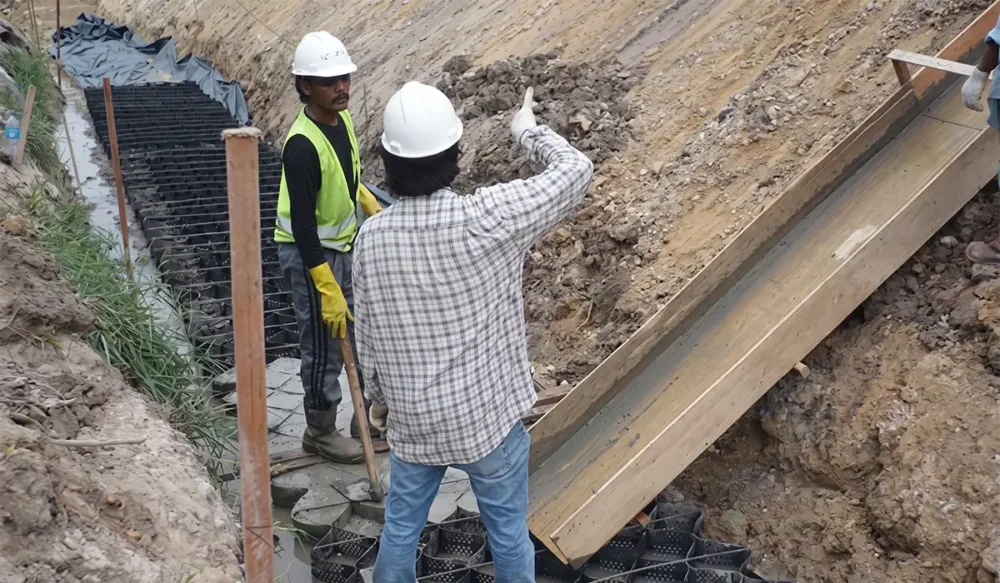
Applying 15cm geocell on this project in Duri, Riau, delivered a twofold result: structural protection and hydrological protection.
- Effective Surface Erosion Control
Geocell acts like a shield. Soil inside the cells is held securely so it is not easily washed away by rain. Surface runoff is slowed by the cell walls, effectively reducing the material loss that is usually swept downslope. - Preserving the Slope Shape
With the cells locking the topsoil, the slope geometry can be maintained for a very long time. The slope is ready for greening (planting grass/vegetation) because its fertile soil is not washed away. - Time Efficiency
For the contractor, geocell installation greatly speeds up construction. Geocell panels only need to be stretched out, pinned to the ground with anchors (J-pins) and filled straight away with heavy equipment. There is no waiting for curing as with concrete structures.
Conclusion
This project in Duri, Riau, is clear proof that integrating a retaining wall with a modern geosynthetic system such as 15cm geocell is key to successful geotechnical engineering today. Geocell not only protects the structure from excessive pressure but also works with nature to prevent erosion and environmental damage.
Other Articles

Geocell Road Construction Project in Surabaya
Geocell road construction project / Geocell project / road construction / geocell installation / geocell laying Geocell application: Road Construction Location: SurabayaMaterial: Project description:
Geocell Landscape Slope Solution in Bali
Project Background & Challenges Bali has always been a centre of green architecture innovation. In this geocell landscape slope project, the contractor and architect worked on a 1,368 m² area designed as a green space. The main problem was the site contours and a structural design with fairly steep slopes, including the architectural roof. When […]

Geocell Industrial Road for Heavy Loads in Batang
Project Challenges The industrial estate in Batang is growing rapidly, and this geocell industrial road project shows a typical problem there: infrastructure is often built on less than ideal subgrade conditions. If crushed stone aggregate (base course) is spread directly over soft subgrade, several serious problems emerge over time: The aggregate mixes with mud […]