


Geocell Access Road on Soft Soil in Sangatta

Background: Dealing with Sangatta’s Soil Conditions
Sangatta is known for its massive industrial and mining activity. This means access roads in the area must constantly carry heavy-duty vehicles, making it a textbook case for a geocell soft soil access road.
The biggest challenge, however, lies in local geotechnical conditions. At many locations in Sangatta the ground is soft soil with high moisture content and very low bearing capacity. When conventional pavement methods are used, such as simply placing aggregate (crushed stone) fill, the fill tends to mix with the soft subgrade.
The result is lateral movement of the aggregate and differential settlement. The road quickly becomes wavy, deep wheel ruts (rutting) appear, and road levels become unstable. Replacing all the soft soil with good soil (soil replacement) would take unreasonable cost and time. This is where geosynthetic intervention is essential.
Technical Solution: How Cellular Confinement Works
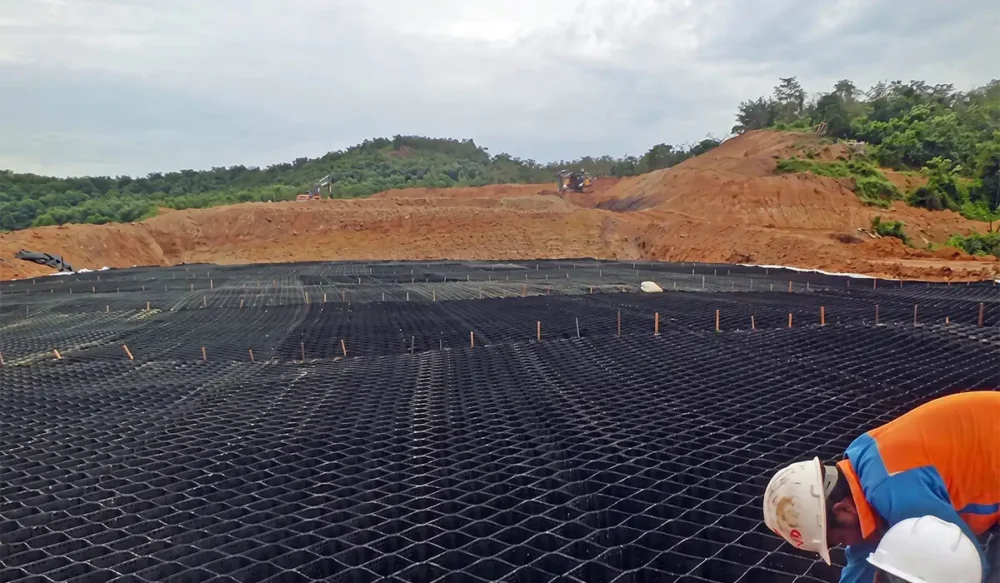
To solve the bearing capacity problem without large-scale excavation, the solution applied was 15cm high Geocell. Geocell works on the principle of a Cellular Confinement System.
Instead of letting the fill move freely under heavy loads, the three-dimensional honeycomb structure of geocell “locks” the material in place.
Technically, here are the three fundamental ways 15cm geocell saved the access road in Sangatta:
1. Even Distribution of Wheel Loads (Increased Bearing Capacity)
When heavy vehicle wheels pass, very large vertical loads press on the road surface. On an unreinforced road, this load drives straight into a single point in the soft soil, causing it to subside.
Geocell changes this dynamic. When the infill (aggregate) inside the cells takes a vertical load, it tries to move sideways. But the geocell walls resist with hoop stress. This interaction distributes the load laterally to the surrounding cells. As a result, the vertical stress reaching the subgrade drops drastically, and the layer behaves like a semi-rigid mattress. Bearing capacity increases significantly.
2. Improved Stability on Soft Soil
The geocell walls prevent shear failure in the aggregate. Granular material that is normally prone to sliding and displacement gains “artificial cohesion” from geocell confinement. This provides outstanding structural stability on soft soil and protects the road foundation from the lateral movement that so often destroys access roads.
3. Reduced Settlement & Maintained Road Levels
With loads widely distributed and the aggregate locked in place, compaction becomes far more effective. Geocell acts as a retaining layer that stops the fill from being pushed down and mixing with mud or the subgrade. This directly minimises settlement, so road levels stay stable in line with the original design.
Project Results and Performance
Installing 15cm geocell on the Sangatta access road project delivered very satisfying results, both in engineering terms and project efficiency:
- Material Efficiency: Because geocell locks the aggregate firmly, the project could use a thinner aggregate layer than a conventional design without geosynthetics, and could use lower-grade local fill while still achieving high strength.
- Long-Term Stability: The access road now carries heavy vehicle traffic with minimal surface deformation (rutting). Road levels remain even, proving that load stresses have been successfully distributed.
- Construction Speed: Geocell panels are very light, easy to carry and quick to stretch out on site, significantly cutting construction time compared with traditional soil stabilisation methods.
Using geocell is not just about repairing roads; it is about engineering the soil to work smarter. The Sangatta project proves that with the right geosynthetic material, natural limitations can be overcome efficiently and permanently.
Other Articles


Geocell Road Construction Project in Surabaya
Geocell road construction project / Geocell project / road construction / geocell installation / geocell laying Geocell application: Road Construction Location: SurabayaMaterial: Project description:
