


Geocell Cut Slope Protection in Cilegon

Project Background & Challenges
This project in Cilegon involved a cut slope to clear land for a new industrial facility, which called for geocell cut slope protection. The problem was that the resulting slope was fairly steep, with surface soil of sandy clay that is very sensitive to water.
In the rainy season, Cilegon often experiences high-intensity rainfall. The combination of slope gradient, soil with low cohesion when wet, and heavy surface runoff created a serious threat. Without proper protection, the slope would suffer rill erosion, which could gradually trigger a shallow landslide.
The client’s main constraint was that they did not want to rely fully on conventional solutions such as shotcrete (sprayed concrete). Besides its high cost, shotcrete was considered less environmentally friendly because it completely seals the ground surface and eliminates any green area. This is where the PT. Petra Nusa Elshada engineering team stepped in with a far more sustainable alternative: 15cm Geocell.
Technical Solution: Why 15cm Geocell?
To deal with these critical conditions, we recommended a 3D Cellular Confinement System using geocell with a 15cm cell height.
The geocell used is made of high-quality High-Density Polyethylene (HDPE) joined by ultrasonic welding. This honeycomb-like structure is the key to stabilising slope soil.
Why a 15cm height? This dimension was chosen based on calculations of soil shear forces and the slope gradient. A 15cm wall provides a sufficiently deep infill material layer to resist the hydraulic load of rainwater while giving vegetation root systems ideal space to develop.
How Geocell Works on Site
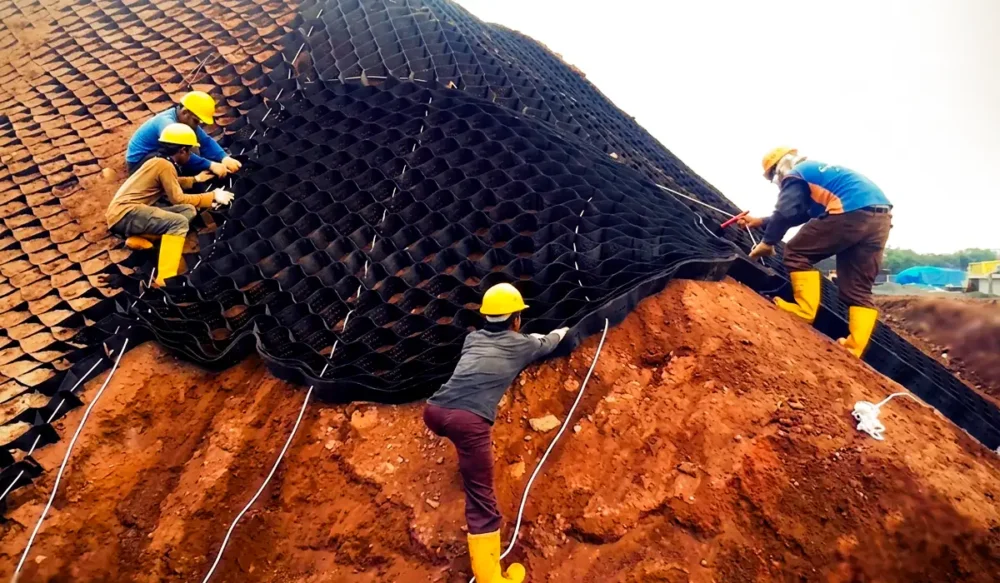
The 15cm geocell installed on this Cilegon project performs six main technical functions at once:
1. Controlling Slope Surface Erosion
When heavy rain falls on Cilegon, raindrops carry kinetic energy that can detach soil particles. Geocell acts as a physical barrier. Its three-dimensional wall structure breaks the direct impact of rain on the soil, so splash erosion is prevented from the start.
2. Reducing Soil Movement on the Slope Surface
Soil on the Cilegon slope tends to move downwards under gravity, especially when saturated. With geocell, the soil is locked inside each pocket (cell). This creates a hoop stress effect, where lateral soil pressure is resisted by the tensile strength of the geocell walls, significantly reducing surface soil movement.
3. Holding Infill Material on the Slope
On steep slopes, placing topsoil as a planting medium is very difficult because it will inevitably slide down. 15cm geocell acts as a set of mini compartments that keep the infill in place, even at extreme gradients.
4. Improving Overall Slope Stability
The geocell system is installed and secured with anchor pins (steel stakes) driven deep into stable soil. When all geocell panels are stretched out and fully filled with soil, they form a single monolithic protective layer. This layer increases the shear strength of the slope’s surface soil.
5. Reducing Surface Runoff Velocity
Water flowing from the top of a slope usually rushes down and scours the soil in its path. The perforations (small holes) in the 15cm geocell walls are designed for lateral drainage. They let water flow slowly between cells while reducing surface flow velocity, giving water time to infiltrate into the soil without damaging the slope.
6. Supporting Vegetation as Long-Term Natural Protection
This is the best part. Once the geocell was filled with topsoil, we used hydroseeding or planted ground-cover grass. The perforations let grass roots grow through the cells horizontally and vertically into the native soil. Over time, the root network and geocell structure interlock, creating a natural protection system that grows stronger year after year.
Results
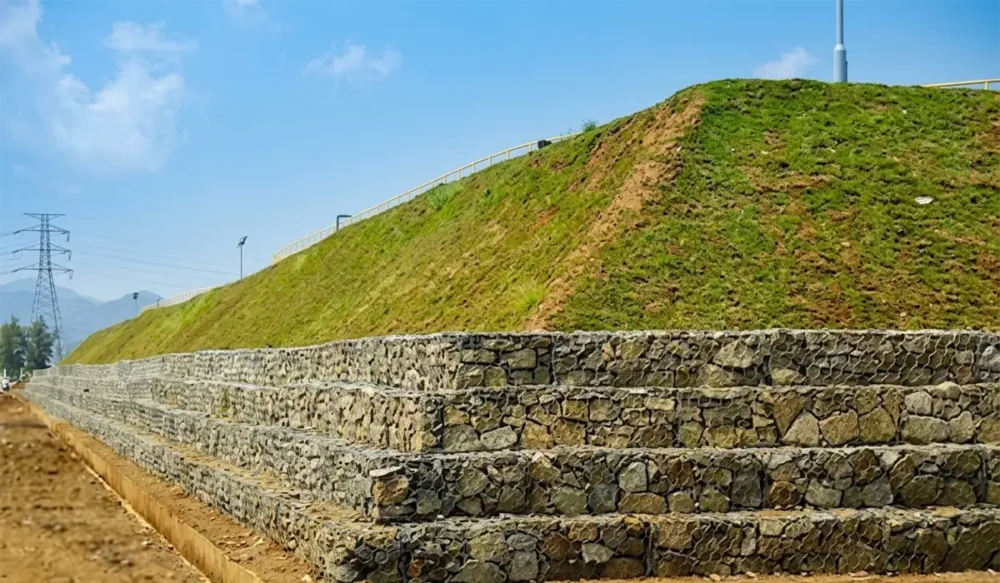
The 15cm geocell application on this project in Cilegon, Banten, was a great success. Once installation was complete and vegetation began to grow within a few weeks, the once barren, landslide-prone slope was transformed into a solid green wall.
In terms of cost efficiency, the project saved the client’s long-term maintenance budget because the risk of surface landslides was minimised without building a massive concrete retaining wall. This project proves that geosynthetic technology is not only about mechanical strength but also about working in harmony with nature.
Other Articles

Geocell Channel Protection at Jakarta International Stadium
Project Background: Why Is Channel Protection So Important? As a stadium located in North Jakarta, an area close to the coast with fluctuating rainfall, JIS needs a very robust drainage and surface water channel system, which is why geocell channel protection was chosen. Water flowing at high volume and velocity carries destructive kinetic energy. Without […]


Geocell Critical Slope Protection in Serpong
Background: The Threat of Erosion Amid Development Serpong is one of the areas with the most aggressive pace of development. However, changes in land use often alter the original ground contours. On this geocell critical slope project, there was a man-made cut and fill slope with a fairly steep gradient. The soil on the slope […]