


Aquaculture Pond Liner in Pariaman

Aquaculture Pond Liner Project Background
This aquaculture pond liner project serves a coastal area of Pariaman in West Sumatra with excellent potential for large-scale aquaculture ponds. However, modern aquaculture requires far more precise operational control than conventional methods. If you still rely on traditional earthen ponds (earthen ponds) across more than ten thousand square meters, the risk of crop failure is too high. Naturally porous subgrade allows massive water loss through seepage. The pond ecosystem also becomes highly vulnerable to pH fluctuations, contaminants entering from groundwater (groundwater) and pathogenic bacteria accumulating in bottom sludge that is difficult to clean after harvest. The Pariaman project was initiated to reduce these risks. The project owner recognized the need for a fundamental infrastructure upgrade across approximately 12,900 m² to create a solid physical barrier (impermeable barrier) between pond water and subgrade, ensuring biosecurity and long-term operational efficiency.
Site Challenges: Why Natural Soil Is Not Enough
This coastal Pariaman project faced challenges common in conventional aquaculture pond areas: soil porosity and contamination risk. When you rely only on earthen ponds, several physical and chemical reactions occur continuously:
- High Seepage Rate: Soil has variable hydraulic conductivity (its ability to transmit water). A 12,900 m² pond without a waterproof liner risks losing thousands of liters of water every day through ground seepage. Water pumps must therefore run constantly, increasing operational electricity costs.
- Cross-Contamination Threat: Groundwater below the pond is not always clean. It can carry pesticide residues, heavy metals or unwanted minerals that disrupt water quality parameters (pH, salinity and Dissolved Oxygen).
- Pathogen Breeding Ground: A porous soil surface is an ideal breeding ground for pathogenic bacteria (such as Vibrio in shrimp) and parasites. When a harvest cycle ends, cleaning feed residue and waste from the soil bottom to 100% is almost impossible.
Technical Solution: The Resilience of 0.5mm HDPE Geomembrane
To break this chain of problems, a lining system using HDPE (High-Density Polyethylene) Geomembrane with a thickness of 0.5 mm was selected as the main solution. But among the many types of geosynthetics, why was this specification used? Let’s look at the technical details.
- Near-Zero Permeability Unlike ordinary tarpaulin, the polymer molecules in HDPE are densely packed. The material has a microscopically near-zero permeability. Deployed across 12,900 m², it acts as an absolute impermeable barrier . No pond water can leak downward, and no contaminated groundwater can intrude upward. Water volume remains stable according to design requirements.
- Tensile Strength & Puncture Resistance A thickness of 0.5 mm is the “sweet spot” (sweet spot) for aquaculture ponds. It provides enough elongation (flexibility) for the geomembrane to follow a slightly uneven subgrade while retaining strong puncture resistance to withstand hydrostatic pressure from the water mass above without risk of tearing.
- UV Protection & Chemical Resistance The HDPE used in this project is formulated with Carbon Black (about 2-3%) and antioxidants. This technical formulation prevents polymer degradation despite daily exposure to intense coastal sunlight in Pariaman (UV Resistant). HDPE is also highly inert chemically. This means it will not react when exposed to water treatment chemicals, chlorine or probiotics added to the pond.
Installation Method: Creating a Monolithic System
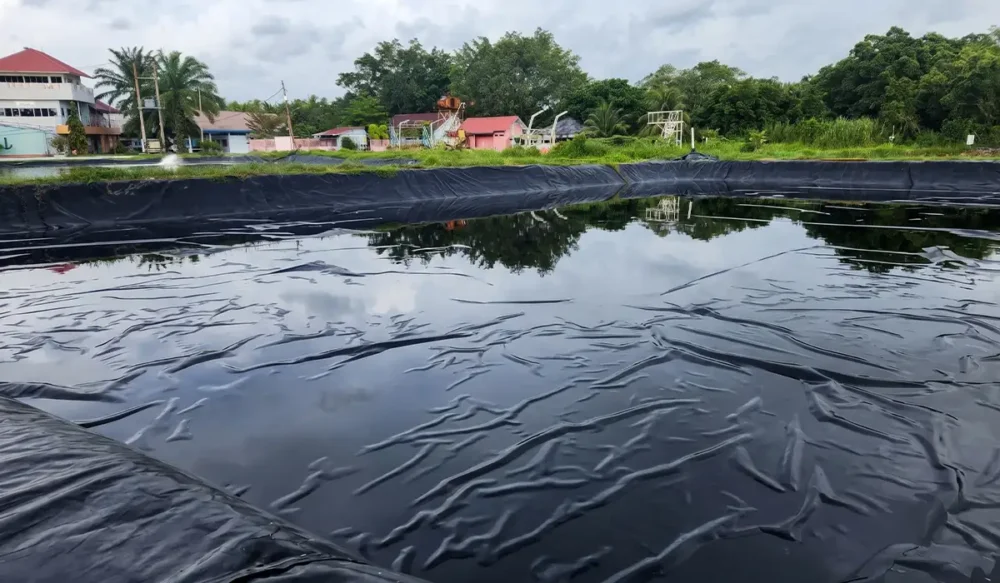
Deploying material across almost 1.3 hectares requires precise engineering. The key to a successful geomembrane system lies not only in material quality but also in the seams (seaming).
The site team used thermal welding (Thermal Welding). A Hot Wedge Welder joined the HDPE sheets (panels). The machine melts the polymer surfaces at a controlled temperature and applies mechanical pressure, creating a double-track seam (double-track seam) fused at the molecular level. The seam is often stronger than the main sheet itself. With proper installation, the 12,900 m² area was converted into a single, gap-free protective lining.
Final Result: A Controlled Aquatic Ecosystem
After installation of the 0.5mm HDPE geomembrane, the Pariaman aquaculture pond was transformed significantly. Water quality is now fully under the operator’s control. pH fluctuations caused by acidic soil (acid sulfate soil) have been eliminated. Levels of biosecurity have increased dramatically because the smooth geomembrane surface makes it easier to remove sediment from feed residue (sludge) using a central drainsystem.
Other Articles

Building a Modern Fish Pond with HDPE Geomembrane
Background: Why Switch from Earthen and Concrete Ponds? Inland fish farming today demands high efficiency. In densely planned areas like BSD City, land must be used to the fullest. The project owner realized early on that a conventional earthen pond carries high risks. Soil permeability (its ability to let water through) varies. If the soil […]


1.5mm Agricultural Pond Geomembrane in Tangerang
Background & Challenges This agricultural project in Tangerang needed a massive raw water storage pond to serve the irrigation system of a plantation covering more than ten hectares. Initially, the most conventional option was to dig an ordinary earth pond, before an agricultural pond geomembrane was chosen instead. But let’s look at it from a […]