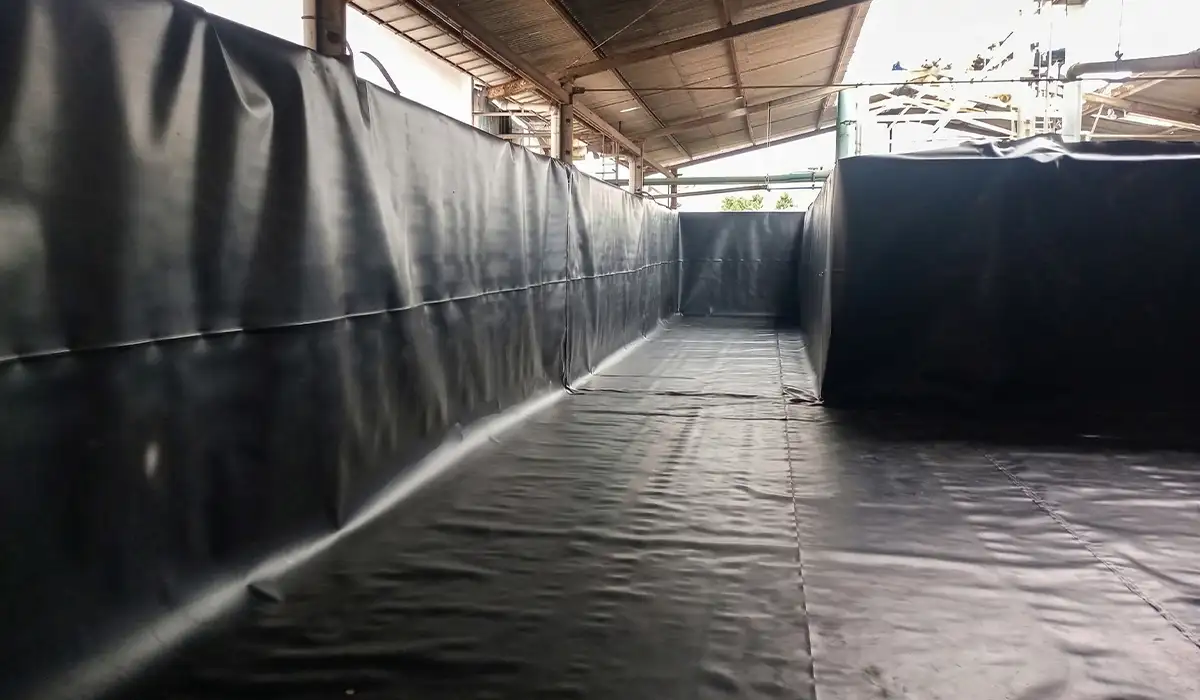
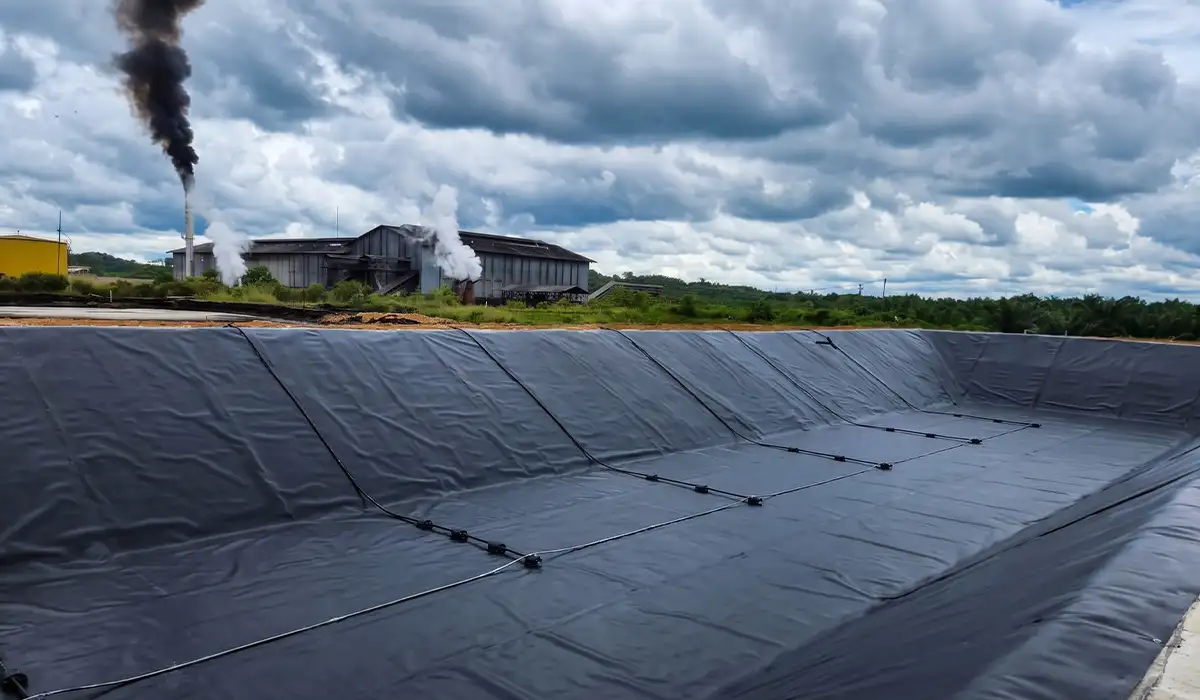
1.5mm HDPE Geomembrane for a Geothermal Drilling Pond

Background: Why Is a Drilling Pond So Crucial?
Drilling projects, especially geothermal ones (geothermal) such as those in the Patuha area, require massive volumes of water. This water is used not only to cool the drill bit, but also as the main ingredient for making drilling mud. A geomembrane drilling pond keeps that water safely contained.
The problem is that fluids produced and used during drilling often contain chemical additives or minerals from deep underground that can damage ecosystems if they seep into shallow aquifers. Contractors therefore need a large-scale storage pond that is 100% watertight, chemically resistant and able to withstand the hydrostatic pressure of thousands of cubic meters of water. Leaving the ground open without a standard liner is not an option.
Project Challenges on Site
The topography at Patuha posed its own challenges. The distinctive volcanic soil and the day-night temperature swings of the highlands demand a pond liner that is not only strong but also flexible.
The main challenges to solve in this project were:
- Seepage Risk
How to guarantee zero leakage (zero leakage) over an area of more than 1.2 hectares? - Load-Bearing Capacity
The pond must withstand the static load of water and mud without tearing or puncture (leaks caused by sharp objects in the subgrade). - Weather Fluctuations
The material must withstand direct UV exposure and must not become brittle under extreme temperature changes.
Technical Solution: The Toughness of 1.5mm HDPE Geomembrane

To meet the operational challenges at Patuha, HDPE (High-Density Polyethylene) Geomembrane with a thickness of 1.5mm was chosen as the main containment solution. With an installed area of 12,191 m², this specification was chosen for strong technical reasons.
For those of you in engineering, a 1.5mm HDPE thickness is the “sweet spot” (sweet spot) for drilling pond projects. The material has a very high density (usually above 0.94 g/cm³), giving almost absolute impermeability.
Technically, the 1.5mm HDPE Geomembrane at Patuha performs three essential functions:
- Keeping Water and Fluids from Seeping into the Ground
The geomembrane acts as the main protective shield (primary liner). With outstanding chemical resistance to hydrocarbons, acids and the various additives in drilling mud, it effectively blocks fluid migration into the underlying soil (subgrade). This drastically reduces and mitigates the risk of soil and groundwater (aquifer) contamination around the pristine Patuha ecosystem. - Storing Hundreds of Thousands of Liters of Water for Operations
Covering more than 12 thousand square meters, the pond works as a giant reservoir. Water stored above the geomembrane is safe from volume loss due to soil absorption. It is ready to be drawn at any time for vital needs such as:
- Continuous mixing of drilling mud.
- Dust control across the site to maintain visibility and worker health.
- Cleaning heavy equipment and drilling rigs.
- Maintaining Water Quality and Volume
Because HDPE is inert (it does not react chemically), the water in the pond is not contaminated by the soil minerals beneath it, and vice versa. In addition, the black color of the geomembrane, which contains carbon black, provides high resistance to UV degradation, ensuring the material’s service life outlasts the project itself without hairline cracking (environmental stress cracking).
Installation and Quality Control (QA/QC)
Of course, quality material must be matched by precise installation. The 12,191 m² of geomembrane sheets were joined using a double hot wedge welder (creating two weld tracks with a test channel between them) and extrusion welding for corners and pipe details.
Every seam was rigorously tested with an air pressure test on the double channel, and a vacuum box test to make sure no pinholes remained. Environmental safety is non-negotiable.
Conclusion: A Geomembrane Drilling Pond That Protects the Environment
The drilling pond project at Patuha proves that environmental management and operational efficiency can go hand in hand. Deploying 12,191 m² of 1.5mm HDPE Geomembrane is not just about meeting project regulations, but a long-term investment in protection. The pond operates with a stable water volume and well-maintained fluid quality, and most importantly, Patuha’s natural environment remains preserved without the threat of pollution.
If you are planning a mining, drilling or other critical waste containment project, choosing the right geosynthetic material is the first step toward success.