


Salt Pond Geomembrane Improves Harvests in Madura
Background and Challenges
When discussing Indonesia’s salt production, Madura always takes center stage. On this island, specifically in Sampang, the traditional salt industry continues to thrive. But have you ever wondered why local salt sometimes struggles to compete with imported industrial salt? The answer often lies in the pond bed, where a salt pond geomembrane can make a decisive difference.
Most traditional salt farmers still rely on soil-based crystallization beds. This method presents many technical challenges. First, clay is porous, allowing concentrated brine to seep away and reducing harvest volumes. Second, during crystallization and harvesting, salt crystals inevitably mix with mud and soil sediment. As a result, the salt tends to be dull and brownish. Most critically, its sodium chloride (NaCl) content is reduced by the high level of contaminants.
Meeting industry standards requires technological intervention. This installation project in Sampang, Madura, therefore offers a highly instructive case study.
Innovative Solution: Why Choose a 0.5 mm Salt Pond Geomembrane?
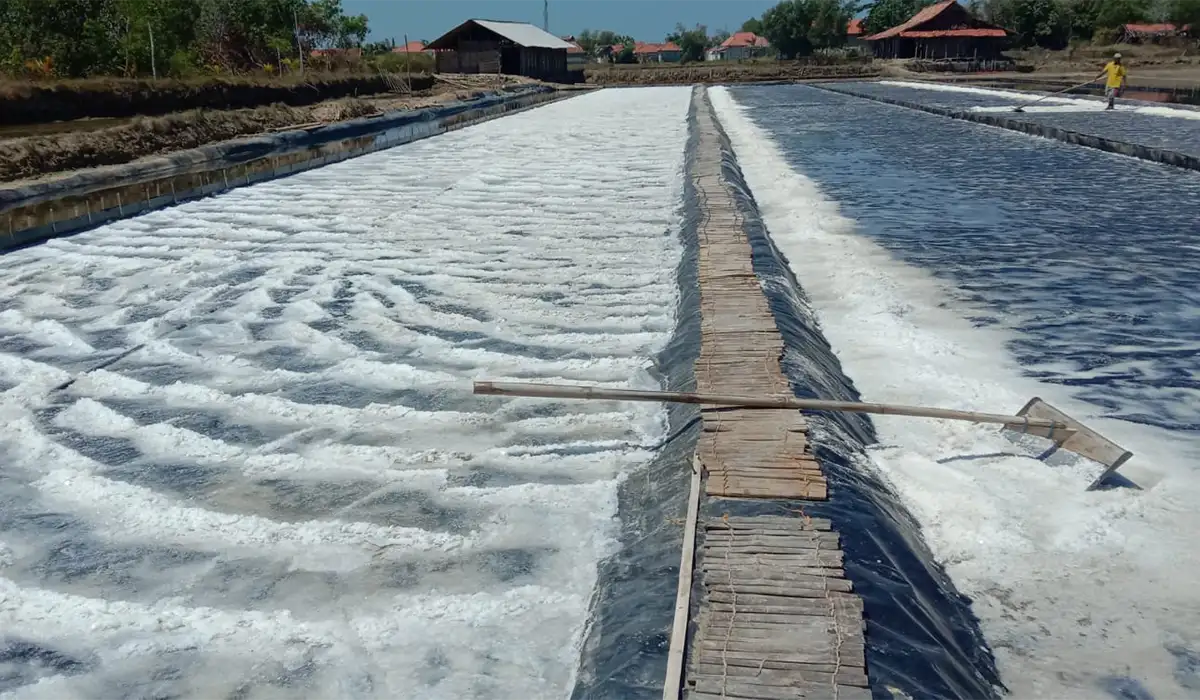
To overcome contamination and leakage across the 900-square-meter site, a synthetic liner was selected: HDPE (High-Density Polyethylene) Geomembrane.
The 0.5mm thickness was selected for sound technical reasons. For salt ponds, 0.5mm offers the ideal balance between flexibility and durability. It is thick enough to withstand workers’ weight and friction from harvesting tools, yet remains highly flexible so it can follow the pond’s contours. HDPE is also known for its strong resistance to UV exposure and corrosive chemicals such as concentrated brine, even under repeated exposure, making it an ideal long-term investment.
Technical Analysis: How Does Geomembrane Change Pond Operations?
Applying HDPE geomembrane to the Sampang salt pond does more than simply “cover the soil.” It literally changes the pond’s thermodynamics and chemical processes. The technical functions and resulting benefits are detailed below:
- Total Isolation from Contamination
The most fundamental function of HDPE geomembrane is its ability to provide nearly 100% impermeability. This layer physically separates the seawater (brine) from the soil beneath it. The result? When the salt crystallizes, no soil or mud particles are lifted with it. Visually, the salt becomes much cleaner and whiter, like clear crystals. Chemically, the absence of mixed soil minerals dramatically increases the NaCl percentage, meeting both food-grade and industrial salt standards. - Faster Crystallization Through Thermal Properties
Have you noticed why HDPE geomembrane for salt ponds is generally deep black? This is a clever application of thermodynamic principles. Rather than reflecting sunlight, black surfaces are excellent heat absorbers. The geomembrane absorbs heat and transfers that thermal energy directly to the brine pooled above it. The water temperature rises faster and remains higher for longer than it would over a soil bed. This temperature increase accelerates evaporation, leading to much faster salt crystallization and significantly shorter waiting times between harvests. - Preventing Concentrated Brine Loss
In soil ponds, some seawater that has already reached a high concentration (Baumé) often seeps away into the ground. The 0.5mm geomembrane keeps this concentrated brine securely above the surface. This maximizes the yield per square meter across the 900m2 area. Not a single drop of valuable concentrated brine is wasted. - Harvesting Efficiency
Imagine sweeping dirt from a deep-pile carpet compared with a smooth tile floor. This illustrates the difference between harvesting salt on a soil bed and on a geomembrane bed. The flat, smooth HDPE surface makes raking and collecting salt crystals much easier and faster. Harvesting tools do not catch in the soil, allowing farmers to collect the entire harvest without leaving any behind.
Conclusion
This 900m2 project in Sampang, Madura, proves that switching from traditional methods to a modern 0.5mm HDPE geomembrane is an essential step. Beyond improving farmers’ operational efficiency by simplifying harvesting and preventing leakage, the liner technically improves the industry’s two most important metrics: quality (high NaCl and a white appearance) and speed (faster crystallization). This simple material innovation can have a major impact on Indonesia’s self-sufficiency in high-quality salt.
Other Articles

Fire Hydrant Tank Geomembrane in Tangerang
Problem Background: An Invisible Threat to the Water Tank This project is located in a strategic area of Tangerang that needed a large-capacity water reservoir dedicated to its hydrant system. Building an open or semi-open water storage tank in direct contact with the soil carries a high risk, because soil has a certain permeability (ability […]

0.75mm Geomembrane for a Reservoir Project in Cianjur
Project Background: The Classic Challenge of an Embung (Small Retention Reservoir) This project is located in Cianjur, West Java, an area that relies heavily on water availability for agriculture and plantations. The main need was to build an embung, or retention pond, that could hold as much rainwater and surface runoff as possible, making a […]
