Non-Woven Geotextile Project on Dieng Subgrade
Background & Challenges
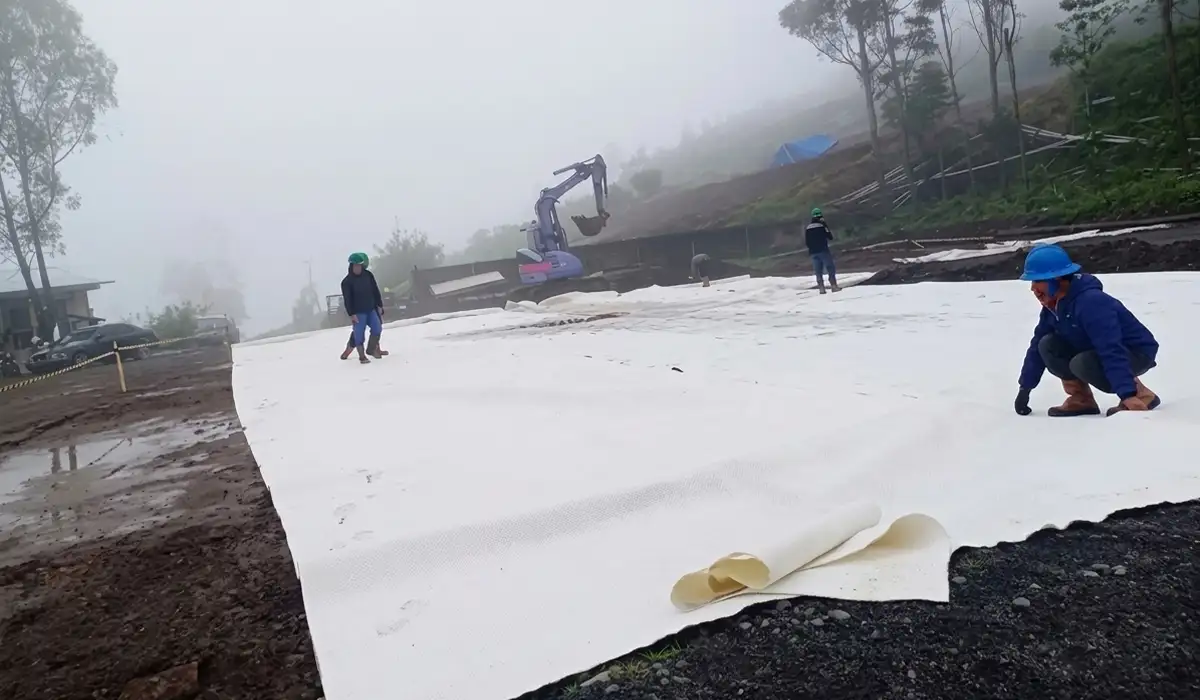
The Dieng Plateau has extraordinary natural beauty, but from a geotechnical point of view, the area poses a big challenge for any non-woven geotextile project. The subgrade (subgrade) in volcanic areas often has a high water content.
When heavy rain falls, this subgrade becomes fully saturated. If aggregate material (crushed stone/gravel) is spread directly over this soft subgrade without any layer in between, what happens? When dynamic loads are applied from above (such as heavy vehicles or equipment passing over), a pumping effect occurs.
The pumping effect is a condition in which mud from the subgrade is squeezed up into the voids of the aggregate above, while the aggregate stones sink into the mud. As a result, the thickness of the aggregate foundation layer shrinks drastically, the structure loses bearing capacity, and eventually the surface subsides or becomes uneven. You certainly don’t want expensive infrastructure to be ruined within a matter of months, do you?
Technical Solution
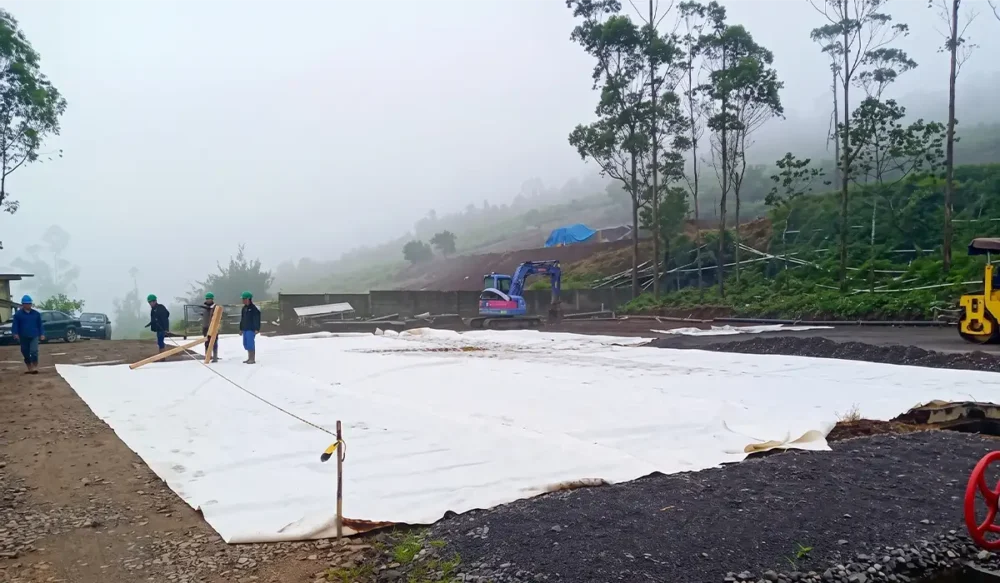
To solve this critical problem, the team decided to lay 10,000 m² of 250 gsm Non-Woven Geotextile as a separator layer between the soft subgrade and the aggregate layer above it.
The choice of a 250 gsm weight was not arbitrary. At 250 grams per square meter, it offers an ideal balance between tensile strength (tensile strength), resistance to puncture (puncture resistance) from sharp aggregate edges, and high permeability to let water through.
How It Works: Why This Solution Is So Critical
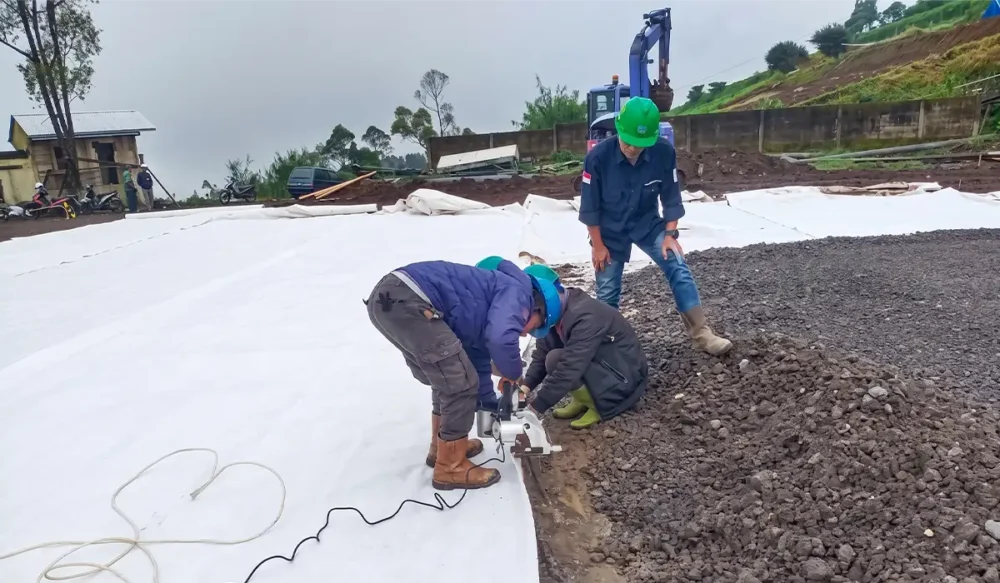
How can these polymer sheets save a one-hectare construction site in Dieng? Let’s break down their 6 main technical functions in the field:
1. Separating Subgrade and Aggregate (Separation)
This is its main function. Non-woven geotextile acts as a solid physical barrier. It prevents fine particles from the subgrade from migrating into and contaminating the aggregate layer. With the aggregate kept clean, the voids between the stones are preserved, so the foundation layer does not lose its interlocking function.
2. Reducing Pore Water Pressure (Pore Water Pressure Dissipation)
Saturated soil has high pore water pressure. Under compressive loads, the water in the soil looks for a way out. Without a drainage path, this pressure can trigger internal sliding or deformation. Non-woven geotextile has a random fiber structure (similar to felt) that is permeable. When water from the subgrade is squeezed out, it passes through the geotextile’s pores without carrying mud particles with it (the filtration function). This drastically lowers pore water pressure and secures the structure above.
3. Maintaining Subgrade Strength
Subgrade strength is often measured by its CBR (California Bearing Ratio) value. Water and material mixing are the main enemies of CBR. By keeping the subgrade isolated and helping it drain through pore water dissipation, the geotextile indirectly maintains (and even helps improve) the shear strength of the subgrade over time.
4. Reducing Settlement (Settlement)
Differential settlement (differential settlement) occurs when one area sinks deeper than the area next to it, causing the structure above to crack. With a 250 gsm Non-Woven Geotextile sheet in place, stresses or loads from above are spread more evenly over a wider area of subgrade. This evenly distributed load minimizes the risk of uneven settlement.
5. Maintaining Structural Stability
The combination of a preserved aggregate layer, released excess water pressure and distributed loads turns the entire road or ground layer system into a single stable unit. The geotextile locks in structural integrity from the very bottom layer.
6. Extending Construction Life (Extended Lifespan)
From a project management and lifecycle cost perspective, using Non-Woven Geotextile is a highly profitable investment. Infrastructure without a separator on terrain like Dieng may need major repairs (overlay or re-excavation) within 1-2 years. With this separation system, the service life of the construction can be extended many times over, saving a huge amount of maintenance budget in the future.
Final Results
Laying 10,000 m² of 250 gsm Non-Woven Geotextile on the Dieng project went smoothly. Layer after layer of aggregate was compacted perfectly on top without any mud rising up (zero pumping effect).
This project proves that the right geosynthetic material is not just an add-on, but a fundamental component that determines whether a construction succeeds or fails on challenging terrain.
Other Articles
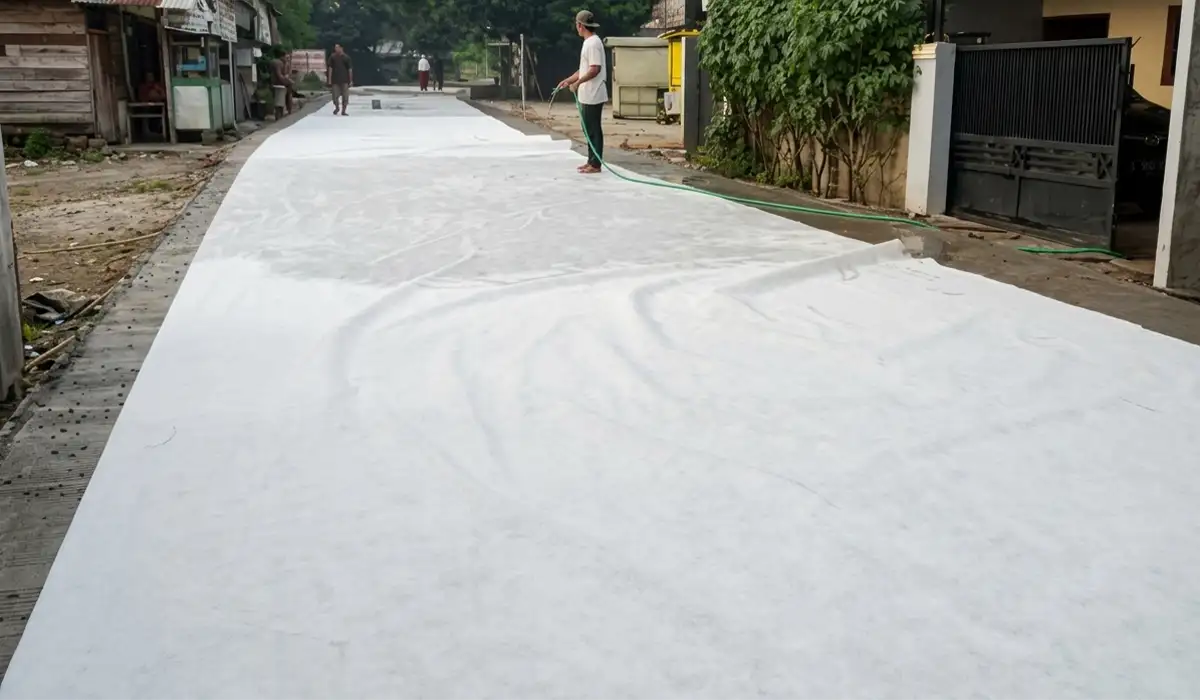
Geotextile Concrete Curing Project in Depok
Background: Hydration Challenges and Extreme Weather This geotextile concrete curing project is located in Depok, an area with fairly challenging weather. During the day, temperatures can be scorching, humidity fluctuates drastically, and gusts of wind speed up evaporation. If you work in civil engineering, you know that cement needs water to undergo a chemical reaction […]