


Geotextile Concrete Curing Project in Depok
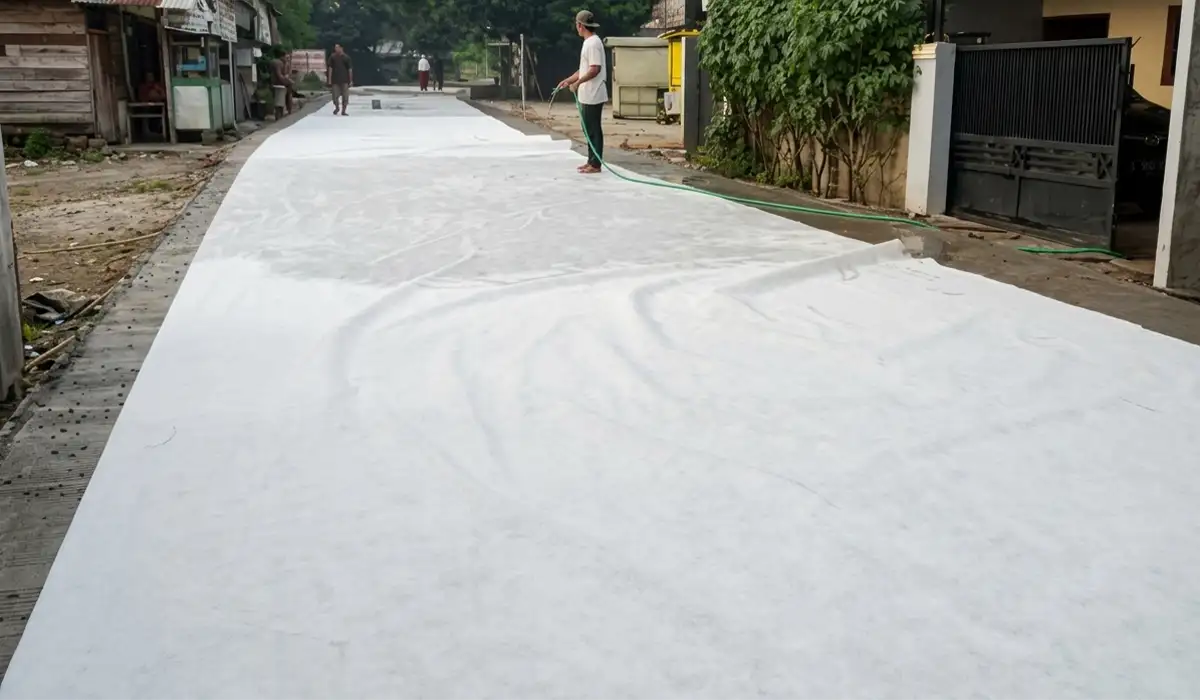
Background: Hydration Challenges and Extreme Weather
This geotextile concrete curing project is located in Depok, an area with fairly challenging weather. During the day, temperatures can be scorching, humidity fluctuates drastically, and gusts of wind speed up evaporation.
If you work in civil engineering, you know that cement needs water to undergo a chemical reaction called the hydration reaction. This reaction is exothermic (it produces heat). When concrete has just been placed, its surface is highly vulnerable to rapid evaporation (water evaporating too quickly).
If water evaporates from the concrete surface faster than the rate of bleeding (water rising from inside the concrete to the surface), the concrete suddenly loses volume. Technically, capillary tension in the concrete pores rises sharply. It is this mechanical pull that triggers Plastic Shrinkage Cracking, or plastic shrinkage cracks.
The challenge on this Depok project was clear: how do you control the exothermic heat and keep water from escaping the concrete surface in hot weather? Traditional methods such as periodic watering are labor-intensive, while burlap sacks are often unhygienic and dry out quickly.
Technical Solution: Why 200 gsm Non-Woven Geotextile?
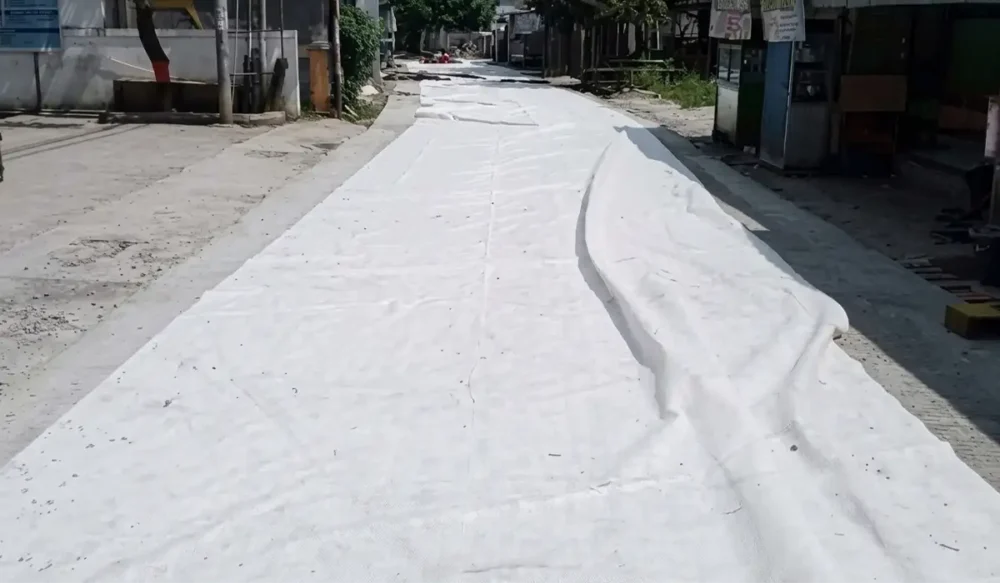
To meet this technical challenge, 200 gsm Non-Woven Geotextile was chosen as the protective curing layer. Unlike Woven Geotextile, which is mainly used for soil reinforcement (since it looks like woven plastic sacking), Non-Woven Geotextile is produced by needle punching, which creates a porous three-dimensional fiber structure resembling carpet or flannel.
So how does it work in the field? As soon as the concrete reaches final setting (hard enough not to be damaged when touched), sheets of 200 gsm Non-Woven Geotextile are laid over the entire concrete surface. The material is then thoroughly soaked with water.
Technically, the material directly influences the physical and chemical processes of the concrete:
- Absorbs and Spreads Water Evenly
A 200 gsm weight is the sweet spot (the ideal point). It has excellent water retention capacity. Its micro-fibers work like a giant sponge that absorbs the water and distributes it evenly across the entire covered area thanks to capillary action. No more dry spots in the corners of the concrete slab. - Reduces Rapid Water Evaporation
The geotextile acts as a thermal and moisture barrier. It cuts off direct contact between the wet concrete surface and the scorching sun and Depok’s winds, keeping the evaporation rate to a minimum. - Keeps the Concrete Surface Moist
With water “locked” inside the geotextile fibers, the concrete surface receives a constant supply of moisture. This lets the cement hydration reaction proceed slowly, completely and continuously. - Controls the Surface Drying Rate
Concrete must not dry too quickly. The geotextile ensures that the difference in temperature and humidity between the concrete core (hot from the reaction) and the surface (exposed to air) is not too extreme. This controlled temperature gradient prevents thermal cracking.
Final Results and Impact
Using 200 gsm Non-Woven Geotextile on this Depok project delivered very satisfactory quality testing results compared with the mock-up area that did not use a proper curing method.
The direct technical benefits included:
- Drastically Reduced Risk of Shrinkage Cracks
Visual inspections on days 7 and 14 showed no hairline cracks (micro-cracks) on the floor slab surface. The structural integrity of the concrete was maintained at the highest level. - Improved Concrete Surface Quality
The resulting concrete surface was much denser, harder and free from dusting (powdery or chalky surface). This is because hydration at the surface (the outermost cement paste layer) was complete, producing a dense Calcium Silicate Hydrate (C-S-H) matrix. - Operational Efficiency
The site team no longer had to water the concrete every 2 hours. The 200 gsm geotextile’s ability to hold water drastically reduced how often it needed wetting, saving daily labor hours and project water.
Prevention is always cheaper and easier than repair. If you are running an infrastructure concrete pour, a rigid pavement (concrete road) or a long-span floor slab project, making sure curing goes as it should is a must. 200 gsm Non-Woven Geotextile has been technically proven to be not just a soil separation material, but also a highly reliable, efficient and modern concrete curing tool.
Other Articles
Non-Woven Geotextile Project on Dieng Subgrade
Background & Challenges The Dieng Plateau has extraordinary natural beauty, but from a geotechnical point of view, the area poses a big challenge for any non-woven geotextile project. The subgrade (subgrade) in volcanic areas often has a high water content. When heavy rain falls, this subgrade becomes fully saturated. If aggregate material (crushed stone/gravel) is […]
Concrete Curing Geotextile Project in Tangerang
Background Imagine you have just finished pouring a 400 square meter concrete floor or road. It looks smooth and perfect, doesn’t it? Yet the biggest challenge, and the reason a concrete curing geotextile matters, really begins the moment the concrete has been poured. In civil engineering, curing is a crucial phase that determines whether a […]

Non-Woven Geotextile for Stronger Toll Roads
Project Background: Why Use Geotextile for Toll Roads on Unstable Subgrade Every toll road project inevitably faces one troublesome natural enemy that makes geotextile for toll roads essential: water and unstable subgrade conditions. Imagine building a road on clay or silty soil. During heavy rainfall, the groundwater table rises. If the aggregate base course (crushed […]