Football Field Drainage with Non-Woven Geotextile
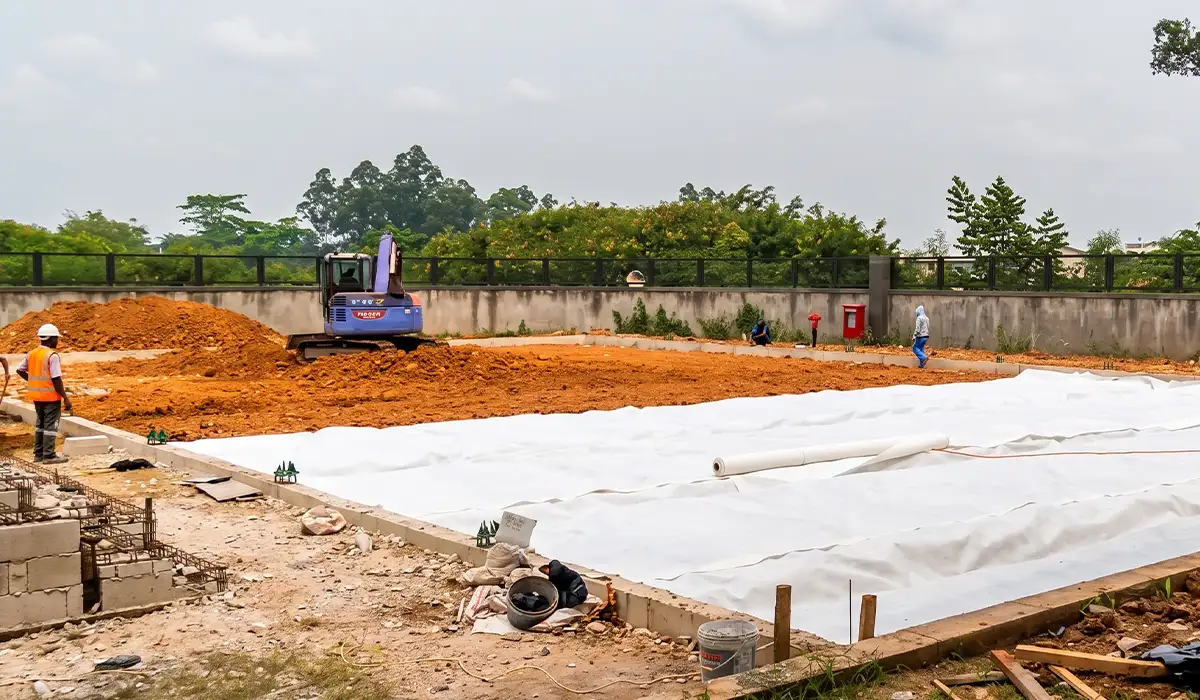
Background
Soils in several parts of Jakarta tend to contain clay, which absorbs water slowly. At the same time, extreme weather often produces rainfall volumes that exceed the soil’s natural infiltration capacity. Effective football field drainage is therefore essential.
For a school football field that is used frequently, relying solely on the surface slope is not enough. A subsurface drainage system is needed to draw water away from the surface as quickly as possible before it can pool. This is where geosynthetic technology plays a role.
Football Field Drainage Challenge: Managing Underground Water Flow
The main challenge at this school field was the limited infiltration area around it because buildings surround the site. Water therefore had to be conveyed horizontally towards the municipal drain. If the design was incorrect, fine soil particles could enter and clog the drainage pipes, causing the system to fail within months.
Technical Solution: Geotextile and Corrugated Pipe

To address these challenges, the PT Petra Nusa Elshada team used materials with carefully selected technical specifications:
1. 250 gsm Non-Woven Geotextile as a Filter
Why use 250 gsm? The higher the weight in gsm, the better the material can withstand the load of the fill above it. Non-woven geotextile acts as both a separator and a filter.
- Separation function: It separates the original soil from the crushed-stone or drainage aggregate layer, preventing the materials from mixing.
- Filtration function: This is crucial. The geotextile allows water to pass freely through its highly permeable structure while retaining soil particles so they cannot enter the pipe. At 250 gsm, the material has sufficient tensile strength for Jakarta’s unstable soil conditions.
2. 4-Inch Corrugated HDPE Pipe (Perforated)
This is not an ordinary PVC pipe like those found in homes. Corrugated HDPE pipe has a ribbed wall that makes it highly flexible yet resistant to compressive loads, with high ring stiffness. We used the perforated type, with small holes that allow water filtered by the geotextile to enter the pipe and flow towards an inspection chamber or main drain.
Installation Process: How Does It Work?
The system was installed through the following technical stages:
Stage 1: Excavating Trenches
 We created a herringbone system beneath the field surface. The trenches were excavated at a minimum gradient of 1-2% so the water could flow by gravity.
Stage 2: Lining with Geotextile (The Envelope Method)
 The excavated trenches were then lined with 250 gsm non-woven geotextile. This is known as the envelope method. The geotextile covered the base and walls of each trench, with enough material left over to wrap the top later.
Stage 3: Installing the Pipe and Aggregate
 The 4-inch corrugated HDPE pipe was placed at the bottom of the trench. The trench was then filled with 20-30 mm crushed stone aggregate. Voids between the stones allow water to move quickly towards the pipe.
Stage 4: Wrapping
 Once the pipe and stone were in place, the remaining geotextile was folded over the top to enclose the entire drainage system. This prevents the fill soil or sand above from entering and contaminating the voids between the stones and the pipe.
Stage 5: Backfilling and Finishing
 Finally, the system was covered with silica sand or a grass-growing medium. The field was then ready for natural or artificial turf.
Final Result: A Field That Is Always Ready to Play
After this system was installed, the school football field achieved excellent drainage performance. During heavy rain, water no longer remains on the surface for more than 15 minutes. It immediately infiltrates the lower layer, enters the geotextile envelope, and is carried by the HDPE pipe to the outlet.
The results:
- Durability: The grass does not rot from waterlogging and oxygen-starved roots.
- Safety: The field surface remains firm, non-slippery, and free of mud, reducing the risk of player injuries.
- Low maintenance: The field surface does not need frequent repairs for settlement or holes caused by surface-water erosion.
Other Articles
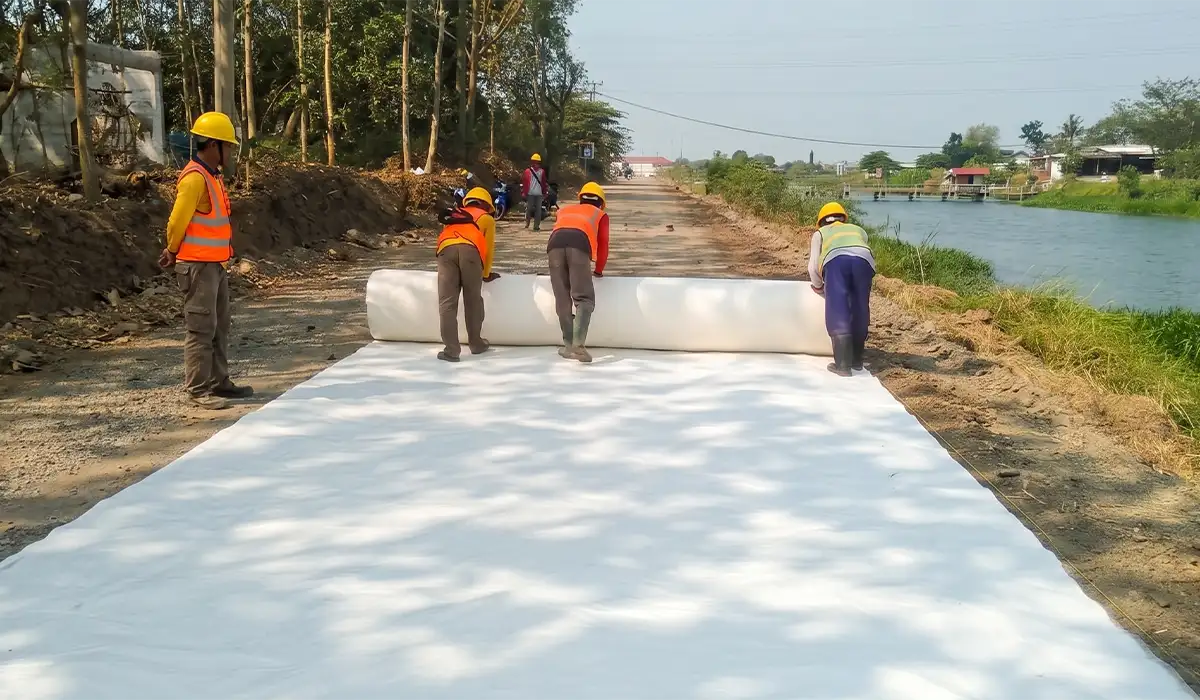
Non-Woven Geotextile Separator for a Karawang Road
Background Karawang has long been known as one of the industrial lifelines of West Java. With thousands of factories and logistics warehouses operating every day, the access roads in this area carry extreme operational loads. Heavy vehicles such as tronton trucks, dump trucks and trailers pass nonstop, 24/7, which is why this project turned to […]
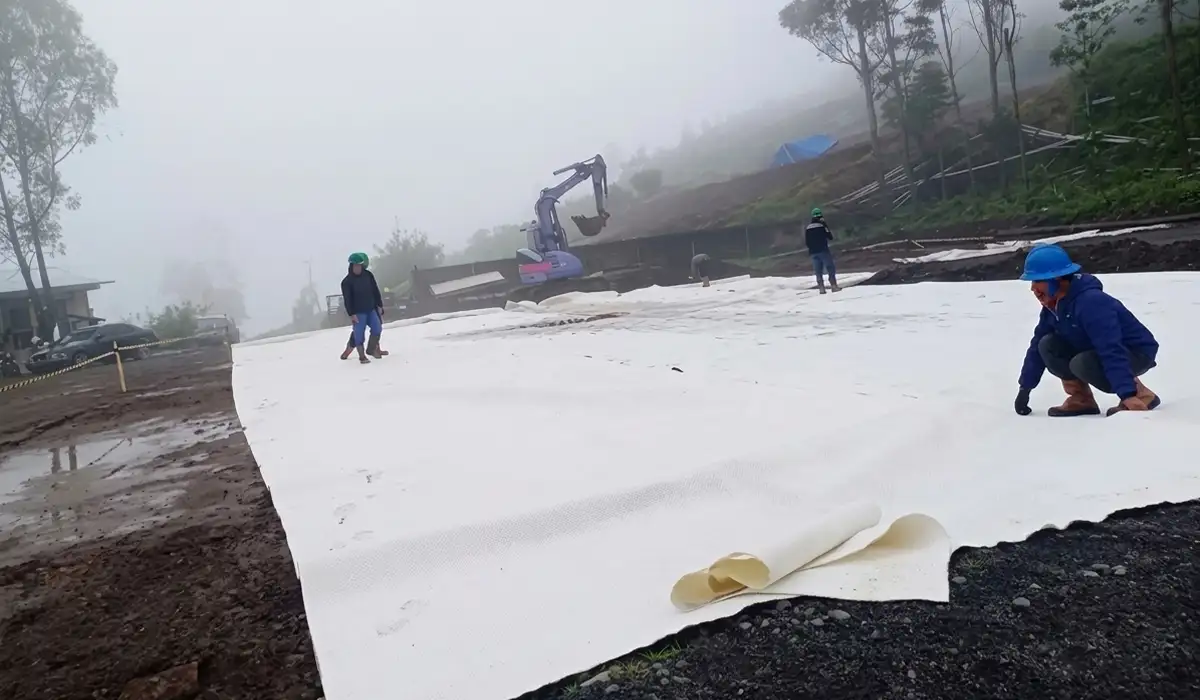
Non-Woven Geotextile Project on Dieng Subgrade
Background & Challenges The Dieng Plateau has extraordinary natural beauty, but from a geotechnical point of view, the area poses a big challenge for any non-woven geotextile project. The subgrade (subgrade) in volcanic areas often has a high water content. When heavy rain falls, this subgrade becomes fully saturated. If aggregate material (crushed stone/gravel) is […]