


Geobag Emergency Dike for a Jakarta Excavation

Background: The Threat of Rain and Erosion on Site
Every earthwork, especially open excavations in urban areas like Jakarta, carries high geotechnical risk. Once the ground is opened, its natural protective layer is gone. The main problem is not just water entering the pit, but the behaviour of the soil around the edge of the excavation.
On this project, the site team faced an emergency: heavy rainfall created surface runoff with considerable volume and velocity. Left unchecked, this runoff would scour the excavation edge (local erosion) and carry sediment into the work area. The worst outcome? Collapse of the excavation walls, threatening worker safety and damaging the foundation under construction. A temporary protection solution was needed that could be deployed instantly and flexibly, yet with high mechanical durability: a geobag emergency dike.
Material Solution: Why Geobag PP 250gr?
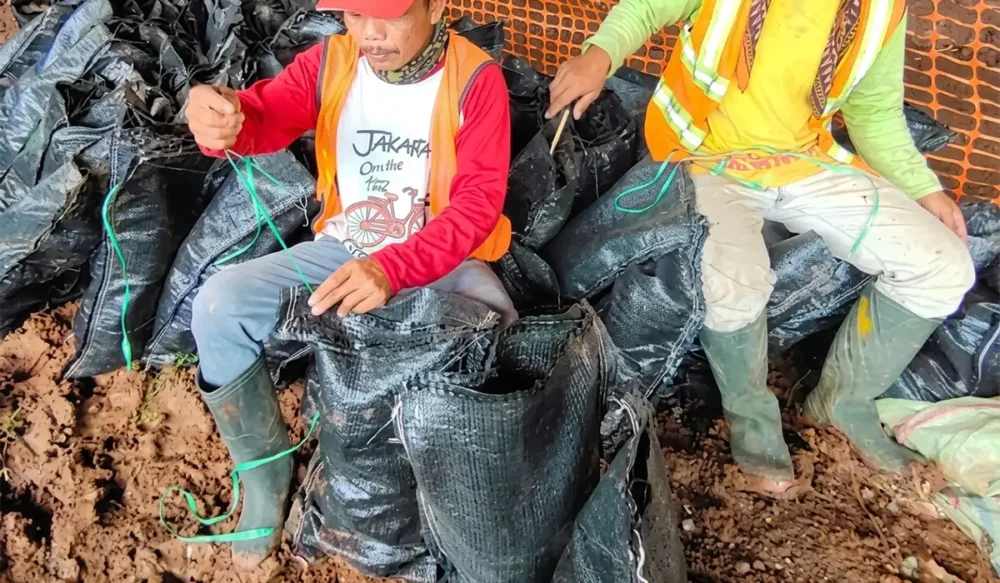
As a rapid response to the emergency, the team decided to build a temporary dike using geosynthetic bags. Of course, these are not ordinary sandbags.
Material Specifications Used:
- Material: GEOBAG PP (Polypropylene)
- Thickness/Weight: 250 gram/m²
- Dimensions: 0.4 metre x 0.8 metre
- Quantity: 500 pcs
- Location: Jakarta
Why Geobag PP 250gr? Polypropylene is known for its outstanding tensile strength. At 250gr, the material is thick enough to hold the fill material (usually sand or local soil) without risk of tearing when dropped or stacked. PP is also resistant to UV light and biological degradation. Even though this is a temporary emergency dike, the material must not break down before the main project is finished.
Technical Implementation and Functions on Site
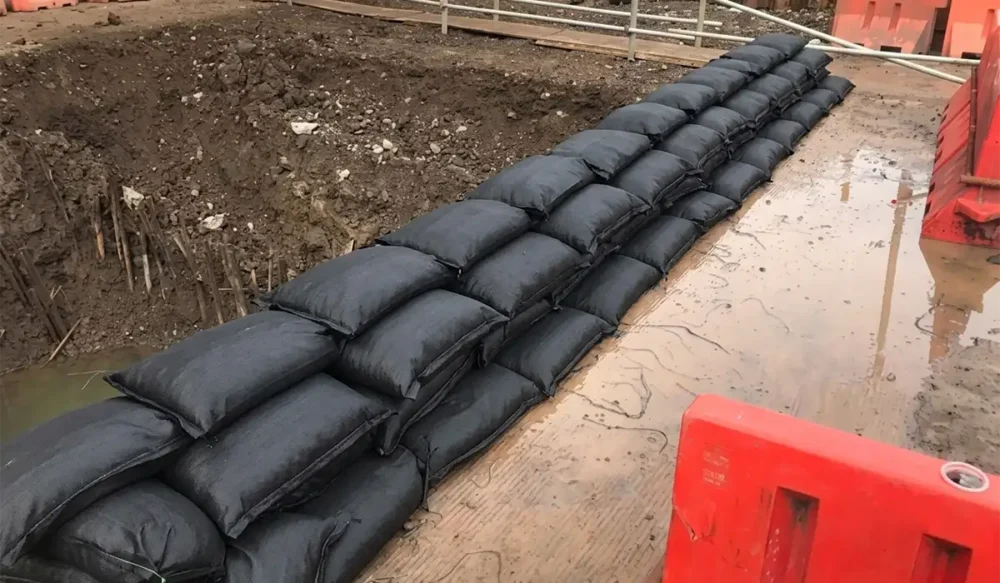
With 500 geobags measuring 0.4m x 0.8m, the site team quickly built a mini cofferdam or perimeter dike around the excavation edge. Geotechnically, this installation performs three crucial functions at once:
A. Increasing Stability of the Excavation Edge
In soil mechanics, the area right at the edge of an excavation is prone to shear failure if it is not supported. By placing fully filled PP geobags along the excavation edge, the arrangement acts as a surcharge load and as a micro-scale retaining wall. The unit weight of geobags stacked using an interlocking pattern (like laying bricks) provides a gravity resisting force that stabilises the soil beneath and prevents the excavation face from collapsing.
B. Reducing Erosion Around the Excavation
When heavy rain falls, the kinetic energy of raindrops and surface flow detaches soil particles and carries them away (erosion). The geobags act as physical armor. The woven texture of polypropylene breaks up the energy of the water flow. The material has a certain permeability, meaning water can still seep out very slowly to relieve hydrostatic pressure behind the dike, while soil sediment stays inside the bags, keeping the original soil profile intact.
C. A Temporary Barrier Against Runoff
The most urgent function of these 500 geobags is as an artificial watertight barrier. Tightly stacked geobags cut off the path of rainwater runoff and ponding from the surrounding area. By diverting the water away from the pit, the work area inside the excavation stays dry and stable. The dewatering pump inside the excavation also does not need to run over-capacity, because surface water has been blocked by the geobag dike.
Results and Conclusion
Using 500 Geobag PP 250gr units (0.4m x 0.8m) proved to be a crucial tactical step. The emergency dike was built quickly, without heavy equipment for installation. Erosion around the excavation edge was significantly reduced, and surface runoff was successfully diverted so it did not flood the work area.
If you manage construction projects, this Jakarta case study is clear proof that disaster mitigation readiness with the right geosynthetic materials is a must. A geobag is not just a “sandbag”, but an efficient, strong protective engineering tool that is highly reliable even in the most critical conditions.
Other Articles

Geobag Coastal Erosion Protection: Padang Case Study
Background & Challenges: Hydrodynamic Threats on the Padang Coast The Padang coastline faces the Indian Ocean directly and has very challenging hydrodynamic characteristics. All year round, the coast is hit by high-amplitude waves, along with fairly extreme tidal fluctuations, making it a prime candidate for geobag coastal erosion protection. The main challenge is not just […]

Geobag Slope Protection for a West Jakarta Pond
The Problem: Erosion Hidden Beneath a Calm Water Surface West Jakarta has fairly distinctive soil conditions, with varying humidity and rainfall. When a water storage pond is built, the surrounding slopes or earth embankments face several main threats, which is why geobag slope protection was needed: Water Level Fluctuation (Drawdown)Pond water rising and falling sharply […]
