


Geobag Coastal Erosion Protection: Padang Case Study

Background & Challenges: Hydrodynamic Threats on the Padang Coast
The Padang coastline faces the Indian Ocean directly and has very challenging hydrodynamic characteristics. All year round, the coast is hit by high-amplitude waves, along with fairly extreme tidal fluctuations, making it a prime candidate for geobag coastal erosion protection.
The main challenge is not just rising water, but the kinetic energy of the waves carrying sand and soil away from the shore little by little (scouring). Left unchecked, this erosion eats away the land, damages roads and threatens residential areas.
Rigid structures such as concrete walls are often not the best choice here. Why? Because concrete reflects wave energy, which ultimately accelerates scouring at the base (toe) of the structure. Subgrade movement can also crack and break the concrete. What is needed is a solution that is flexible, permeable to water, and heavy enough to resist the waves’ drag force.
Technical Solution: Geobag PP 500 GSM for Coastal Erosion Protection
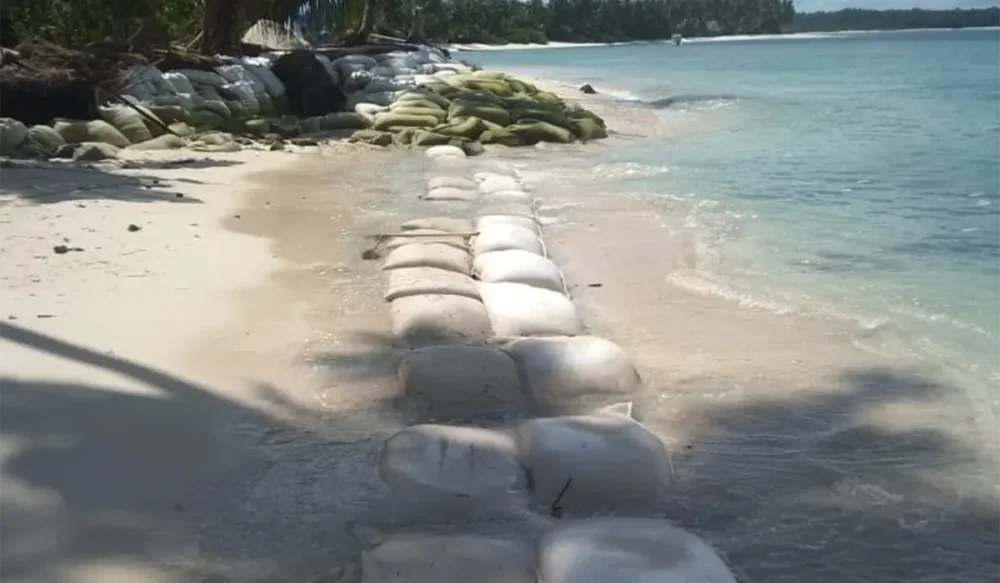
To meet these challenges, the team decided to install Geobag PP 500 gsm from Petrane along the critical stretch of coastline. If you are not yet familiar with the technical side, let’s break down the material’s specifications:
- High-Strength Polypropylene (PP)
These geobags are made from polypropylene fibres, known for outstanding resistance to mechanical abrasion, UV exposure and chemical degradation from corrosive seawater. - 500 GSM Weight (Grams per Square Metre)
The 500 gsm figure indicates the density and thickness of the material. In geotechnical engineering, 500 gsm falls into the heavy-duty category. The material does not tear easily (high puncture resistance) when rubbing against coral, debris, or sediment carried by the waves. - Precise Dimensions (1.50 x 0.90 m)
The 1.50 m x 0.90 m size was chosen for good reason. When filled with local material (usually beach sand), a single geobag can weigh hundreds of kilograms. These dimensions give an ideal stability ratio when stacking them into a wave-resisting slope. - Controlled Permeability
Unlike concrete, geobags let water flow in and out (permeable) while still retaining the sand inside. Technically, this lowers the hydrostatic pressure in the soil behind the geobag stack and absorbs (dissipates) the energy of the waves that hit it.
Execution and Installation on Site
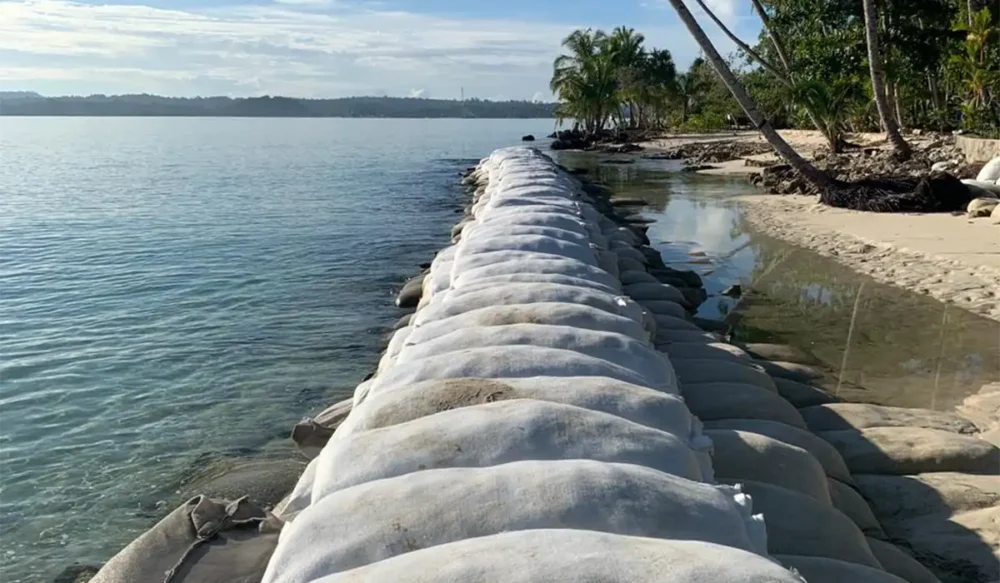
Completing a project with 700 pcs of geobags takes precise coordination on site. Here are the technical installation stages:
- Subgrade Preparation
The shoreline surface is levelled. In some cases, an extra geotextile separator layer is laid beneath the geobags to keep the base sediment from mixing with the structure above. - Filling the Geobags
Filling is done on site using local sand (about 70-80% of the bag’s total volume). This saves the cost of transporting material (stone aggregate) from elsewhere. Once filled, the geobag opening is sewn shut with special high-tensile UV-resistant thread. - Interlocking Placement
The 700 pcs of geobags are not simply piled up. They are placed using an interlocking method, like brickwork, at a set slope. Part of the arrangement is buried below the seabed level (toe trenching) to prevent the structure from collapsing due to toe scour.
Results and Performance
Once all 700 pcs of geobags were in place across the critical area of the Padang coastline, the results were visible in the very next tidal cycle. The geobag structure successfully dampened the Indian Ocean waves.
Instead of reflecting waves into the air like a concrete wall, the stack of Geobag PP 500 gsm absorbs their energy. Its flexibility also lets the structure settle with subgrade movement without losing its structural integrity. This project proves that environmental and infrastructure protection can be cost-efficient, quick to install and durable.
Other Articles

Geobag Slope Protection for a West Jakarta Pond
The Problem: Erosion Hidden Beneath a Calm Water Surface West Jakarta has fairly distinctive soil conditions, with varying humidity and rainfall. When a water storage pond is built, the surrounding slopes or earth embankments face several main threats, which is why geobag slope protection was needed: Water Level Fluctuation (Drawdown)Pond water rising and falling sharply […]


Geobag Emergency Dike for a Jakarta Excavation
Background: The Threat of Rain and Erosion on Site Every earthwork, especially open excavations in urban areas like Jakarta, carries high geotechnical risk. Once the ground is opened, its natural protective layer is gone. The main problem is not just water entering the pit, but the behaviour of the soil around the edge of the […]