


Geotextile Tube Coastal Protection in Indramayu

The Challenge on Site: Aggressive Java Sea Erosion
Juntinyuat Beach in Indramayu faces the Java Sea directly, waters known for fairly aggressive wave dynamics, especially during the monsoon season. Historical records and environmental monitoring show that the area has suffered a very significant shoreline retreat due to coastal erosion. Land that used to lie hundreds of meters from the shoreline has gradually been eroded, leaving a dangerously small buffer for the structures on the land behind it.
The main challenge was to design a wave-retaining structure (breakwater or revetment) that could not only break the energy of sea waves but also hold the soil in place so it would not be washed back into the sea (scouring), while being built efficiently in an area that is constantly flooded by high tides.
Technical Solution: C-Tube Non-Woven PP 1200 GSM
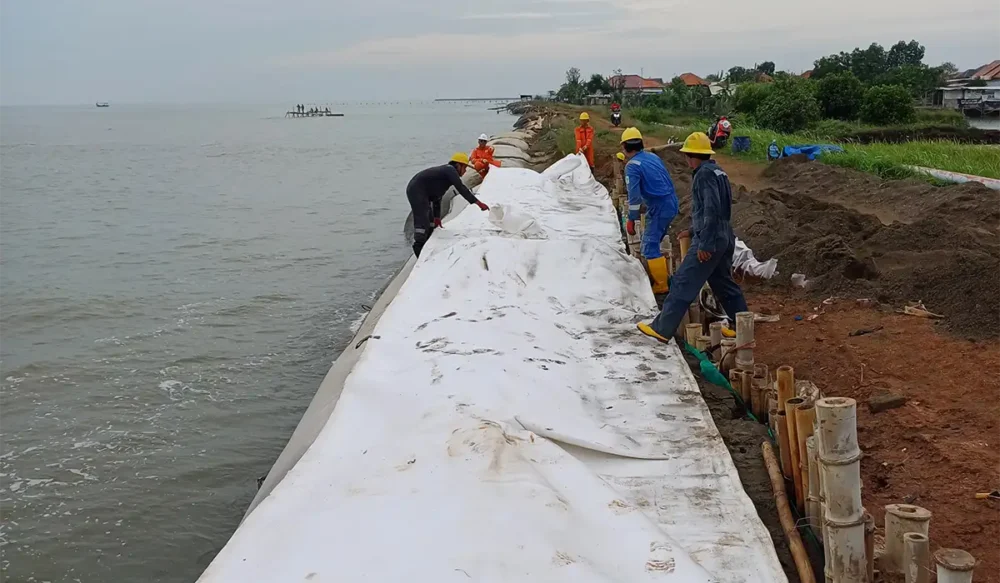
To tackle this extreme coastal erosion, the infrastructure solution chosen was Geotextile Tube technology (often called Geotube), specifically using C-Tube non-woven PP (polypropylene) material with a weight of 1200 GSM.
If you are not yet familiar with it, a Geotube is essentially a giant tubular bag made of a porous yet very strong geosynthetic material. In the Juntinyuat project, installation relied on the dredging method. Local sand or slurry from the seabed was pumped hydraulically at high pressure directly into the C-Tube through the prepared filling ports.
The water in the slurry filters out through the pores of the non-woven material, while the sand particles are retained and consolidate inside. The result? A massive, heavy and dense wave-retaining structure that follows the contours of the seabed perfectly.
Why Non-Woven PP 1200 GSM?
Material specifications for coastal projects cannot be chosen at random. Using a non-woven polypropylene C-Tube with a density of 1200 GSM (grams per square meter) is based on several critical technical reasons:
- Maximum Mechanical Strength and Puncture Resistance
The 1200 GSM figure indicates that this material is extra thick and heavy. In a coastal environment full of pounding waves, shells, driftwood and sharp rocks, it offers far greater resistance to puncture (puncture resistance) and physical abrasion than standard geosynthetics. Once the tube is completely filled and consolidated, it will not tear easily even under constant impact from marine debris. - Optimal Filtration vs. Retention Performance
The main job of a Geotube is to release water (dewatering) as quickly as possible during pumping while retaining the solid material (sand) inside. The non-woven structure of this PP 1200 GSM fabric creates a labyrinth-like three-dimensional structure with very precise pore openings (aperture). Seawater can flow out freely without building up hydrostatic pressure inside, while the fill soil stays safely contained. - Extreme Resistance to Open Exposure (UV & Chemicals)
Polypropylene (PP) polymer naturally offers excellent resistance to biological degradation (rotting) and to aggressive liquids such as highly corrosive seawater (high salinity/alkalinity). A quality C-Tube is also formulated with a UV stabilizer, ensuring the material does not turn brittle even after years of exposure to the intense coastal sun of Indramayu.
Results: Robust Geotextile Tube Coastal Protection
Installing C-Tube Non-Woven PP 1200 GSM along Juntinyuat Beach delivers two protective functions at once.
First, it prevents active erosion and abrasion. The consolidated Geotube acts as a primary shield (coastal protection structure) that dissipates the kinetic energy of the waves before they reach the land. Second, it prevents further shoreline retreat. By trapping sediment carried by the waves, the structure gradually supports accretion, the build-up of sand sediment behind the structure, slowly stabilizing and reclaiming the lost stretch of beach.
This geosynthetic approach proves that protecting coastal infrastructure does not always have to rely on expensive rigid materials. With the right installation technique and high-quality Geotextile Tube materials, even a critical shoreline can be protected effectively, in an environmentally friendly and highly cost-efficient way.
For civil project planners, a system like this is clearly a technical solution worth considering for your next maritime infrastructure project.
Other Articles

Geobag Emergency Dike for a Jakarta Excavation
Background: The Threat of Rain and Erosion on Site Every earthwork, especially open excavations in urban areas like Jakarta, carries high geotechnical risk. Once the ground is opened, its natural protective layer is gone. The main problem is not just water entering the pit, but the behaviour of the soil around the edge of the […]

Geobag Slope Protection for a West Jakarta Pond
The Problem: Erosion Hidden Beneath a Calm Water Surface West Jakarta has fairly distinctive soil conditions, with varying humidity and rainfall. When a water storage pond is built, the surrounding slopes or earth embankments face several main threats, which is why geobag slope protection was needed: Water Level Fluctuation (Drawdown)Pond water rising and falling sharply […]

Geobag Coastal Erosion Protection: Padang Case Study
Background & Challenges: Hydrodynamic Threats on the Padang Coast The Padang coastline faces the Indian Ocean directly and has very challenging hydrodynamic characteristics. All year round, the coast is hit by high-amplitude waves, along with fairly extreme tidal fluctuations, making it a prime candidate for geobag coastal erosion protection. The main challenge is not just […]