


Geobag Slope Protection for a West Jakarta Pond

The Problem: Erosion Hidden Beneath a Calm Water Surface
West Jakarta has fairly distinctive soil conditions, with varying humidity and rainfall. When a water storage pond is built, the surrounding slopes or earth embankments face several main threats, which is why geobag slope protection was needed:
- Water Level Fluctuation (Drawdown)
Pond water rising and falling sharply between the rainy and dry seasons changes the pore pressure inside the embankment soil. - Wave Action
Wind blowing across the pond surface creates ripples or small waves that constantly hit the slope. - Surface Runoff
Rainwater flowing from higher ground carries soil particles down into the pond.
Left unchecked, the pond slopes will suffer scouring. Conventional solutions such as cast concrete or river stone (riprap) are often expensive, slow to build, and not flexible enough to cope with subgrade movement. You need a material strong enough to resist scouring, yet permeable enough to let groundwater escape without carrying soil particles with it.
Geotechnical Solution: Why Geobag PP 300 GSM for Slope Protection?
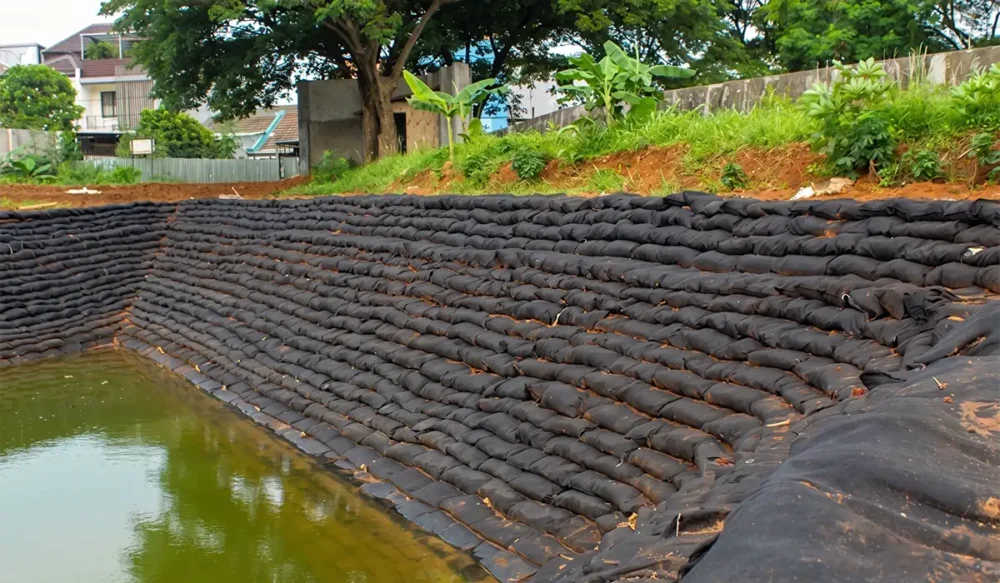
To meet these challenges, the engineering team chose a flexible geosynthetic protection system. On this project, the material used was Geobag Polypropylene (PP) 300 GSM measuring 1m x 0.5m, a total of 10,000 Pcs.
If you are not yet familiar with the material details, let’s look at the technical side:
- Polypropylene (PP)
This polymer was chosen for its outstanding resistance to chemicals, soil or water acidity (pH), and attack by decaying microorganisms. Being wet all the time will not make this material rot. - 300 GSM Density (Grams per Square Metre)
This fibre thickness and density offers very high tensile strength and puncture resistance. The bags do not tear easily during filling with soil or sand and compaction. - Permeability & Filtration
This is the most crucial property. Geobags have microscopic pores. Technically, a geobag works as a filter. Groundwater from behind the embankment can still flow out through the geobag (reducing hydrostatic pressure), but the soil particles stay inside. The result? No more embankment soil washing away!
Technical Installation Details on Site
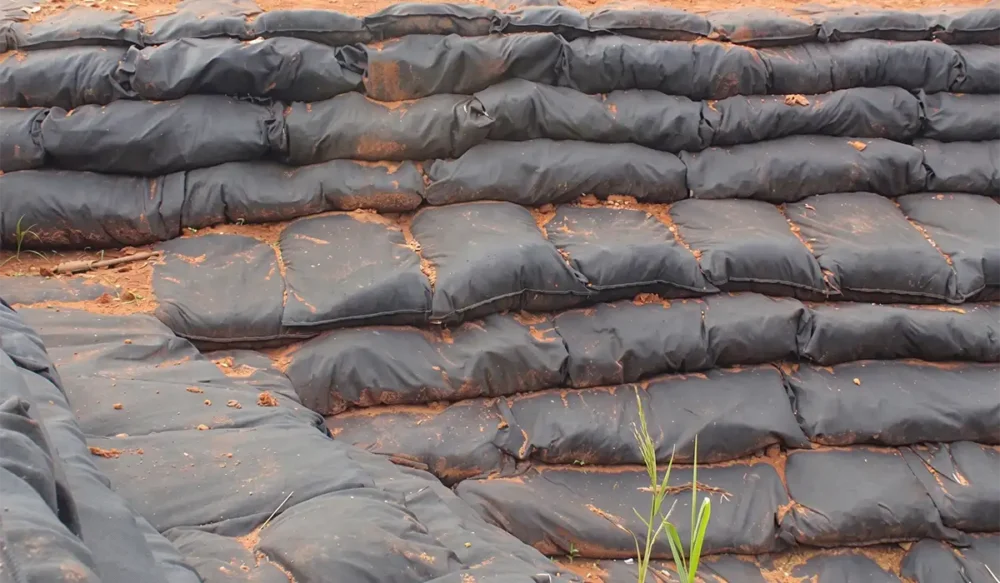
Installing 10,000 pcs of geobags is not just stacking sandbags. A strict procedure must be followed so the interlocking structure forms properly.
- Subgrade Preparation
The pond slope is first shaped (grading) to a geotechnically safe design gradient (for example 1:2 or 1:3). The slope surface is cleared of sharp rocks, tree roots and organic material that could affect base stability. - Filling
The Geobag PP 300 GSM is filled with granular material (sand or a local soil mix that meets the specification) to the optimal volume (usually about 70-80% of full capacity). Overfilling actually makes geobags hard to shape and stack. The material inside is then compacted. - Toe Anchoring
The toe of the slope is the critical point that carries the entire load above it. An anchor trench is dug at the toe, and the first layer of geobags is buried below the pond bottom level to prevent sliding. - Interlocking Placement
The thousands of geobags are then laid like bricks, in a staggered pattern working upwards. Friction between the rough PP geobag surfaces creates a strong mechanical bond between layers.
Final Result: Four Vital Functions Achieved
Once the 10,000 pcs of geobags were installed, the protective structure immediately began providing layered protection. Here are the technical benefits seen right away on this West Jakarta project:
- Protecting the Slope from Erosion
Wave impact and surface runoff are now absorbed by the geobag structure. The original soil behind the slope is 100% protected from direct exposure to weather and water. - Keeping the Slope Shape Stable
Geobags are heavy and massive yet flexible, so they follow the ground contour without cracking (unlike concrete, which can break if the ground beneath it undergoes slight settlement). The slope geometry stays intact as designed. - Improving Embankment Stability
With good drainage paths through the geobag pores, the pore water pressure inside the embankment can be reduced significantly. In soil mechanics terms, lower pore water pressure automatically increases soil shear strength, making the embankment sturdier. - Reducing the Risk of Slope Failure
The water load and gravity trying to pull the soil downwards are countered by the counter-weight of the geobag arrangement at the toe and along the slope face.
This West Jakarta project is real proof that a modern geosynthetic engineering approach can deliver a solution that is not only technically functional, but also more economical and faster to build.
Other Articles

Geobag Emergency Dike for a Jakarta Excavation
Background: The Threat of Rain and Erosion on Site Every earthwork, especially open excavations in urban areas like Jakarta, carries high geotechnical risk. Once the ground is opened, its natural protective layer is gone. The main problem is not just water entering the pit, but the behaviour of the soil around the edge of the […]

Geobag Coastal Erosion Protection: Padang Case Study
Background & Challenges: Hydrodynamic Threats on the Padang Coast The Padang coastline faces the Indian Ocean directly and has very challenging hydrodynamic characteristics. All year round, the coast is hit by high-amplitude waves, along with fairly extreme tidal fluctuations, making it a prime candidate for geobag coastal erosion protection. The main challenge is not just […]
