


Geocell Landscape Slope Solution in Bali
Project Background & Challenges
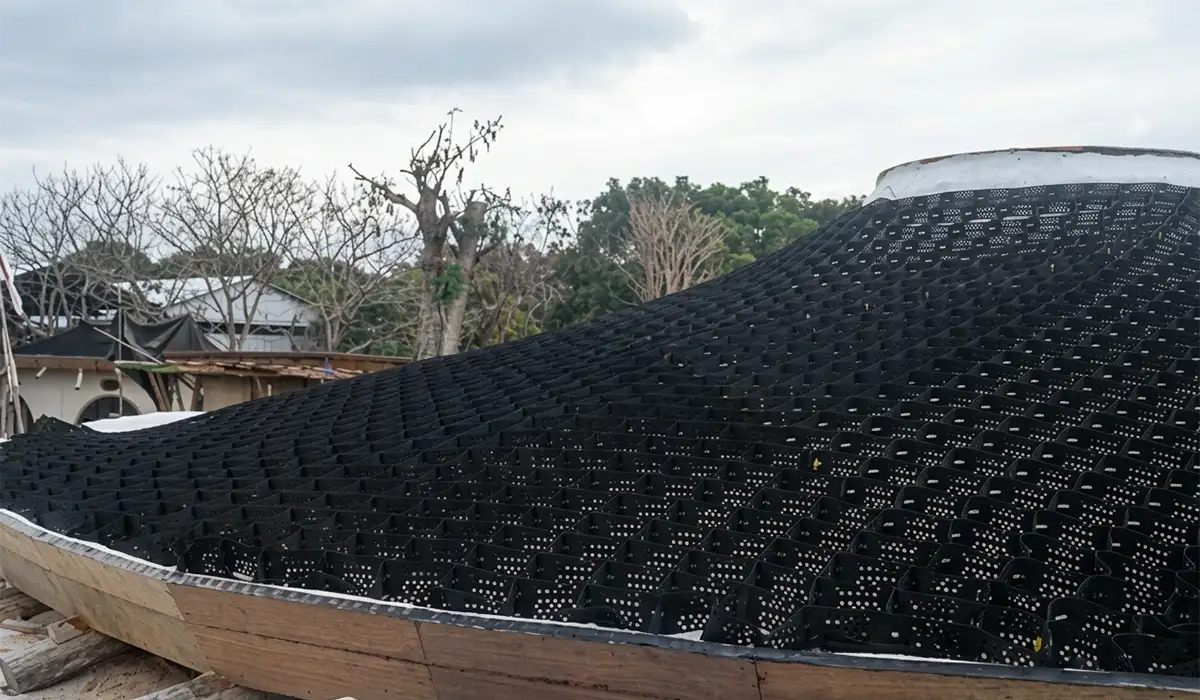
Bali has always been a centre of green architecture innovation. In this geocell landscape slope project, the contractor and architect worked on a 1,368 m² area designed as a green space. The main problem was the site contours and a structural design with fairly steep slopes, including the architectural roof.
When you place soil or planting media on a sloping waterproof surface (such as a concrete slab), the soil has no natural grip. Without proper reinforcement, Bali’s heavy rainfall quickly creates surface runoff that carries soil particles away. The result? Vegetation cannot grow, drainage clogs with mud, and the roof loses its aesthetic and thermal function. The contractor needed a material that was lightweight and flexible enough to follow the curves of the architectural design, yet structurally strong enough to lock the soil in place.
Technical Solution: Combining 10cm Geocell & Non-Woven Geotextile
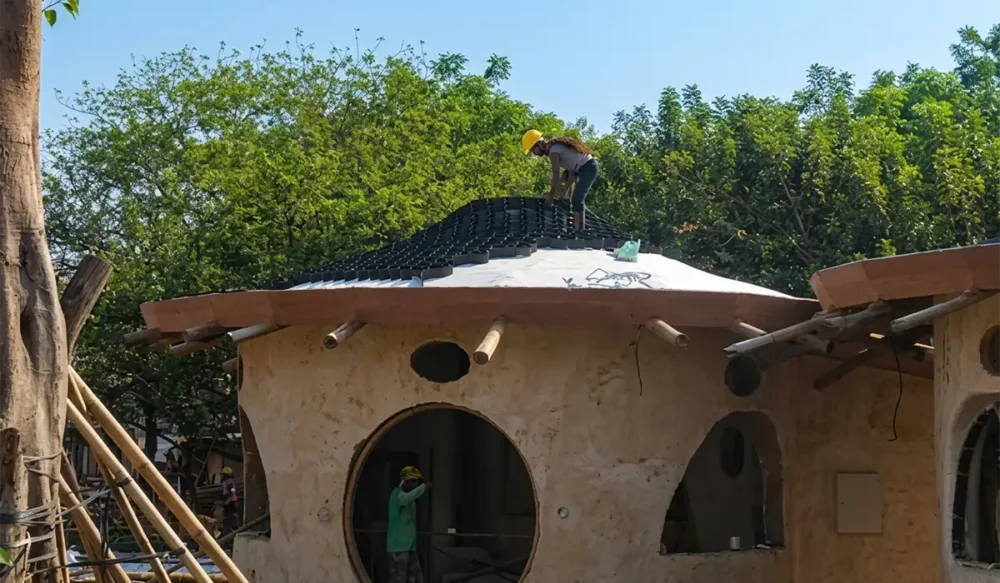
To overcome gravity and erosion, we applied a layered protection system. First, Non-Woven Geotextile was laid directly on the base surface as a separation and filtration layer. Then Geocell with a 10cm cell height was stretched out on top, anchored, and filled with a special planting medium.
Why is this combination so crucial? Here are the technical details of how the system works on site:
1. Locking Soil Against Gravity (3D Confinement Effect)
The most vital function of the 10cm geocell in this project is to create a 3D cellular confinement system. When planting media is placed in the honeycomb cells, the geocell walls exert lateral pressure. The cells literally “imprison” the soil so that it does not slide down under gravity, even on roofs or slopes with aggressive gradients.
2. Even Load Distribution
Wet soil is very heavy. If this load concentrates at the lowest point of the roof slope, the building structure can be at risk. The interconnected geocell structure distributes vertical and lateral loads evenly over the whole 1,368 m² area. This keeps the planting media stable and prevents a point of failure in the structure below.
3. Retaining Soil Particles from Water Flow (Effective Filtration)
This is where the non-woven geotextile layer combined with geocell plays a key role. During heavy rain, the geotextile acts as a permeable filter: it lets water pass to the drainage system below but retains soil particles so they are not washed away (piping effect). Meanwhile, the geocell walls break up the kinetic energy of surface flow, preventing gully erosion in the planting media.
4. Supporting Vegetation Growth
Geocell is specially designed to support greening. Geocell walls usually have perforations (small holes) that let plant roots grow sideways and bind adjacent cells together. The perforations also maintain the circulation of water and nutrients in the soil. As a result, growing roots create a secondary natural reinforcement system that makes the landscape stronger over time.
5. Reducing Runoff Volume
Green architecture is not only about looks but also water management. With a porous geocell and geotextile system, rainwater flowing over the slope slows down drastically. Water has enough time to infiltrate into the planting media before any excess is discharged. This significantly reduces the volume and velocity of runoff that could overload the project’s main drainage channels.
Results
Using 10cm geocell and non-woven geotextile proved to be a highly effective value-engineering solution for this landscape project in Bali. Not only was installation relatively fast and efficient, the system also keeps the 1,368 m² area safe from erosion on sloping ground. Plants can now thrive at challenging elevations and gradients, realising a vision of eco-friendly architecture that is stable, safe and durable.
Other Articles

Geocell Palm Oil Road on Soft Soil in West Kalimantan
Background: Extreme Subgrade Challenges in Kalimantan If you are familiar with the topography and geotechnical conditions of West Kalimantan, you know that mud, peat or soft soil with a very low CBR (California Bearing Ratio) is the main enemy of road construction, and the reason this geocell palm oil road was needed. Every day, this […]


Geocell Slope Stability to Protect a Retaining Wall in Duri
Project Background & Challenges The Duri area in Riau is known for dynamic soil conditions and challenging rainfall. On this infrastructure project, which became a geocell slope stability case, the site team needed to build a safe, solid and durable retaining wall. However, there was one major technical problem: the fill on the slope had […]