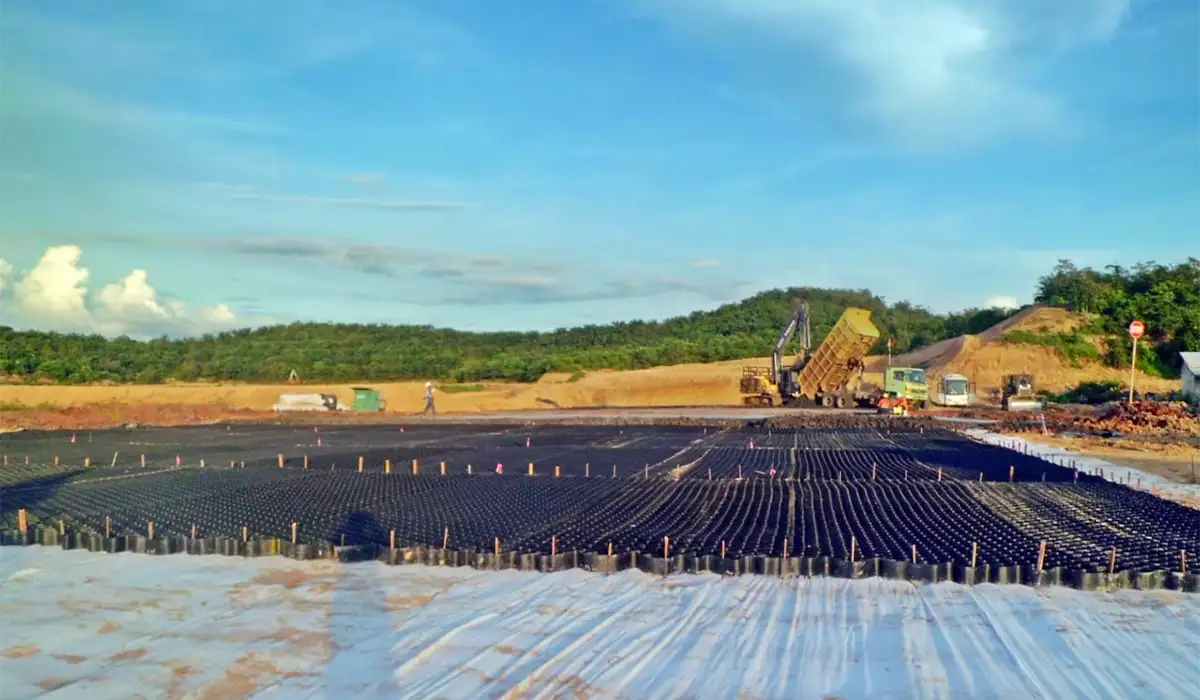
Geocell Parking Lot and Paving Block Road in Bandung
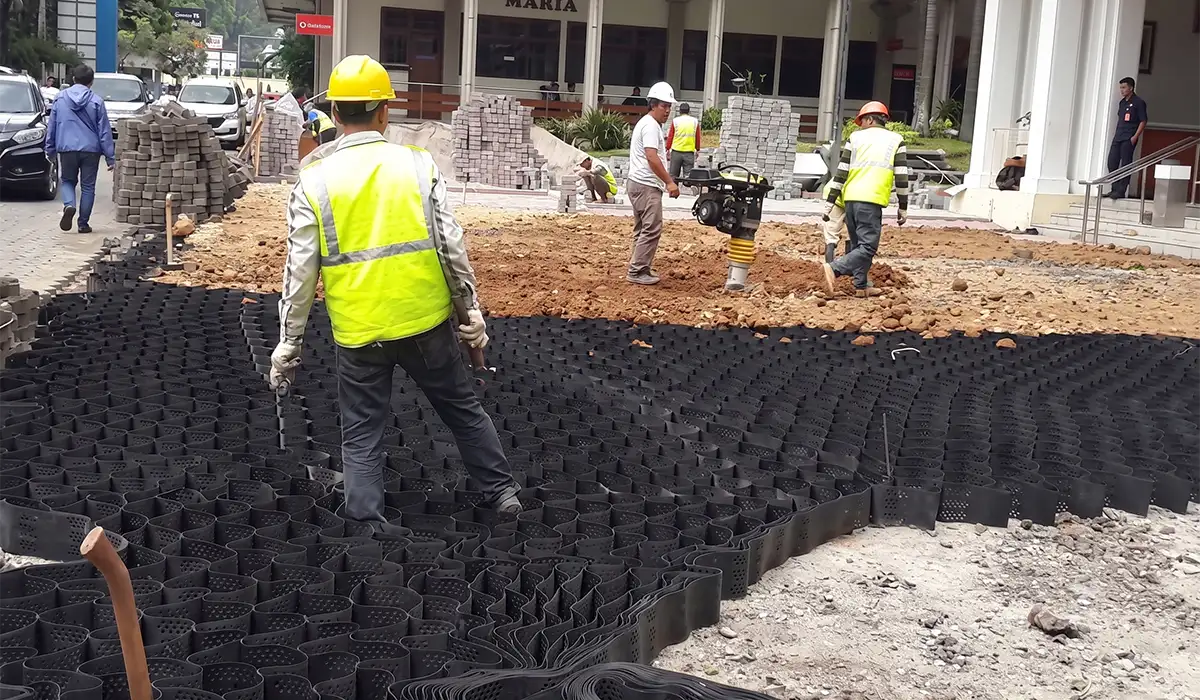
Project Background & Challenges
Bandung is known for fairly high rainfall and varied topography. On this geocell parking lot project, the team worked on an area to be turned into a car park and access road using paving blocks. However, there were major challenges on site:
- Soft Subgrade: The CBR (California Bearing Ratio) of the native soil was low. If paving blocks were laid directly on a conventional base without extra reinforcement, static loads from parked cars and dynamic loads from passing vehicles would press straight onto the subgrade.
- Risk of Ponding: With high rainfall, poor drainage would trap water beneath the paving blocks. Ponding water weakens the soil structure, erodes the base material and triggers local settlement.
Had conventional methods been forced through, the car park was expected to suffer rutting and structural damage within the first few months of operation.
Technical Solution: Integrating 15cm Geocell
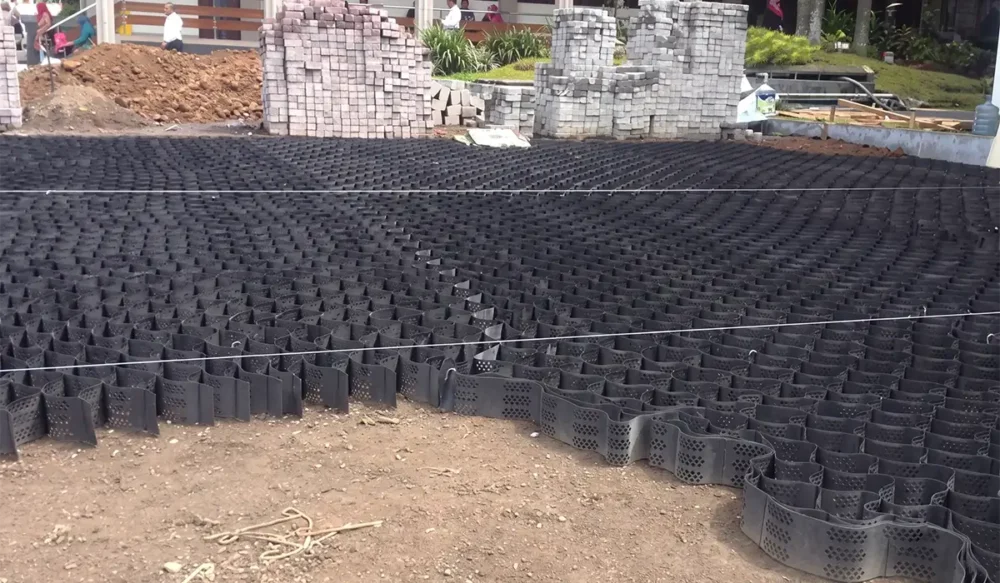
To meet these challenges, it was decided that a conventional system was not enough. The project team turned to a cellular confinement system, applying 15cm high Geocell on the subgrade, filled with aggregate (crushed stone/gravel), then topped with sand bedding and paving blocks as the surface layer.
This geocell is a 3D honeycomb made from HDPE (High-Density Polyethylene) strips. When stretched out and filled with aggregate, geocell works by restricting the sideways movement of the infill (lateral confinement).
Technical Analysis: Why Is 15cm Geocell So Effective?
Using 15cm geocell on this Bandung project was no accident. Here are the functions and technical mechanisms by which this geosynthetic saved the car park project:
1. Mattress Effect (Even Load Spreading)
When vehicle wheels press on the paving blocks, the load is transferred to the layers below. Without geocell, this pressure is concentrated at one point (localized stress). With geocell, the honeycomb distributes the load laterally to the surrounding cells. The result? Vehicle loads spread more evenly in a mattress effect, greatly reducing direct pressure on the subgrade.
2. Drastically Increased Bearing Capacity
This is the key to building on soft soil. Because the aggregate inside the geocell is tightly locked and cannot escape sideways under pressure, the layer acts like a semi-rigid slab. This significantly increases the bearing capacity of the car park, keeping it stable even under heavy vehicles.
3. Goodbye Rutting and Settlement
Because the aggregate is confined within the geocell walls, it is prevented from moving (infill movement is prevented). This locking directly reduces wheel ruts (rutting) on the surface and the risk of local settlement that often makes paving blocks uneven.
4. Superior Water Management (Permeable System)
Geocell does not block water. On this project, the perforated geocell walls combined with coarse aggregate infill let rainwater infiltrate quickly into the ground. Hydrologically, this greatly reduces surface runoff and successfully reduces ponding in the car park. The surface stays dry and safe even after heavy rain.
5. Faster Construction
For contractors, time is money. Geocell installation proved to speed up construction. The material is very light when folded and transported. On site, workers only need to stretch it out and stake it, and heavy equipment can tip the infill straight in. There is no waiting for curing as with rigid concrete pavement.
Results
Since completion, the car park and paving block road in Bandung have shown outstanding structural performance. Despite being built on less than ideal soil and exposed to heavy rainfall, no significant deformation, rutting or ponding has been found. 15cm geocell has proven to be a long-term investment that cuts maintenance costs and significantly extends the service life of the car park.
Other Articles

Geocell Slope Protection Project in Bogor
Geocell Project / Geocell Slope Protection / Access Road / Slope Reinforcement Location: Jasinga, Bogor Materials: Project description:

Geocell Slope Protection in Lebak Bulus
The Problem: Erosion Threats in the Heart of South Jakarta The project site in Lebak Bulus has sloping terrain that is quite vulnerable to surface soil movement, making it a clear case for geocell slope protection. The main problem facing slopes in tropical urban areas is scouring by rainwater (surface runoff). During heavy rain, water […]