


Geocell Access Road Pavement in East Kalimantan
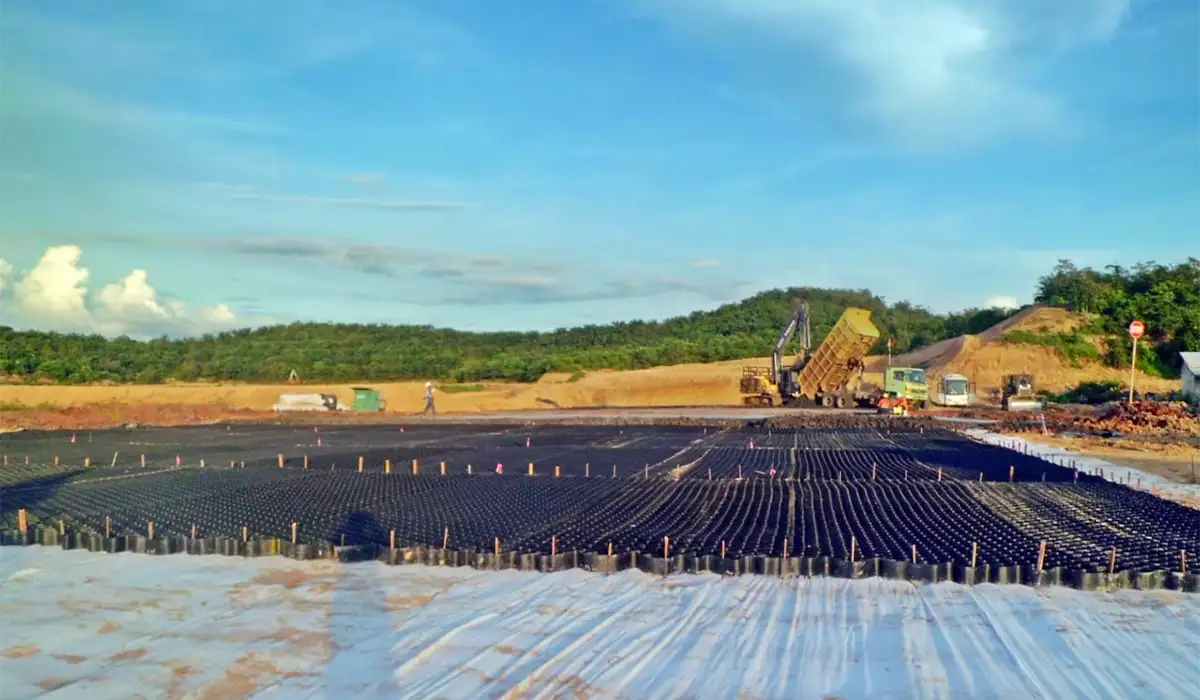
Project Background & Challenges
This access road project in East Kalimantan plays a crucial role as a logistics lifeline for heavy equipment and material trucks. However, the engineering team on site faced one main challenge: very low subgrade bearing capacity (CBR). This case study shows how geocell access road pavement solved it.
With highly compressible soil (soil that shrinks and compacts easily under load) and high rainfall in the region, building the road directly on the native soil would be the same as throwing material away. Crushed stone or aggregate placed on top would quickly be “swallowed” by the soft soil (punching shear failure).
If forced, the road would undergo uneven subsidence (settlement), creating water-filled potholes and eventually cutting off a costly logistics route. The project needed a solution that was not only structurally strong but also quick to install and cost-efficient in material use.
Solution: Geocell Access Road Pavement with a Cellular Confinement System

Faced with these extreme conditions, the team decided to abandon the conventional mass-fill method and switch to Cellular Confinement System (CCS) technology: Geocell with a height of 15 cm.
The geocell was laid on the prepared subgrade (usually combined with Non-Woven Geotextile as a separation layer). Once the geocell was spread out and stretched into a beehive-like structure (honeycomb), the cells were filled with local aggregate and compacted.
Why 15 cm Geocell for Access Road Pavement?
Technically, using 15 cm geocell on this project provides three main mechanical functions that directly address the problems on site:
1. Spreading Wheel Loads Evenly (Load Distribution)
This is the main advantage of geocell. When the vertical load from heavy truck wheels (axle loads) passes over the road surface, the infill inside the geocell tends to move sideways (lateral yield). However, the geocell walls restrain that lateral movement, generating circumferential stress (hoop stress).
This interaction creates a remarkable stiffening effect. The geocell spreads concentrated stress or wheel loads over a much wider area of the subgrade (the snowshoe effect). The result? The pressure reaching the soft soil below is drastically reduced, so it stays within the soil’s bearing capacity.
2. Improving Stability on Soft Soil (Mattress Effect)
The interlocking three-dimensional cells of the geocell create a semi-rigid platform layer (semi-rigid mattress) on top of the soft soil. The stiffness of this structure prevents shear failure in the subgrade. You no longer need to worry about the aggregate mixing with or sinking into the mud, because the cellular system binds the aggregate into a single solid slab.
3. Reducing Subsidence (Settlement) & Maintaining Elevation
The biggest problem in Kalimantan is roads that sink unevenly (differential settlement). With a 15 cm geocell layer, the road gains additional tensile resistance (tensile strength). Technically, the system reduces vertical stress on the subgrade, which directly slows soil consolidation. The access road elevation therefore stays stable and level for much longer, cutting maintenance costs significantly.
Project Results and Performance
Using 15 cm geocell on this East Kalimantan access road proved to be a game-changer. Not only was the road completed in less time thanks to reduced excavation and fill volumes, but its performance under heavy equipment was also highly satisfactory.
The access road kept its design elevation with no sign of severe rutting (wheel ruts) or subsidence, despite heavy rain and repetitive loads every day.
Other Articles

Geocell Slope Protection in Lebak Bulus
The Problem: Erosion Threats in the Heart of South Jakarta The project site in Lebak Bulus has sloping terrain that is quite vulnerable to surface soil movement, making it a clear case for geocell slope protection. The main problem facing slopes in tropical urban areas is scouring by rainwater (surface runoff). During heavy rain, water […]

Geocell Palm Oil Road on Soft Soil in West Kalimantan
Background: Extreme Subgrade Challenges in Kalimantan If you are familiar with the topography and geotechnical conditions of West Kalimantan, you know that mud, peat or soft soil with a very low CBR (California Bearing Ratio) is the main enemy of road construction, and the reason this geocell palm oil road was needed. Every day, this […]

Geocell Critical Slope Protection in Serpong
Background: The Threat of Erosion Amid Development Serpong is one of the areas with the most aggressive pace of development. However, changes in land use often alter the original ground contours. On this geocell critical slope project, there was a man-made cut and fill slope with a fairly steep gradient. The soil on the slope […]