What Is Geotextile? Non-Woven vs Woven and Their Functions

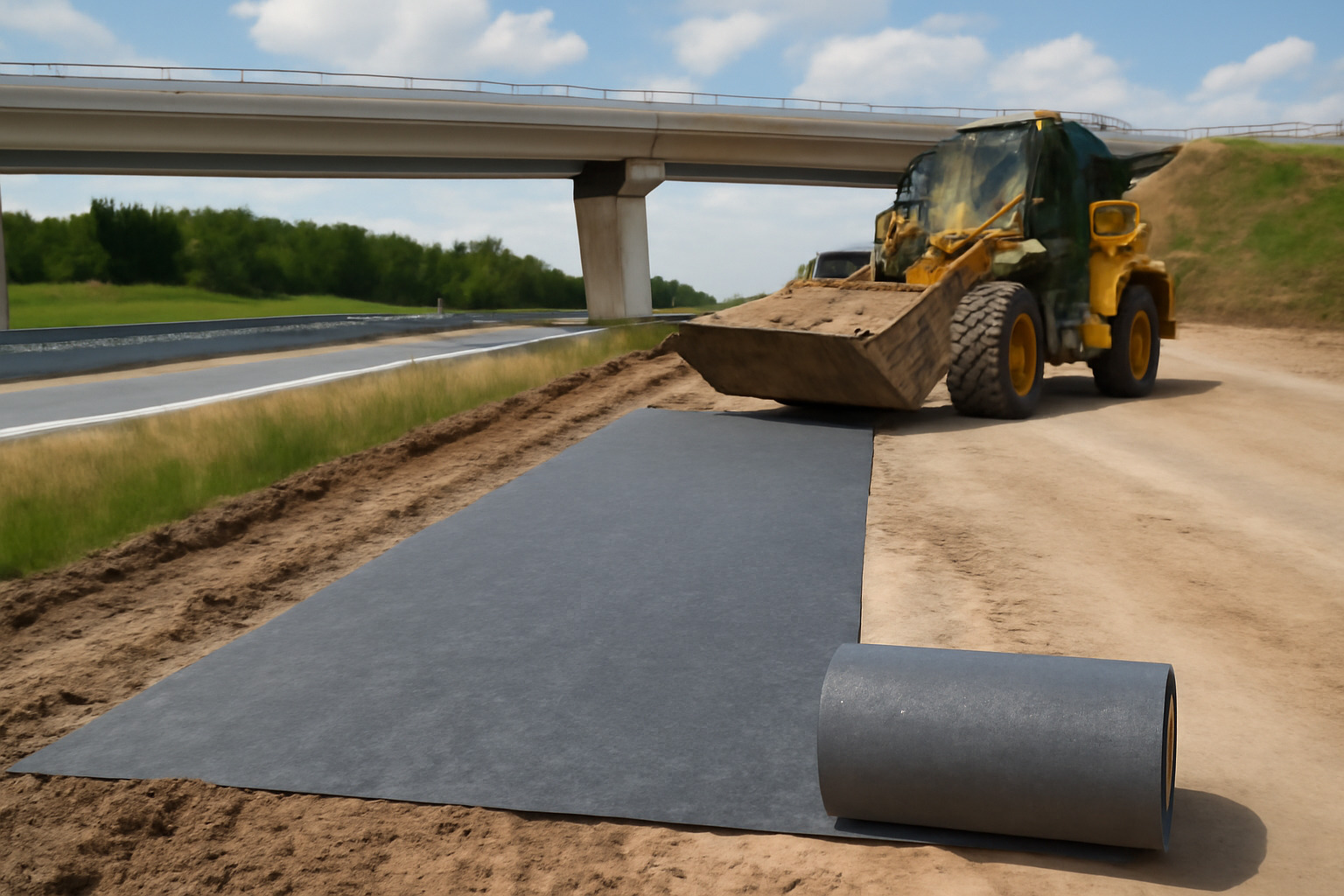
What is geotextile non-woven? Non-woven geotextile is the type of geotextile geosynthetic other than woven. It is called non-woven because it is not made by weaving, so how is it produced if it is not woven?
In non-woven production, the raw materials are joined using bonding or interlocking methods. There is also non-woven geotextile produced by a combination of these methods.

The bonding method uses machines (mechanical), chemicals, solvents or heat (thermal), or a combination of these. The interlocking method is usually done with needle punch or stitching techniques. Basically, the fibers used in geotextile are polypropylene (PP), polyester (PET) or a blend of the two.
Non-Woven Geotextile Functions
In general, non-woven geotextile has three main functions: drainage, filtration and separation. These three functions are possible because of the properties of non-woven geotextile itself.
The permeable nature (dense, with small pores) of non-woven geotextile lets liquids pass through the material while retaining solids. As a result, soil is not carried away by flowing water and the layers stay well separated.
Read Also: What Is Geotextile and What Are Its Functions

Drainage
Non-woven geotextile can be used as a passive element for conveying liquids or gases. Non-woven geotextile works well as drainage on its own, without other materials. It can also be used as a supporting material for other geosynthetics such as geomembrane and other materials.
Filtration
Filtration is another function of non-woven geotextile. In this role, non-woven geotextile retains fine aggregate particles. Filtration prevents fine particles from being washed out or scoured, so the two elements (liquid and aggregate) remain well separated.
Historically, this type of filtration was already in use by the mid-1960s, when geotextile was used on a massive scale across Europe.
Separation
As a separator, non-woven geotextile divides soil layers of different types and characteristics so that they do not mix.
Non-woven geotextile works as a separator by keeping the fine soil layer (subgrade) from entering the permeable granular layer. Put simply, the fine layer carried by water will not be washed away; it stays in position and does not mix with another layer of different particle size (base course).
Separation with non-woven geotextile is needed to ensure the long-term performance of the structure. The most common applications are highway foundations, railway track beds, dam walls and sea dikes.
Read Also: Woven Geotextile for Road Reinforcement
Differences Between Non-Woven and Woven
Judging by how it is made, geotextile comes in quite a few varieties. However, only two types are commonly used: woven and non-woven geotextile. Both are now widely used in construction and civil engineering projects. What distinguishes each type? See below.
Woven Geotextile
The main difference lies in how the material is made. Woven material is produced by weaving on high-tech machines. Yarns or thin tapes are interlaced into large sheets that are wound into rolls. Continuous, repeated weaving produces a uniform surface.

In terms of function, they are quite different. Woven geotextile has high tensile strength and can carry heavy loads, so it is better suited to and widely used for reinforcement and containment.
Although it is woven, in shape and appearance woven geotextile looks more like plastic than fabric. This also makes it watertight, so it offers no drainage. With its high load capacity, woven geotextile is commonly used in high embankment or slope protection projects.
Woven geotextile applications
The weaving process produces much higher tensile strength, making this material suitable for heavy-load projects such as road construction. Unlike non-woven geotextile with its many pores, woven geotextile has a less porous, almost watertight surface, which makes it unsuitable for drainage projects. Because water has difficulty passing through low-porosity woven geotextile, it would clog drainage channels.

Because woven geotextile has hardly any pores, it is ideal for erosion control projects. In some erosion control projects, surface water must be diverted or carried past so that it does not flow into the soil layers below. Other advantages of woven geotextile are high corrosion resistance and a relatively long service life.
This material has high tensile strength, so it is very suitable for road construction, mall parking areas, airport runways and car parks. Another advantage is its resistance to UV degradation, making it suitable for long-term use.
Non-Woven Geotextile
Unlike woven geotextile, which is made by weaving, this type is the opposite: it is produced without weaving. Non-woven material is made using bonding or interlocking methods. In bonding, fibers or film layers are joined with the help of machines, chemicals or heat. The interlocking method uses needle punch or stitching techniques.
The main functions of non-woven geotextile are filtration, separation and drainage, because its surface is dense with small pores. Despite this density, non-woven geotextile lets water and gas through while filtering out fine aggregate particles.
Non-woven geotextile resembles fabric in both texture and appearance. This material is usually classified by weight.
It offers high permeability and is usually used in projects involving liquids, such as drainage channels. It can also be used in projects focused on filtration, such as coastal protection and riverbank protection.
Non-woven geotextile applications
As explained above, non-woven geotextile can be used in construction and civil engineering projects, mainly for drainage, filtration and separation.
Basically, non-woven geotextile is quite flexible, more so than the woven type. This advantage makes non-woven geotextile very suitable for separation. The thickness and puncture strength of non-woven geotextile provide cushioning and protection for geomembrane in ponds, river canals, drainage, dams, coastal works, dikes, mining and landfills.
Other Articles

Geobag Applications for Flood Protection
Damage to dikes and dams is very common when the structure experiences water seepage, erosion, slope failure and natural disasters. These are the main problems that can lead to flooding (figure 1.1), which is why geobag flood protection is often needed. Special measures are needed to prevent flooding and provide protection when existing dikes or […]