


Dam vs Reservoir: What Is the Difference?
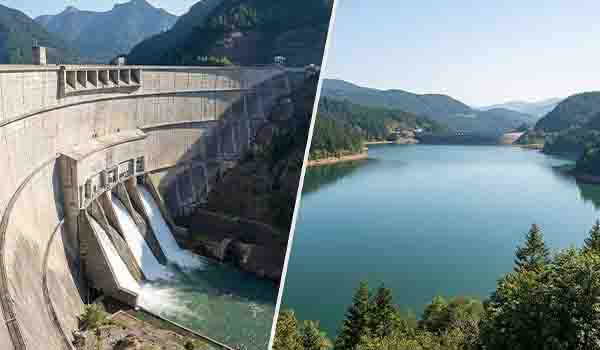
Petra friends, have you ever passed a vast body of water such as Jatiluhur or Gajah Mungkur and wondered what to call it? “What a huge dam!” or “What a beautiful reservoir!” The two terms, Dam and Reservoir, are often used interchangeably as if they mean the same thing. In civil engineering and water-resource management, however, they are two very different entities.
Whether you work in construction or simply want to learn more about the country’s infrastructure, understanding the distinction is essential. It is not merely about terminology but also technical functions, construction methods, and the materials used.
In this article, the Petra Nusa Elshada team will thoroughly examine the actual difference between a “Dam vs Reservoir.” Read through to the end!
Basic Definition: Structure vs Contents
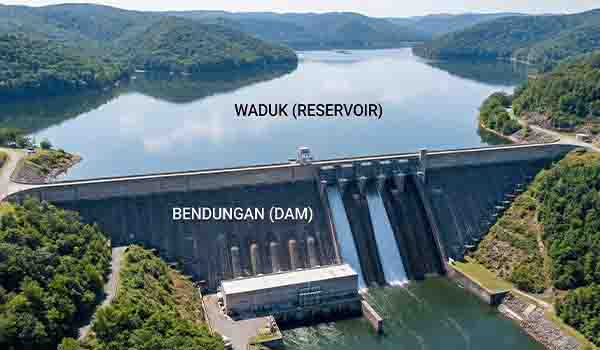
The first thing to understand is the basic concept. Imagine a glass filled with water. The glass is the physical retaining structure, while the water inside is the stored volume.
What Is a Dam? A dam is the physical structure. It is a massive construction built across a river or valley to hold back water flow. Thus, if you see a giant concrete wall or a towering earth embankment blocking a river, that is the dam. In English, it is called a Dam.
What Is a Reservoir? A reservoir, meanwhile, results from the dam. It is an artificial lake or water-storage basin formed upstream because the river flow has been impounded. Thus, the broad expanse of water where people often take photographs or fish is the reservoir. In English, it is called a Reservoir.
In short: The dam is the wall; the reservoir is the pool of water.
How They Form
Another striking difference is how they form. You may have heard the term “natural lake.” A reservoir resembles a lake, but it is not always created by humans.
- Dam Formation: Entirely engineered and built by humans. It is constructed using highly detailed civil-engineering calculations involving geotechnics, hydrology, and structural engineering.
- Reservoir Formation: Can occur naturally or artificially. An artificial reservoir forms after a dam is completed. A natural reservoir, however, can form when a major landslide naturally dams a river or when a volcanic crater fills with water.
Building Components and Structures
Technically, a dam is much more complex than a mere pile of soil or stone. This is where the “art” of civil engineering comes into play. A dam has several vital components that prevent it from failing while holding millions of cubic meters of water.
Several crucial parts of a dam include:
- Dam Body: The main water-retaining structure. It may be made from concrete, earth fill, or rockfill.
- Foundation: The part that transfers the dam’s loads to the underlying ground.
- Spillway: This is a safety feature. If the reservoir becomes too full, such as during a severe storm, water is released through it so that water does not overtop the dam crest, which could have fatal consequences.
- Intake: The water entrance leading to turbines, when used for hydropower, or irrigation channels.
A reservoir, by contrast, has no complex structural components because it is the body of water itself. Reservoir management focuses more on water quality and sedimentation , or shallowing.
Construction Materials & the Role of Geosynthetics
This interesting aspect often goes unnoticed. You may think dams are made only from cement and stone. In fact, modern material technology, particularly Geosynthetics, plays a key role in the safety of today’s dams.
Why is this important? Because a dam’s main enemy is water seepage (seepage). If water seeps through the dam body, the structure can collapse (failure).
This is where advanced materials also supplied by Petra Nusa Elshada play a role:
- Geomembrane: An impermeable plastic sheet often installed on the upstream face of a rockfill dam. It serves as the primary waterproofing layer, preventing reservoir water from leaking through the rocks.
- Non-Woven Geotextile: A porous fabric serving as a filter and separator. It is placed between the subgrade and fill material. It retains soil particles so groundwater flow does not carry them away while still allowing water to pass. This prevents internal erosion, or piping, within the dam body.
- Geogrid: Used to reinforce soil on dam slopes, making them more stable and resistant to landslides, particularly in earthquake-prone regions such as Indonesia.
Without these materials, a dam’s service life may be much shorter and its risks far greater.
Primary Functions: More Than Just Water
Despite their different forms, dams and reservoirs operate as an inseparable system serving many people’s needs. What are their functions?
- Agricultural Irrigation: This is the most traditional function. Reservoirs store water during the rainy season, and dams release it at controlled rates to rice fields during the dry season.
- Hydroelectric Power Generation: The potential energy of water falling from the dam’s height turns turbines. This is one of the cleanest forms of renewable energy.
- Flood Control: During heavy rainfall, dams hold water back so it does not immediately flow downstream toward cities or residential areas. Water is “stored” temporarily in the reservoir and then released gradually.
- Raw-Water Supply: The water used for bathing and drinking in major cities, supplied by municipal water utilities, often comes from reservoirs.
Tourism & Fisheries: These are additional reservoir functions. Floating net cages and boat tours create new sources of income for surrounding communities.
Types of Dams
You should know that not all dams have the same shape. Civil engineers design dams according to site soil conditions and topography.
Gravity Dam
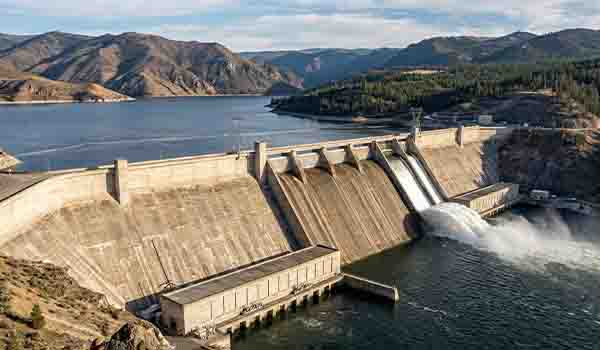
Relies on its own weight to withstand water pressure. It is usually made from mass concrete.
Embankment Dam
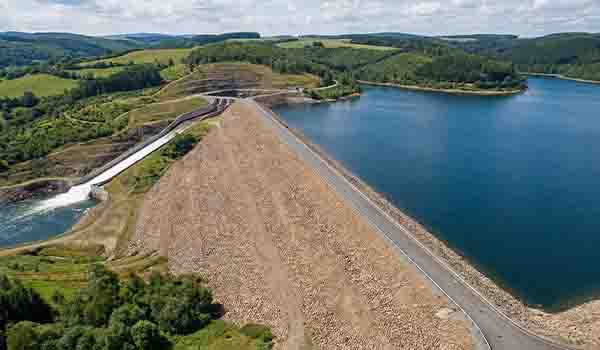
Made from compacted earth or rockfill. This type is most common in Indonesia because materials are readily available near project sites. This is also where Geosynthetics are most often used as impermeable liners.
Arch Dam
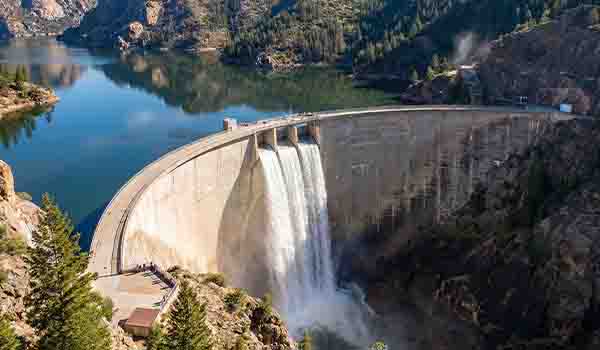
Curves toward the reservoir. It is extremely strong and is usually built in narrow valleys with hard rock walls.
Challenge: Reservoir Sedimentation
Have you heard reports about a reservoir becoming shallow? This is a major issue in the relationship between dams and reservoirs.
Rivers flowing into reservoirs carry silt and sand. Over time, this material settles on the reservoir floor. This process is called Sedimentation. If not managed, reservoir capacity declines drastically. A reservoir that originally held 1 million cubic meters of water may hold only 500 thousand cubic meters once filled with silt.
The solution? Routine dredging or tree planting upstream to prevent soil erosion, known as reforestation, is required. In addition, using Geotextile Tubes or dewatering bags can provide a modern solution for handling dredged sludge, making it easier to dispose of or reuse.
Conclusion: One Inseparable System
The distinction should now be clear. A dam is the strong barrier that withstands the load, a masterpiece of civil construction. A reservoir is the storage body, an artificial lake that supports agriculture, electricity generation, and our clean-water supply.
Each needs the other. A dam without a reservoir is merely a useless wall, while a reservoir without a dam would cause a flash flood.
Understanding the complexity of dam construction reveals the importance of high-quality materials. The selection of construction materials, from concrete to geosyntheticlayers, determines whether the dam remains strong for decades or fails within years.
Need a Consultation for Your Requirements?
If you are planning a water-infrastructure or soil-reinforcement project, or need the best geosynthetic solution for civil construction, infrastructure safety begins with selecting the right materials!
Feel free to consult the Petra Nusa Elshadateam. We supply a wide range of high-quality geosynthetics ready for delivery throughout Indonesia. Let us discuss your project needs today!
View Our Catalog: Catalog
Chat on WhatsApp Now: WhatsApp
Remember Geosynthetics, Remember Petra!
Other Articles

What Is Bronjong (Gabion)? Uses and Benefits
What is gabion? Bronjong (gabion) is a structure used to prevent erosion on slopes, generally used along riverbanks. However, quite a few people also use gabions to add beauty to an architectural design. A gabion is woven steel wire mesh in the shape of a cube or block, filled with rocks. It is usually used […]

Geotextile Separator or Stabilizer for Road Construction
Geotextile has been widely applied in road construction to make construction costs more economical. Used as a geotextile separator or stabilizer, it can reduce aggregate thickness and extend the service life of the road. A single layer of geotextile can typically save 1/3 of the aggregate base thickness for roads on soft to medium subgrade […]