


Geobag Dike Design for Ponds and Flood Control
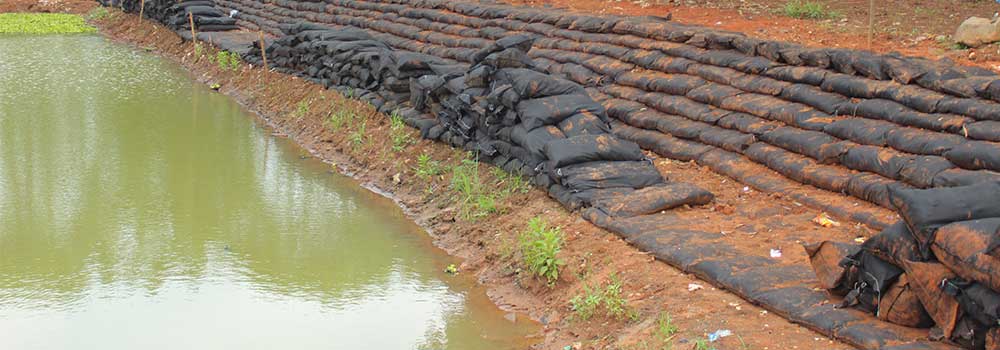
A dike is an earth structure built to hold back water or other liquids on one side, and geobag dike design offers a simple way to build one. With a dike, liquid is held back so it does not overflow into unwanted areas. Dikes do not only hold back water but also liquid mud. One example is the dike used for the Lapindo mudflow.
Dikes are usually built in a stepped shape with a layer of gabions. Instead of gabions, geosynthetic products can be used, such as geocell and geobags. With geocell, the shape can be adjusted to the geocell height, and geocell can provide reinforcement as a retaining wall. Geobags are simpler: just fill them with sand or soil and stack them. Below is a simple design for building a dike with geobags:

Geobag dike design
A dike built with geobags not only holds back water but also reinforces the dike so that its top can be used as an access road. The use of geobags should be matched to the height of the dike so that not too many geobags are stacked, reducing installation time on the dike.

Geobag dike design
Besides replacing gabions on dikes, geobags can also be used to build artificial dikes, stacked to form the dike structure. The advantage of this approach is that the existing soil does not need to be shaped into a dike; the filled geobags simply need to be stacked on top of one another. A geobag dike built this way can serve as a retaining wall during floods or to minimise coastal erosion, keeping some areas free of floodwater and protecting beach sand from being washed away. Below is a simple geobag dike:

Geobag dike design

Geobag dike design

Geobag dike design
Other Articles


DWC Pipe Joining with a Join Tracker
DWC pipe joining using a Join Tracker is a common method for creating a strong, secure connection between double-wall corrugated (DWC) pipes. The following are the general steps for joining DWC pipes with a Join Tracker: 1. Preparing Tools and Materials: DWC pipes to be joined. Join Tracker (pipe extraction tool). Joint rubber (gasket/rubber ring). […]