Geocell for Roads: Boosting Strength and Stability
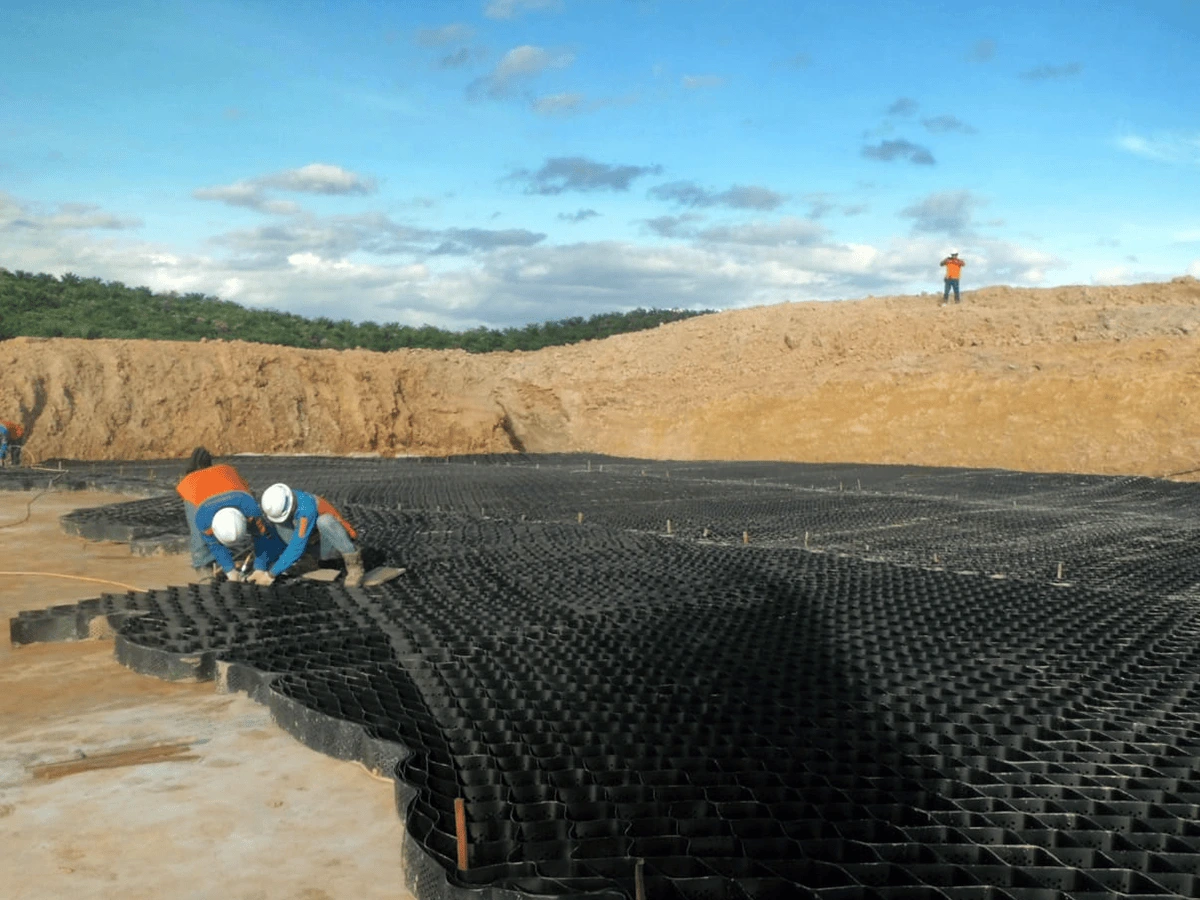
Geocell, the latest innovation in road construction, aims to improve the strength, stability and efficiency of road infrastructure development. This technology uses a cellular structure made of high-quality plastic, filled with granular material or cement to reinforce the soil foundation and reduce the risk of future road damage. Geocell has been proven to deliver major benefits, especially in road construction in areas with difficult soil conditions and diverse environmental challenges.
Definition and Brief History of Geocell
Geocell technology was first introduced in the late 1970s as part of innovation in geotechnics and civil engineering. Initially, geocell was used mainly to reinforce weak soil and improve slope stability, especially in landslide-prone areas and areas with inadequate soil layers.
As technology developed, geocell use expanded and became a leading solution for building roads, tunnels, coastal reclamation projects and large building foundations. Geocell is a flexible cellular structure system, usually made of polymers such as polyethylene or polypropylene, specially designed to withstand vertical pressure and distribute loads evenly.
The main geocell material is highly resistant to a wide range of environmental conditions, including extreme temperatures, UV exposure and contact with chemicals. This makes it suitable for many challenging soil and environmental conditions and able to last for a considerable time. Geocell use in road construction has now become an important part of modern infrastructure development standards in many countries, including Indonesia.
Origins and technological development
Geocell technology originated from geotechnical research aimed at increasing soil strength without major excavation or expensive materials. Through continued development, innovators found that a cellular structure filled with granular material could significantly strengthen soil layers. Several key factors drove geocell development, including the need for low-cost, efficient solutions for roads in remote areas and efforts to reduce the environmental impact of large construction projects.
Over time, innovations in geocell manufacturing and design had a major impact on its use. Examples include lighter yet still strong geocells and geocells that can be customized to specific project requirements. In Indonesia, geocell has become widely known over roughly the last decade and is widely applied in building village roads and toll roads, as well as projects rehabilitating damaged and landslide-affected roads.
Working Principle and Structure of Geocell
Geocell works on the main principle of creating a cellular structure that protects the soil beneath it. When applied to road construction projects, this structure helps distribute loads evenly across the entire supporting soil surface. The cells can be filled with various materials such as gravel, sand, cement or high-strength crushed stone mixtures.
The use of geocell in road construction is based not only on its mechanical strength, but also on its ability to control soil movement, reduce the risk of erosion and increase soil bearing capacity. By filling the cells that are formed, geocell strengthens the foundation and prevents saline, soft or waterlogged soil from undergoing uncontrolled consolidation.
In addition, quick and easy installation makes this technology increasingly attractive to contractors and infrastructure developers. Geocell can speed up road construction, reduce the need for soil excavation or wasteful fill materials, and at the same time improve environmental sustainability.
Main components of the geocell structure
The geocell structure consists of a series of interconnected cells, usually made of strong, elastic polymer. Each cell is hexagonal or rectangular and tightly arranged, producing a network that is flexible yet very sturdy. When filled with granular material, this structure withstands vertical pressure from traffic and other mechanical loads very well.
Besides the basic polymer material, geocell is now also available in various versions to suit requirements, including UV-resistant coatings, chemical resistance and specific degrees of curvature to suit rocky or uneven terrain. The advantage of this structure is its ability to adapt to soil conditions in the field and to local geomorphological features, delivering optimal, long-lasting results.
Benefits of Using Geocell in Road Construction
The use of Geocell brings benefits that concern not only structural strength, but also sustainability and cost efficiency. It is therefore no surprise that this technology is increasingly applied in road construction projects across Indonesia, both in cities and in remote areas with weak soil.
The main benefit of geocell is improved soil foundation stability, which can significantly reduce the risk of road damage from traffic loads and environmental factors such as landslides and erosion. Geocell can also extend road service life by reducing the frequency of repairs and maintenance, which are often costly.
Besides strength, another benefit of this technology is its environmental friendliness. By using natural materials and reducing the need for large-scale soil excavation, geocell technology helps reduce the ecological impact of road infrastructure. It also lowers carbon emissions associated with transporting construction materials and excavating soil.
Geocell can also accommodate a wide range of soil conditions, including soft soil, sandy soil and unstable crushed-rock soil. Ultimately, this opens up opportunities to build roads in areas previously considered unsuitable because of extreme soil conditions.
Positive impact on national infrastructure development
The positive impact of applying geocell technology to national infrastructure development is very significant. In Indonesia, with its diverse soil and climate conditions, geocell can be an innovative solution to many field challenges. Sturdy, durable infrastructure can certainly accelerate development, improve accessibility and reduce future road maintenance costs.
Besides economic benefits, this innovative technology also supports government programs for sustainable development and carbon emission reduction. Geocell technology therefore not only provides a technical solution, but also supports the national vision of developing environmentally friendly, sustainability-oriented infrastructure.
Geocell Installation and Maintenance
Integrating Geocell into road construction must follow the proper procedure to achieve maximum results. Correct installation ensures the structural strength and long service life of the road being built. The process generally includes soil preparation, geocell placement, material filling and ongoing quality control.
Given the complexity and importance of this process, understanding the installation stages is crucial for engineers and contractors who want to apply this technology optimally. The entire process must be carried out carefully, according to standards, and with attention to field conditions and local soil characteristics.
Besides installation, routine maintenance and inspection are important for ensuring the sustainability and performance of geocell-based roads. Make sure the cells do not become clogged, as this can affect load distribution and overall structural strength.
Initial installation and preparation
The initial stage of geocell installation involves preparing the subgrade. The ground surface must be cleared of organic matter, roots or unstable particles. The soil is then leveled and compacted optimally to prevent unwanted movement or settlement later. Once the subgrade is ready, the geocell is installed in sequence, since the structure must be interconnected and tightly fitted.
Installation is usually carried out by controlling the tension and position of each geocell unit to prevent folds or mechanical damage during material filling. At this point, accuracy and precision are essential because small oversights can greatly affect the final strength of the road structure being built.
Granular material filling and compaction
Once the geocell is properly installed, the next step is filling the cells with granular material such as gravel, coarse sand or crushed stone of a specific size. These materials are chosen for their ability to carry loads and prevent deformation. Filling is done in stages and must be thoroughly compacted to avoid air voids that could reduce bearing capacity.
In this process, filling speed and compaction level must be tightly controlled for optimal results and to ensure the structure does not weaken in the future. After the cells are filled, visual inspection and strength testing are carried out to assess installation success. If the results are satisfactory, work proceeds to constructing the upper road layers according to the design.
Maintenance and periodic inspection
Maintaining the strength and stability of geocell-based roads requires routine maintenance and periodic inspection. Inspections should cover physical damage, open cells or deformation caused by traffic loads or natural factors. Repair any damage immediately so the infrastructure’s condition does not worsen.
Besides visual inspection, periodic testing of structural strength and stability is also necessary. This maintenance not only preserves road quality, but also helps extend service life and reduce long-term repair costs. Proper installation and maintenance are therefore an important investment in ensuring the health and sustainability of road infrastructure built with this innovative technology.
Other Articles

Geotube for Coastal Protection and Erosion Control
Have you ever seen a large fabric tube along the shore? That is called a geotube, and it is a proven method of geotube erosion control. In general, a geotube is a geosynthetic product made of geotextile and shaped like a large tube or cylinder. One function of a geotube is to act as an […]