


Geomembrane for Final Disposal Sites and Landfills
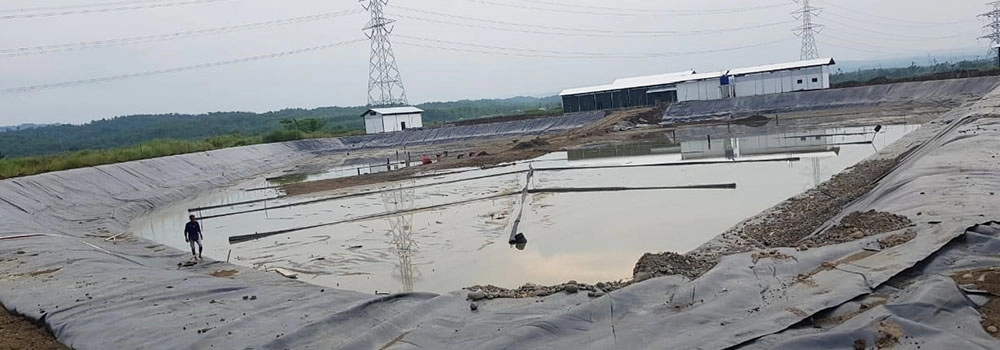
The Role of Geomembrane for Landfills and TPA (Final Disposal Sites)
- Geomembrane used as a cover layer reduces the rainwater that seeps into the waste mound, which in turn reduces leachate at the landfill.
- It controls the spread of odors and captures gas at the top of the waste mound as a form of pollution control.
- It inhibits the spread of disease-causing bacteria and insects such as mosquitoes and flies.
- It prevents soil erosion at the landfill.
- It improves the stability of the waste mound.

Why Applying Geomembrane at Landfills Matters
If geomembrane is not applied at a landfill, the following problems can occur:
- Groundwater contamination: hazardous substances contained in the waste can pollute groundwater, threatening water sources and the surrounding environment.
- Soil contamination: waste in the mound can seep into the soil and pollute the surrounding area, disrupting vegetation growth and soil sustainability.
- Spread of hazardous gases: without a protective layer, organic matter in the waste decomposes and produces hazardous gases such as methane and hydrogen sulfide. These gases can spread into the surrounding environment, affecting air quality and the health of local residents.
- Higher fire risk: without effective control measures, waste at the disposal site may be more prone to fires, increasing the risk of fire and endangering the environment and the safety of residents.
- Visual blight: the lack of a protective layer leaves the disposal site exposed and spoils the landscape.

In short, using geomembrane at waste disposal sites is an essential measure to prevent environmental pollution, protect water resources, maintain air quality and ensure public safety. Without geomembrane, the harmful impact on the environment and human health will increase. That is why appropriate protective measures must be used throughout the waste disposal process.
How to Install Geomembrane at a Landfill
- Site preparation: clean the base of the landfill so the surface is level and free of sharp objects that could damage the geomembrane.
- Geotextile placement: roll out geotextile as an underlayer to protect the geomembrane.
- Geomembrane placement: roll out the geomembrane across the landfill area. Avoid stepping on the geomembrane to prevent damage.
- Geomembrane seaming: geomembrane panels are joined using welding machines designed specifically for geomembrane.
- Geomembrane anchoring: anchoring is carried out at the outer edges of the geomembrane.
Which Geomembrane Specifications Suit Landfills?
- Environmental factors: hot climates require geomembrane that resists high temperatures and UV light, while humid climates require geomembrane that resists corrosion.
- Water table: the higher the water table, the higher the performance the geomembrane needs.
- Type of waste: the type of waste affects how it interacts with the geomembrane.
- Service life: the longer the required service life, the thicker the geomembrane needs to be.
- Thickness: geomembrane thickness is closely related to its durability.
Other Articles

Geotextile Functions for Railways, Farming and Drainage
Just like road construction, railway construction certainly requires the application of geotextile. One of the key geotextile functions here is to act as a separation layer, or separator, between the soil and the underlying subsoil. The separator applied will certainly not disrupt groundwater circulation. Another advantage of this layer is that it effectively dampens the vibrations […]

Geotextile Innovation Speeds Up Indonesia’s Toll Road Projects
Toll road infrastructure development in Indonesia continues to be accelerated at an extraordinary pace. From the expanding Trans-Java Toll Road network to the pioneering Trans-Sumatra Toll Road, the government is targeting efficient logistics connectivity in a short time. However, behind the race against deadlines and the wave of inaugurations lies a crucial technical challenge that […]
