


Role of Wastewater Geomembrane in Treatment Systems
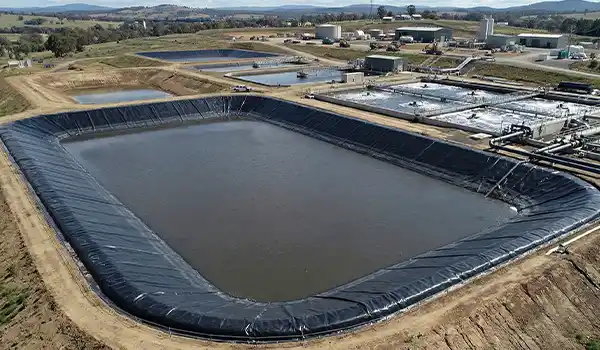
Hello, Petra friends! Have you ever wondered where the dirty water left over from factories, hospitals or even nearby landfills goes? As industry and populations grow rapidly, the volume of waste generated each day has reached an extraordinary level. If not managed properly, this waste can become a ticking time bomb for environmental sustainability and public health. This is where Wastewater Treatment Plants (WWTPs) play a crucial role.
However, simply building a WWTP pond is not enough. Imagine if the waste holding pond leaked and slowly seeped into the ground. All the hazardous chemicals, heavy metals and pathogenic bacteria would directly contaminate the groundwater reserves we normally consume. To prevent such an ecological disaster, modern civil and environmental engineering relies on an exceptionally tough lining material. This material has become the central element in today’s waste management and sanitation systems. Let’s explore waste treatment geomembrane in depth and see why its role is truly irreplaceable.
What Exactly Is Geomembrane?
For those who aren’t yet familiar with the term, geomembrane is a polymer sheet specifically designed to be impermeable to water and gas. Visually, it resembles an exceptionally thick, flexible black carpet or tarpaulin, yet it has very high mechanical tensile strength.
The primary raw materials most often used to manufacture geomembrane for heavy industrial applications are High-Density Polyethylene (HDPE) and Linear Low-Density Polyethylene (LLDPE). During production, these polymer resins are mixed with carbon black (around 2–3%), antioxidants and UV stabilizers. This mixture makes geomembrane resistant not only to physical pressure from solid objects, but also to intense sunlight for decades without cracking or material degradation.
Why Do Waste Ponds Need Liners?
You may be wondering, “Why not use an ordinary earthen pond or simply line it with concrete?”
This is a perfectly reasonable question. In the past, many industries simply excavated the ground to create waste holding ponds (open earthen ponds). This practice proved extremely dangerous because soil naturally has pores. Toxic liquids or leachate can easily seep downward (infiltrate) and permanently contaminate groundwater aquifers.
Meanwhile, concrete or cement may look solid at first, but it has a critical weakness when used to hold pools of corrosive chemicals. Strong acids easily erode concrete. In addition, static ground movement or even a minor earthquake can create hairline cracks in a concrete liner. Once the concrete cracks, waste can escape and seep underground undetected. Unlike concrete, geomembrane is elastic (flexible), allowing it to follow ground movement or settlement (differential settlement) without tearing or breaking.
Main Functions of Geomembrane in a WWTP
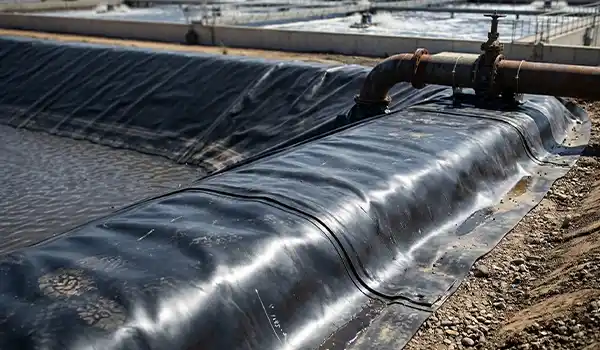
Using geomembrane in a waste treatment system offers a range of outstanding technical benefits. Here are some of the main roles that make it a superior product:
1. Absolute Leak Protection (Impermeable Liner)
The primary function of geomembrane is, of course, to serve as an impermeable liner. HDPE has extremely low permeability, with water absorption close to zero (typically a hydraulic conductivity below 1×10^-12 cm/second). This means that as long as it is installed correctly, without holes or seam defects, liquid waste can never penetrate the material. This provides complete assurance that soil formations and water sources around an industrial facility remain pure and free from contamination hazards.
2. Exceptional Chemical Resistance
Industrial wastewater, especially from metal processing, textile and chemical manufacturing sectors, often has an extremely high or low pH, whether highly acidic or strongly alkaline. Corrosion will occur quickly if it comes into contact with ordinary plastic or cast concrete. Remarkably, high-quality HDPE geomembrane for sale offers excellent resistance to a broad spectrum of aggressive chemical liquids, including dilute sulfuric acid, organic solvents and heavy metal deposits. The membrane surface will not react, melt or deteriorate even after years of immersion in these harsh liquids.
3. Optimized Biogas Capture
In palm oil mills or large-scale livestock operations, organic wastewater (such as POME—Palm Oil Mill Effluent) produces enormous quantities of methane during anaerobic decomposition and fermentation. Instead of releasing this methane into the open air as a greenhouse gas that worsens global warming, geomembrane is used as a pond cover (floating cover lagoon). This flexible layer traps the methane so it cannot escape into the atmosphere. The captured gas can then be extracted through a dedicated piping system and used as the primary fuel for a biogas power plant. This is a remarkable innovation that turns harmful waste into profitable renewable energy!
4. Maintaining Slope Stability and Preventing Erosion
Besides protecting the basin floor, geomembrane is also used to cover the embankment walls or slopes of waste ponds. Without this tight wall lining, rippling water created by WWTP aerators and runoff from heavy rainfall can slowly erode the soil structure. Over time, this constant erosion can cause retaining walls to slide and the pond to collapse. With this protective sheet installed, the pond’s engineered geometry remains precise while the embankment foundation stays safe from abrasion.
Geomembrane Applications Across Various Sectors
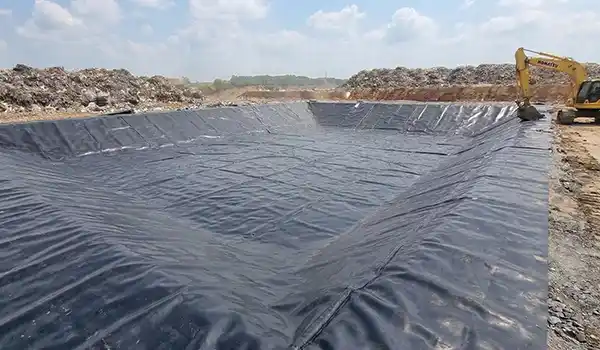
It is important to note that this protective role is not exclusive to a single industry. Almost every modern commercial manufacturing sector must include this system to meet government Environmental Impact Assessment standards. Examples of geomembrane applications include:
- Landfills: Used as a landfill liner at the bottom of a vast mass of waste to intercept highly toxic leachate before it reaches residential areas below. Geomembrane is also used as a cover (capping) so rainfall does not soak the waste pile and increase the volume of leachate.
- Mining: Gold or copper washing tailings ponds absolutely require thick geomembrane to contain toxic cyanide wastewater left over from mineral ore extraction.
- Palm Oil Industry: Essential for POME cooling facilities, ponds that cultivate beneficial waste-consuming bacteria and high-value biogas capture centers.
Geomembrane Selection Standards and Criteria
You must not be careless when planning a geomembrane purchase for a WWTP project. Manufacturers must meet international benchmarks, the most prominent of which is the GRI GM13 standard issued by the Geosynthetic Research Institute. This standard provides reference parameters for testing tensile strength, tear resistance, resistance to natural stress cracking and material weathering performance under intense UV exposure.
For geomembrane used with hazardous waste, civil engineers recommend a membrane thickness of no less than 1.5 mm to 2.0 mm. Using a liner that is too thin (below 1.0 mm, for example) carries a high risk of tearing due to abrasion from sharp rock fragments in the ground or the hydrostatic pressure of the water above it. Naturally, geomembrane prices on the market fluctuate and depend heavily on thickness in millimeters and the purity of the virgin resin used by the manufacturer. It is highly inadvisable to be tempted by exceptionally low prices if the liner appears to use low-quality recycled plastic, as the resulting leak could cause a disaster and lead to fines worth trillions of IDR from the environmental ministry.
Understanding the Geomembrane Installation Process
Even the strongest base material in the world can do little if the joining process (seaming) is performed incorrectly. Here is an overview of the crucial stages when field contractors install this system on WWTP infrastructure:
- Subgrade Preparation
The excavated base must be hardened or compacted with heavy equipment and completely cleared of roots, sharp rocks and debris. If the area is too gravelly, the team generally first lays a cushioning textile called non-woven geotextile so the geomembrane rests on a soft surface without the risk of puncture. - Deployment
The enormous geomembrane rolls are laid out with great care. The placement layout must be planned intelligently to minimize the percentage of the area requiring seams. - Seaming Process (Thermal Welding)
This is the key to keeping the pond leak-free. Professional technicians join the ends of two sheets using a heating tool called a Hot Wedge Welder, which neatly melts the material surfaces. In addition to this heavy machine, they use a special high-temperature melting gun called an Extruder to patch corner details or curves around piping areas. - Quality Testing (QC Test)
Once all seams are completed, the contractor must carry out a rigorous inspection. This evaluation uses high-pressure air injected into the weld channel (an Air Pressure Test) or air suction (a Vacuum Box Test).
For industrial landowners, ensuring that the work is handled by a supervisor or contractor with official certification is an absolute requirement.
The Right Investment for the Environment and Business
In conclusion, including a budget for waste treatment geomembrane liners in a project’s cost plan is not wasteful spending at all. It is a pillar of technical responsibility that prevents a chain of future disasters, from containing groundwater contamination and strengthening waste reservoir walls to enabling methane harvesting that reduces operating fuel costs.
Make sure you work with the right partner! At PT. Petra Nusa Elshada, we are ready to provide comprehensive support for the success of your infrastructure installation. We not only distribute robust material lines such as specialized polymer piping, but also provide access to premium-quality geosynthetics that improve the safety of your sanitation and waste facilities (and can even be easily integrated with our superior spiral pipe specifications).
Need a Consultation for Your Requirements?
Are you currently preparing the design of a WWTP center, expanding a corporate landfill area or planning repairs to an old holding dam that has begun to corrode?
Feel free to consult the Petra Nusa Elshada team. We supply a wide range of high-quality geosynthetics ready to ship throughout Indonesia. Let’s discuss your project needs now!
Check our catalog: Click here
Chat on WhatsApp Now: Click here
Remember Geosynthetics, Remember Petra!
Other Articles

HDPE Geomembrane Applications Across Industries
Main Functions of HDPE Geomembrane Seepage prevention: a geomembrane layer acts as a waterproof, anti-seepage liner that actively prevents moisture ingress and leakage, which underpins most HDPE geomembrane applications. Improved soil stability: it can be used to improve the stability and load-bearing capacity of soil. It can reinforce soil structures such as road subgrades, reduce […]

Woven Geotextile vs Non-Woven Geotextile
Woven Geotextile Woven geotextile is a woven geosynthetic material made from PP or PET with good resistance to chemical compounds and microorganisms. This material has the following properties: 1. High Tensile Strength2. High Puncture Resistance3. High Tear Strength Woven Geotextile Functions A. Subgrade Stabilization Known as a high-tensile-strength geosynthetic material, this product can reinforce subgrade, especially […]

Geotextile Sewing Machine and Sack Bag Closer
Before introducing the geotextile and sack sewing machine, let us briefly explain what geotextile is. Woven geotextile and non-woven geotextile each have their own advantages depending on how they are used on the ground. Geotextile is made from synthetic fibers with added ultraviolet protection, using Polypropylene Polymer (PP) or Polyester (PET), woven or knitted by […]