



Geopipe Installation: Step-by-Step Guide
Subgrade Preparation for Geopipe Installation For geopipe installation, the geopipe is placed on prepared ground or in a trench dug specifically for it, at the design depth. If the material beneath the geopipe is subgrade soil, it must be compacted to 95% of Standard Proctor compaction to minimise pipe deformation during its service life. Read […]

Geomembrane Uses and Benefits in Construction
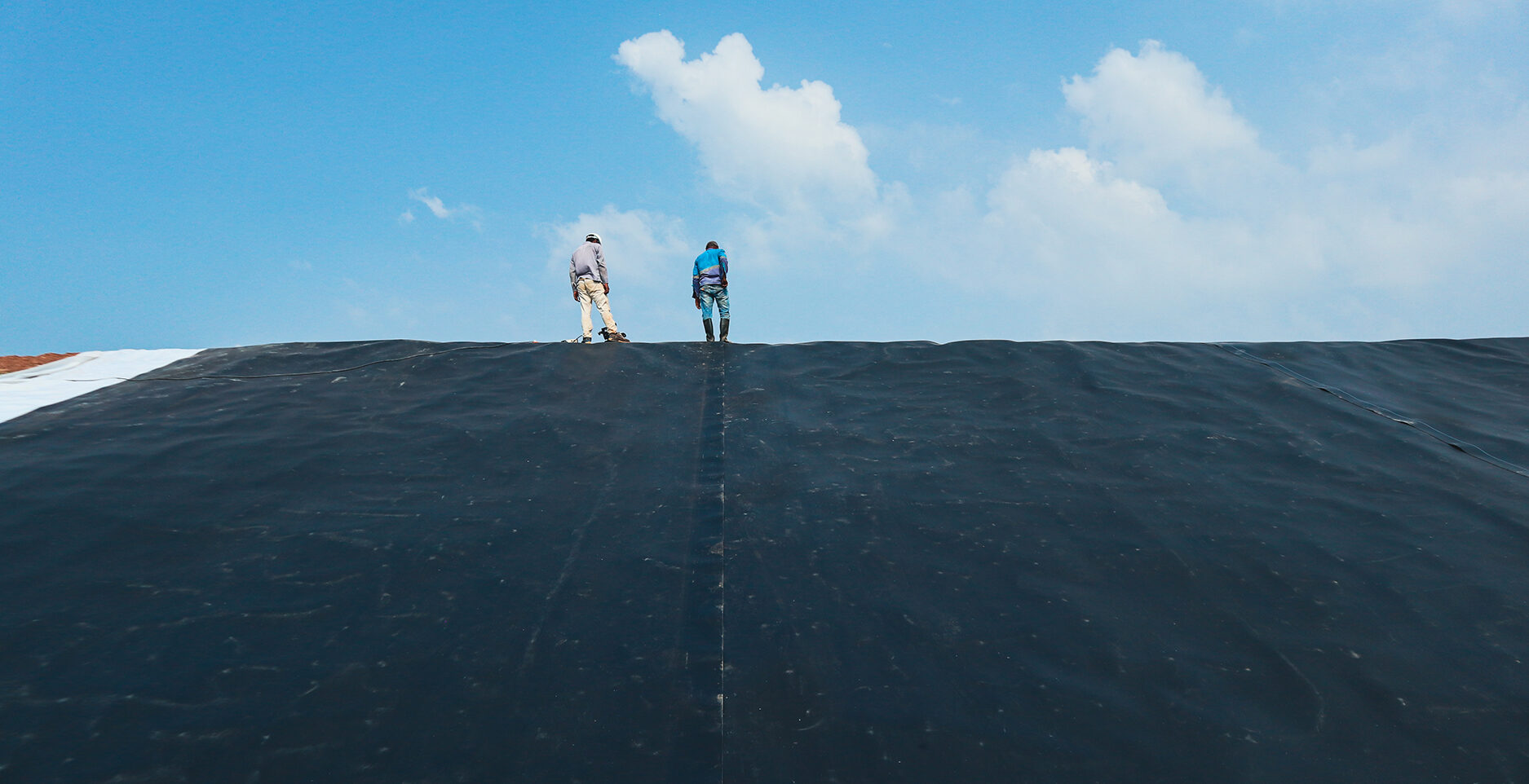
Geomembrane is a type of geosynthetic used as a waterproof liner, made from synthetic plastic-like materials. Geomembranes are generally produced from thin polymer sheets, but they can also be produced by impregnation. Here are the main geomembrane uses. HDPE geomembrane can also be used as a waterproof layer to separate solids and liquids, whether waste […]

Types of Geogrid: Uniaxial, Biaxial and Triaxial
Here are the types of geogrid and their functions. Several types of geogrid are available on the market, but four are commonly used: uniaxial geogrid, biaxial geogrid, triaxial geogrid and polyester geogrid. Types of Geogrid Uniaxial Geogrid Uniaxial geogrid has long, elongated apertures and is manufactured as an integral structure. It can be made from […]

Geocomposite for Road Construction and Landslide Control
Composite geotextile (geocomposite) is a combined material made of non-woven geotextile and high-strength polyester yarn woven in 2 directions. It functions as reinforcement and separation at the same time and can carry water horizontally [in-plane drainage]. Read also Woven Geotextile Advantages of geocomposite geotextile: UV resistant. Resistant to chemicals. Cost-effective. Flexible and fairly easy to […]

Visual Soil CBR Identification in the Field
Soil CBR identification. To determine the CBR of a soil precisely, tests must be carried out in accordance with SNI 1738:2011 using a field CBR apparatus or a DCP (Dynamic Cone Penetrometer). This requires certified specialists to perform the CBR test, interpret and process the data, and make recommendations based on the results. For […]

Geotextile Joining Methods: Overlap and Sewing
Geotextile is used as a reinforcement and separation layer for embankments on soft soil. Geotextiles on the market come in rolls with a standard width of 4 m and lengths of 50 m, 100 m, 150 m and 200 m, so geotextile joining methods matter on every project. That is why the quality of geotextile […]