


Palm Oil Plantation Road Pavement with Geocell: Case Study

Background: Tackling Kalimantan’s Soil Challenges
West Kalimantan is known for challenging subgrade conditions. In many plantation areas the soil tends to be soft, has a low CBR (California Bearing Ratio) value, and is highly sensitive to changes in moisture content, which makes a geocell palm oil plantation road an attractive solution.
Before this project, the plantation access road was often badly damaged. With trucks carrying tens of tonnes passing continuously, the stone or aggregate placed on top slowly “sank” into the mud. The result was very deep wheel ruts (rutting). Left unchecked, the risk of trucks sinking and getting stuck in mud became very high, ultimately halting the harvest supply chain.
The conventional method of constantly adding new aggregate proved inefficient in both cost and time. What was needed was a technical solution that could carry the load while locking the road structure in place so it would not spread out. This is where geosynthetics come in.
Technical Solution: Geocell 7.5 cm Combined with Woven Geotextile 250
To solve this problem permanently, our technical approach used a two-layer reinforcement system: Woven Geotextile 250 as the separation layer and Geocell 7.5 cm as the aggregate confinement structure (3D confinement).
1. Bottom Layer: Separation with Woven Geotextile 250
The first step after levelling the subgrade was laying Woven Geotextile 250. This woven material has high tensile strength.
Its technical role is crucial: it acts as a separator between the soft, wet subgrade and the aggregate/fill above it. Without geotextile, the good fill material mixes (pumping effect) with the subgrade mud under wheel loads, and the road breaks down again. The geotextile also spreads local stresses (wheel loads) more evenly over a wider area of subgrade.
2. Top Layer: Three-Dimensional Confinement with Geocell 7.5 cm
On top of the geotextile, we installed the star material: Geocell. With a panel height of 7.5 cm, the geocell is pulled and stretched into a honeycomb shape and then filled with aggregate (either sirtu sand-gravel mix or crushed stone).
In soil mechanics terms, geocell works through Lateral Confinement. When heavy truck wheels press on the road surface, aggregate normally moves or spreads sideways (making the road sag in the middle and bulge at the edges). The geocell walls hold this lateral movement back completely. The infill inside the cells is forced to stay tight and dense, creating a solid stiff-slab effect (mattress effect) under the wheels.
How It Works and Results on Site
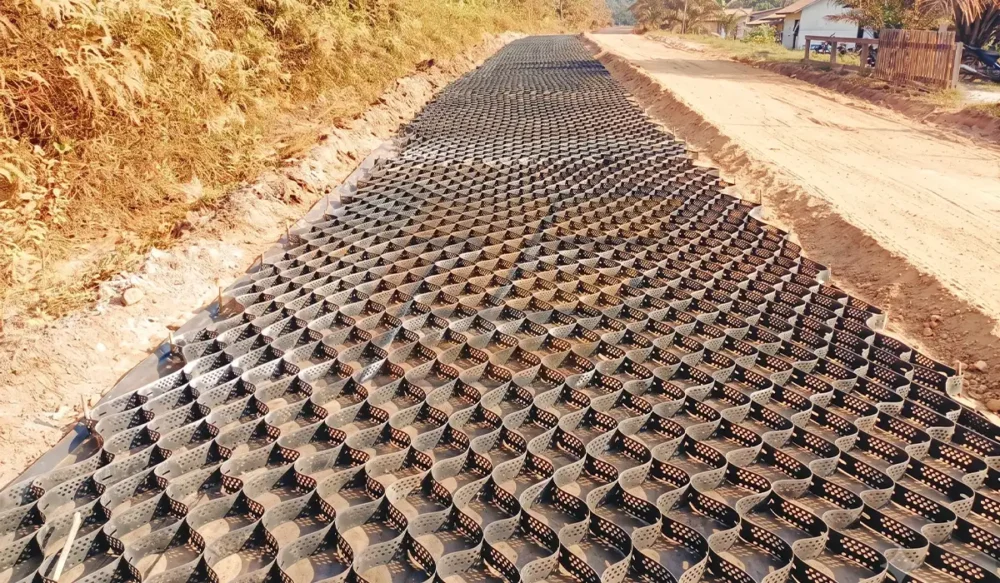
After the 3,984 m² road area was completed with the geocell and geotextile system, the plantation road showed significant mechanical improvements. Here is how the solution addressed the challenges on site:
- Infill Stays Locked in Place
The geocell walls create frictional resistance and active confinement. The aggregate inside is tightly locked, so its density is maintained. - Aggregate No Longer Spreads Sideways
This is the main reason the road no longer fails. Shear stress from truck tyres is resisted by the cell walls, eliminating the risk of aggregate spreading onto the road shoulders. - Vehicle Loads Spread Over a Wider Area
The system converts the vertical compressive force (point load) from heavily loaded truck tyres into horizontal forces distributed over a wide area. - Higher Subgrade Bearing Capacity
More even load distribution means the stress reaching the subgrade is much lower, so the road can carry loads beyond the bearing limit (CBR) of the original soil. - Drastically Reduced Risk of Sinking
Thanks to the combination of geotextile tensile strength and the stiff slab formed by the geocell, tankers and FFB (fresh fruit bunch) trucks can pass safely without fear of getting stuck in the ground. - Reduced Wheel Ruts (Rutting)
Because the aggregate is confined vertically, the plastic deformation (tyre tracks) that usually forms along wheel paths hardly occurs. - Road Surface Stays Level
The structural stiffness of the “honeycomb” system keeps the road profile stable. - More Uniform Settlement
Even if settlement occurs due to peat or soft clay underneath, it will be uniform settlement, not the differential settlement that makes roads wavy and cracked. - Road Remains Stable Under Heavy Vehicles
Repeated dynamic loads from plantation vehicles are absorbed and dampened very well by this flexible pavement structure. - Less Need for Routine Repairs
In the end, all these structural improvements lead to economic efficiency. The company no longer has to send heavy equipment regularly for re-grading or to add new aggregate after every rainfall.
Conclusion
This West Kalimantan project proves that a technical approach using geosynthetics is far superior to conventional soil pavement methods, especially on extreme palm oil plantation terrain.
Using Geocell 7.5 cm and Woven Geotextile 250 from Petrane created a road structure that not only withstands repeated loads from heavy vehicles, but also provides long-term stability that greatly reduces maintenance costs.
Other Articles
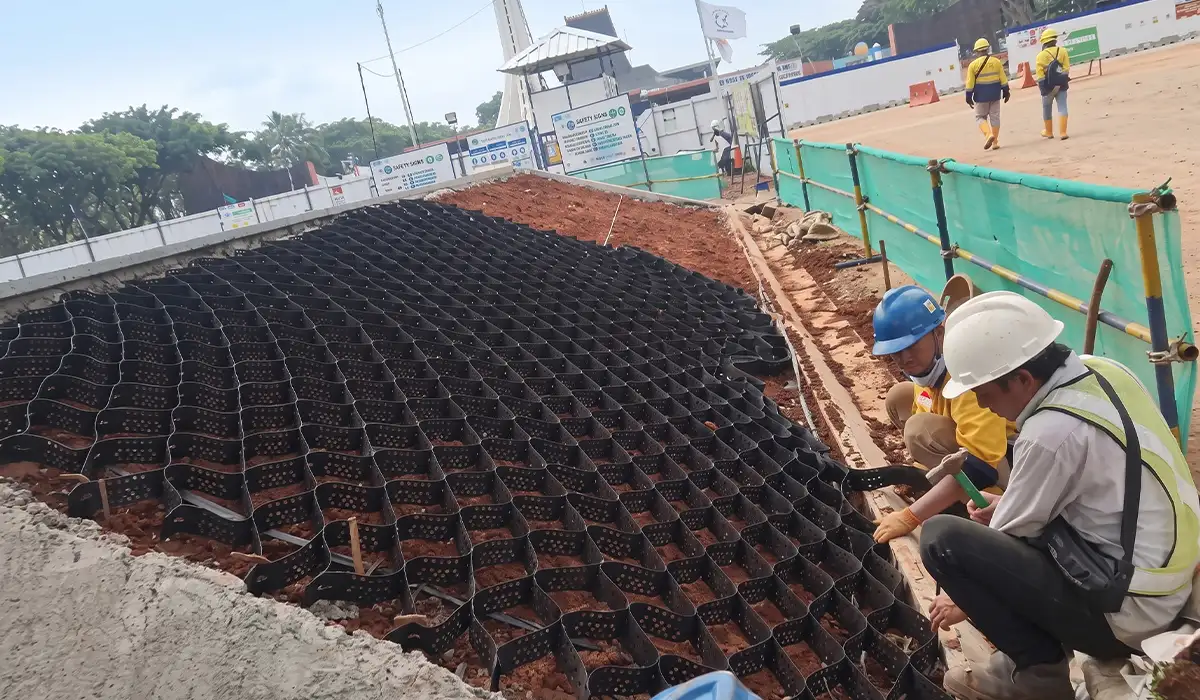
Geocell Slope Protection and Roads at TMII Jakarta
Project Background & Challenges TMII (Taman Mini Indonesia Indah), one of Indonesia’s largest recreational and cultural icons, has a road network that winds through various man-made and natural landscapes. One of the main challenges on this 2,568 m² geocell slope protection project was a slope directly adjacent to road infrastructure. Without adequate protection, the slope […]

