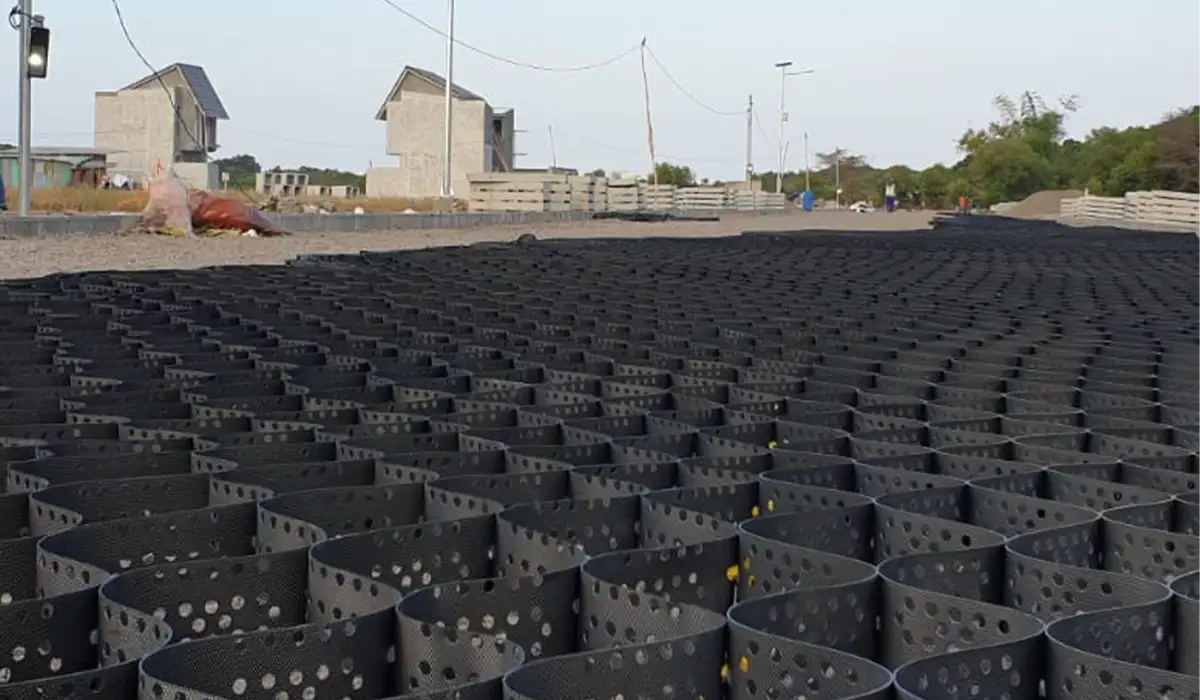
Geocell Warehouse Access Road for Heavy Trucks in Banten

Background: Why Do Warehouse Roads Fail So Often?
Before discussing the solution, you need to understand the root of the problem. This geocell warehouse access road in Banten was designed to carry static and dynamic loads from fully loaded heavy trucks and trailers. The main problems that typically occur in such conditions include:
- Excessive load concentration at a single point, causing excessive stress on the subgrade.
- Lateral shear forces from vehicle wheels that push the foundation aggregate sideways.
- Wheel ruts (rutting) caused by plastic deformation of the foundation layer.
If left unchecked, the soil undergoes differential (uneven) settlement, which ultimately damages the road structure above.
Technical Solution: Why 15cm Geocell?
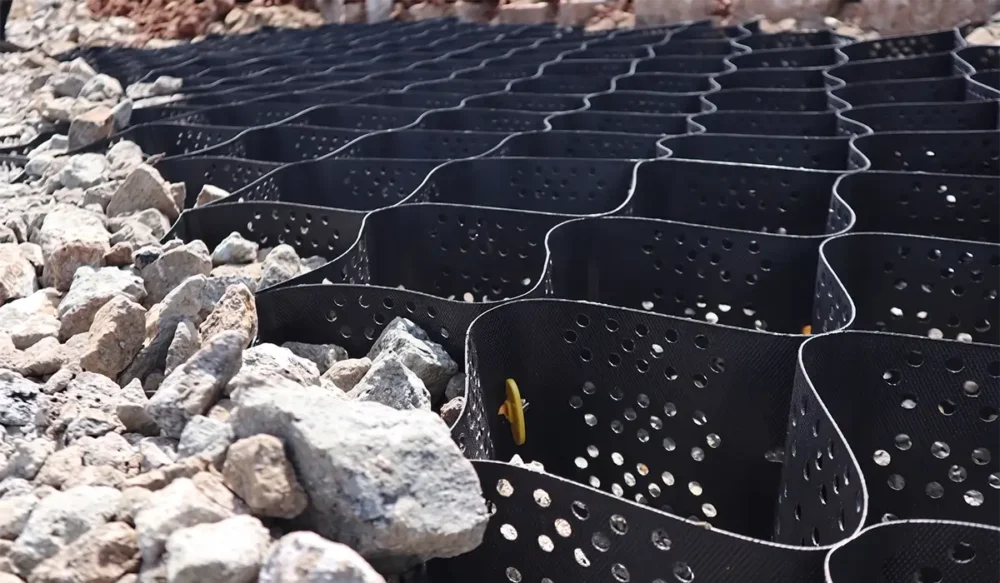
To meet this challenge, 15cm Geocell was installed directly on the subgrade. Unlike two-dimensional geosynthetics (such as plain geotextile), geocell has a three-dimensional honeycomb structure that provides mechanical confinement.
The 15cm depth was chosen based on calculations of the axle loads of the heavy vehicles that would use the road. The geocell panels were stretched out, filled with selected aggregate and compacted. The system instantly changes the mechanical properties of the loose infill into a stiff composite structure that behaves like a semi-rigid slab (mattress effect).
10 Technical Functions and Performance of Geocell on Site
Applying 15cm geocell on this Banten project had a very significant technical impact. Here is a technical analysis of how geocell works:
- Increases Subgrade Bearing Capacity
With the geocell cell walls in place, vertical stress from vehicles is resisted by friction between the cell walls and the infill. This effectively multiplies the California Bearing Ratio (CBR) of the subgrade. - Spreads Vehicle Loads over a Wider Area
The mattress effect created by geocell stops concentrated truck wheel loads from punching straight into the subgrade, spreading them evenly over a wider distribution angle. Pressure on the subgrade drops drastically. - Infill Stays Locked (Confinement Effect)
Cellular confinement applies hoop stress to the aggregate. This means the stones interlock inside the cells and have no room to move. - Aggregate Does Not Spread Sideways Easily
On conventional roads without geocell, heavy loads push aggregate outwards laterally. The 15cm geocell walls provide passive resistance that fully restrains this lateral movement. - Reduces Wheel Rutting
Because the aggregate cannot shift sideways, plastic deformation of the road surface is kept to a minimum. Heavy vehicle wheels no longer leave deep ruts. - Keeps the Road Surface Level
The dimensional stability of the geocell-aggregate composite gives the pavement above a solid foundation, so road levels and evenness are maintained. - More Uniform Settlement
On ground with a variable profile, this stiff composite helps bridge weak areas. If settlement does occur, it happens uniformly rather than locally, which is what usually triggers structural cracking. - Reduced Risk of Subsidence
With optimal stress distribution and lateral movement prevented, punching shear (where a load punches through the soil layer) can be avoided. The risk of road subsidence drops drastically. - The Road Stays Stable Under Heavy Vehicles
All these factors combine to produce a robust, stable road foundation ready for daily heavy equipment manoeuvres and logistics traffic. - Less Need for Routine Repairs
From a business efficiency perspective, a road that does not break up easily cuts maintenance and routine repair costs. Warehouse operations run more smoothly without road closures for repairs.
Conclusion
This warehouse access road project in Banten is clear proof of how the right engineering approach can solve complex infrastructure problems. Using 15cm Geocell is not just about placing material on the ground; it is about engineering the mechanical behaviour of soil and aggregate so they work together to carry extreme loads.
Other Articles

Geocell Slope Stability to Protect a Retaining Wall in Duri
Project Background & Challenges The Duri area in Riau is known for dynamic soil conditions and challenging rainfall. On this infrastructure project, which became a geocell slope stability case, the site team needed to build a safe, solid and durable retaining wall. However, there was one major technical problem: the fill on the slope had […]
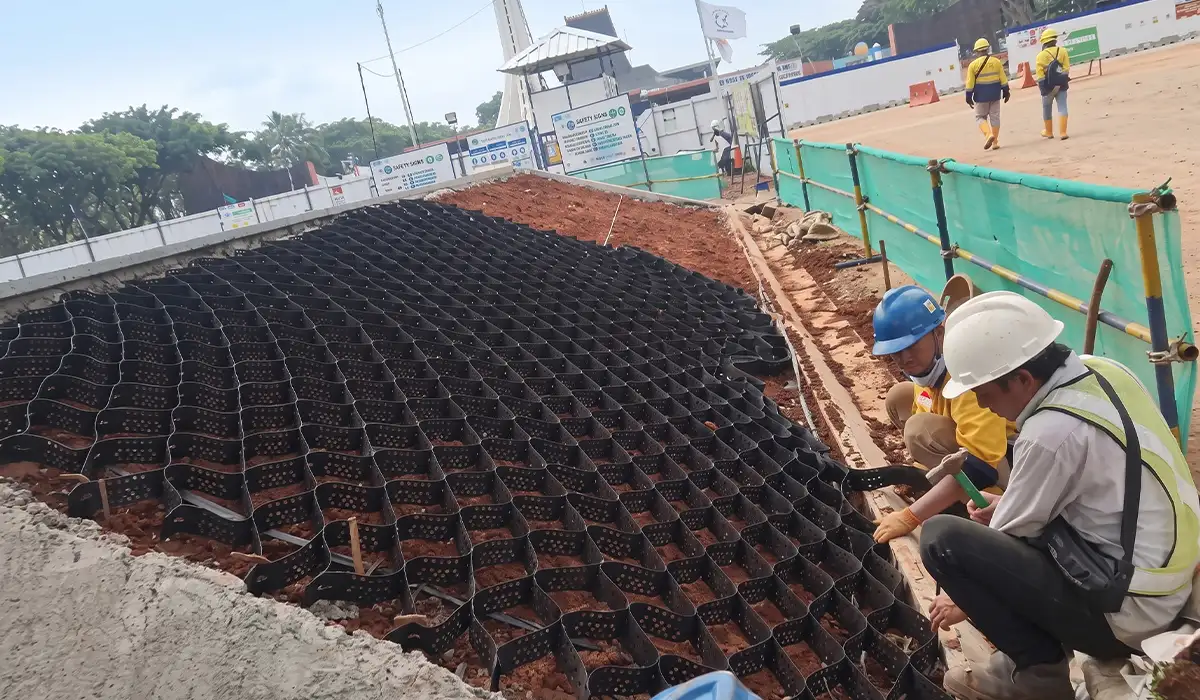
Geocell Slope Protection and Roads at TMII Jakarta
Project Background & Challenges TMII (Taman Mini Indonesia Indah), one of Indonesia’s largest recreational and cultural icons, has a road network that winds through various man-made and natural landscapes. One of the main challenges on this 2,568 m² geocell slope protection project was a slope directly adjacent to road infrastructure. Without adequate protection, the slope […]