


Geocomposite Access Road on Soft Soil in Tasikmalaya
Background: The Challenge of Building on “Unstable” Ground
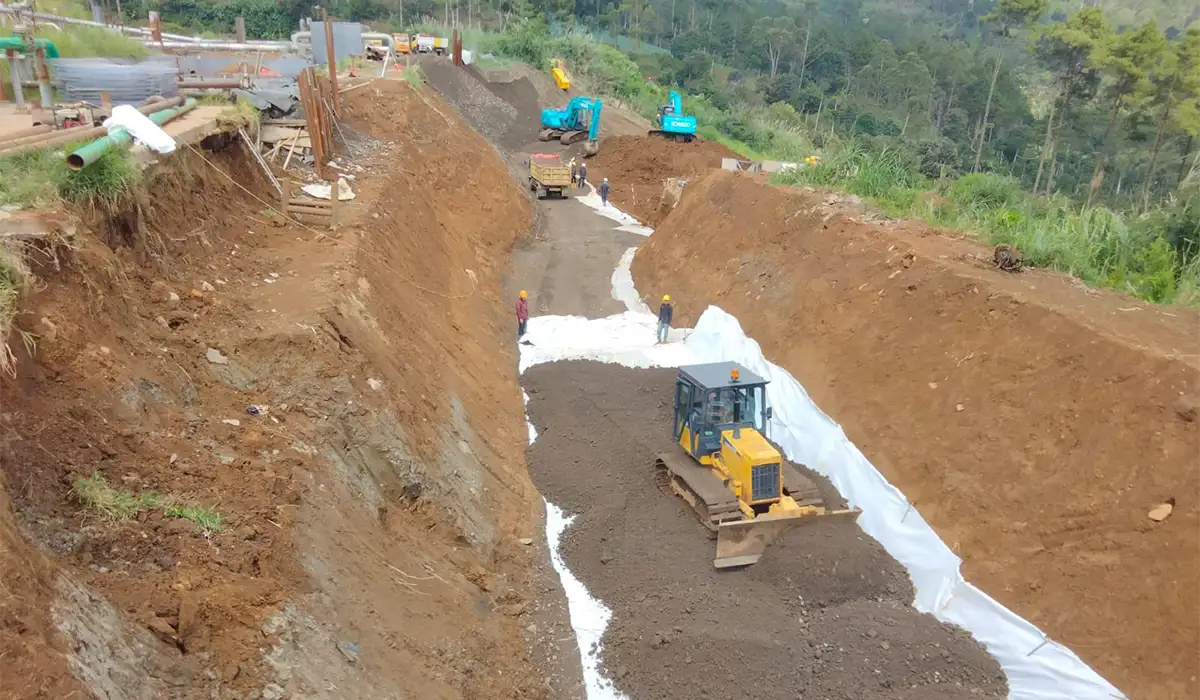
Have you ever imagined how difficult it is to build a smooth, durable access road in hilly terrain with high rainfall? That was the main challenge faced on this geocomposite access road project in Tasikmalaya, West Java.
The area is known for its dynamic ground contours and a relatively soft subgrade with a low California Bearing Ratio (CBR) value. When we talk about access roads, especially those used by heavy-tonnage vehicles or heavy equipment during construction and operation, soft soil is the “number one enemy”. Without proper treatment, repeated vehicle loads will damage the road structure before the road has even opened.
Technical Challenges: The Threat of Rutting and Aggregate Loss
On this project, covering an area of 3,640 m², the field team faced a classic but crucial technical dilemma. If the aggregate (crushed stone/gravel) for the road base were placed directly on the soft subgrade, two major problems would occur:
- Pumping Effect & Intermixing: When vehicles pass, their dynamic load presses the aggregate down. Wet soft soil is squeezed upward and mixes with the clean aggregate. The result? The base layer loses its structural strength.
- Deformation and Rutting: Because the soil’s bearing capacity is uneven, the road surface starts to sag, creating deep wheel ruts (rutting). This is very dangerous and makes the road impassable.
Replacing all the soft soil with quality fill (the conventional cut and fill method) is clearly not a wise choice, as it would take weeks and inflate the project budget. What was needed was a smart, fast and proven engineering solution.
A Smart Solution: Optimizing the Geocomposite Access Road with 50/50 kN

To meet this extreme challenge, the team decided to apply Geocomposite 50/50 kN. If you are not yet familiar with it, Geocomposite is a “hybrid” or combined geosynthetic material. It brings together the strength of a Geogrid (the reinforcement backbone, with a tensile strength of 50 kN/m in both directions/Biaxial) and a Non-Woven Geotextile (for separation and filtration) in a single sheet installed in one go.
The 3,640 m² of Geocomposite laid on this Tasikmalaya project works simultaneously to perform 4 of the most vital technical functions:
1. Separation Between Aggregate and Soft Soil
The first and most immediately visible function is separation. The non-woven geotextile layer of the Geocomposite acts as a protective “blanket” that separates the soft, muddy subgrade from the base course aggregate above it. It prevents fine soil from migrating upward, while ensuring the expensive aggregate we have spread does not sink or get swallowed by the mud.
2. Increasing Subgrade Bearing Capacity
Thanks to its Geogrid component, the material provides a confinement effect. When aggregate is spread over the Geocomposite, the stones enter and lock into the geogrid apertures. This interlock creates a stiff composite layer (stiffened platform). The subgrade, which was once soft, now has a much higher and more stable load-spreading capacity.
3. Reducing Deformation and Rutting
This is a direct effect of the material’s high tensile strength (50/50 kN). Geocomposite works like a “snowshoe” (the snowshoe effect). When heavy vehicle wheels pass, concentrated pressure is spread evenly over a wider area through the Tension Membrane Effect. As a result, the vertical stress on the subgrade drops dramatically, so the road avoids deformation and damaging wheel ruts (rutting).
4. Extending the Road’s Operational Life
By preventing material mixing and reducing deflection, the structural integrity of the pavement stays intact for a very long time. Economically, using Geocomposite on this Tasikmalaya project not only sped up construction, but also significantly cut future maintenance costs. The road’s design life is much longer than with conventional methods.
Conclusion and Final Results
Installing 3,640 m² of Geocomposite 50/50 kN on the Tasikmalaya access road project proves that geosynthetic technology is the definitive answer to today’s geotechnical challenges. The material is very practical to apply in the field: it simply needs to be laid on a leveled subgrade and then covered with aggregate.
The project was completed with outstanding time efficiency, producing a solid, stable road structure ready to carry heavy loads without worrying about the road sinking or rutting.
Other Articles
Geocomposite Slope Reinforcement Against Landslides
Background & Challenges in the Field Bekasi, with its massive infrastructure development, often faces geotechnical challenges, one of which is keeping slopes stable in high embankment or new excavation areas. The biggest challenge on this Bekasi geocomposite slope reinforcement project was not just holding back the soil mass, but fighting an enemy that often goes […]

Geocomposite Unpaved Road Stabilization in West Java
Background: Extreme Challenges in the Field This geocomposite unpaved road project in West Java has topography and weather that seriously test the durability of road infrastructure. High annual rainfall drastically increases the moisture content of the subgrade. As a result, the soil’s California Bearing Ratio (CBR) drops to a very critical level (below 3%). This […]