


Geocomposite Unpaved Road Stabilization in West Java

Background: Extreme Challenges in the Field
This geocomposite unpaved road project in West Java has topography and weather that seriously test the durability of road infrastructure. High annual rainfall drastically increases the moisture content of the subgrade. As a result, the soil’s California Bearing Ratio (CBR) drops to a very critical level (below 3%).
This soft clay has to withstand high-pressure cyclic loads from heavy vehicles passing every day. Without adequate reinforcement, the crushed stone layer (aggregate base) spread on top quickly sinks and mixes with the mud. This situation demands a structural solution that is not only strong, but also able to preserve the integrity of the pavement layers permanently.
Why Choose 50/50 kN Geocomposite for an Unpaved Road?
Instead of conventional methods such as costly material backfilling, the engineering team decided to apply Geocomposite 50/50 kN.
For your information, this Geocomposite is a smart hybrid material. It combines the high tensile strength of a Geogrid (50 kN/m in both directions/ biaxial) with the excellent filtration of a Non-Woven Geotextile, bonded together in the factory. The material is designed to solve three main problems at once:
1. Total Separation Between Aggregate and Soft Soil
This is where the non-woven geotextile layer of the Geocomposite works to the full. When heavy trucks pass, tire pressure pumps groundwater upward (the pumping effect). Without a separation layer, mud particles infiltrate the voids in the stone aggregate.
Geocomposite acts as a filter or “security guard” that holds back fine subgrade particles so they do not contaminate the aggregate layer above, while still letting water flow slowly for drainage. With the aggregate kept clean, the road structure does not lose its strength.
2. Reducing Deformation and the Threat of Rutting
Rutting, or deep wheel ruts, occurs when aggregate shifts sideways under vertical pressure from vehicle tires. The Geogrid layer of the Geocomposite has apertures that lock the aggregate in place (interlocking mechanism).
When crushed stone is compacted on top of the Geocomposite, the stones enter and lock into the grid. This interlock limits lateral movement of the aggregate, making the pavement layer structurally stiff. The result? Deformation and local settlement are significantly reduced, keeping the road surface level even under constant heavy traffic.
3. Significantly Increasing Subgrade Bearing Capacity
With a tensile strength of 50 kN/m in both the longitudinal (machine direction) and transverse (cross-machine direction) directions, Geocomposite spreads concentrated wheel loads over a much wider stress area (the snowshoe effect).
Instead of the subgrade receiving sharp pressure at one point, the load is distributed evenly. This “Tension Membrane” mechanism directly increases the bearing capacity of a very soft subgrade, allowing it to support heavy operational loads without shear failure.
An Efficient Installation Process
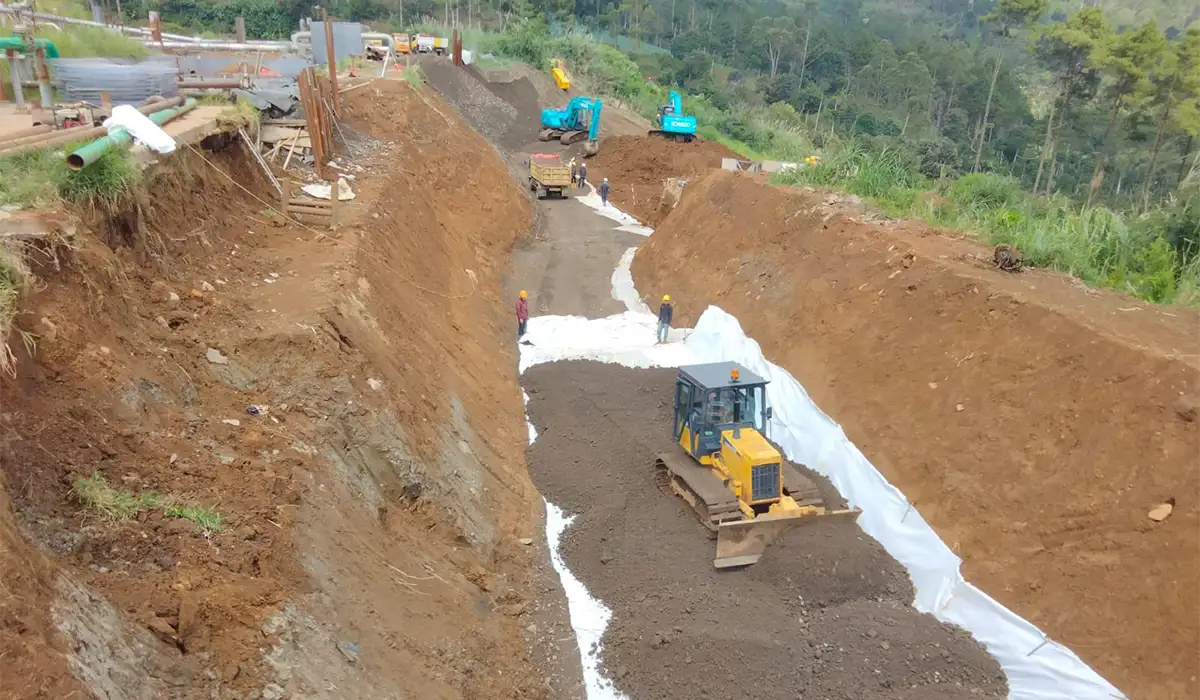
One of the outstanding advantages of this material is how easy it is to install. In this project, the subgrade only needed to be cleared of vegetation and sharp stones. The Geocomposite was then laid directly on the soft soil. After that, aggregate was spread (usually by end-dumping so heavy equipment does not drive directly on the geosynthetic) and compacted with a vibro roller. This process drastically cuts working time and excavation volume compared with chemical stabilization or soil replacement.
The Final Result: A Smart Long-Term Investment
After installation and several rainy seasons, the unpaved road on this West Java project has shown outstanding performance. No significant rutting was found, the aggregate layer remains intact, and vehicle operations run without interruption.
Using Geocomposite 50/50 kN has proven to be not just an expense, but an investment in protecting infrastructure assets. The solution saved on routine maintenance costs, reduced the required aggregate thickness and, most importantly, ensured the project never stopped because of muddy roads.
If you are facing soft soil challenges on a road, slope protection or other civil infrastructure project, choosing the right geosynthetic specification is the key.
Other Articles
Geocomposite Access Road on Soft Soil in Tasikmalaya
Background: The Challenge of Building on “Unstable” Ground Have you ever imagined how difficult it is to build a smooth, durable access road in hilly terrain with high rainfall? That was the main challenge faced on this geocomposite access road project in Tasikmalaya, West Java. The area is known for its dynamic ground contours and […]
Geocomposite Slope Reinforcement Against Landslides
Background & Challenges in the Field Bekasi, with its massive infrastructure development, often faces geotechnical challenges, one of which is keeping slopes stable in high embankment or new excavation areas. The biggest challenge on this Bekasi geocomposite slope reinforcement project was not just holding back the soil mass, but fighting an enemy that often goes […]