


Geocomposite Slope Reinforcement Against Landslides
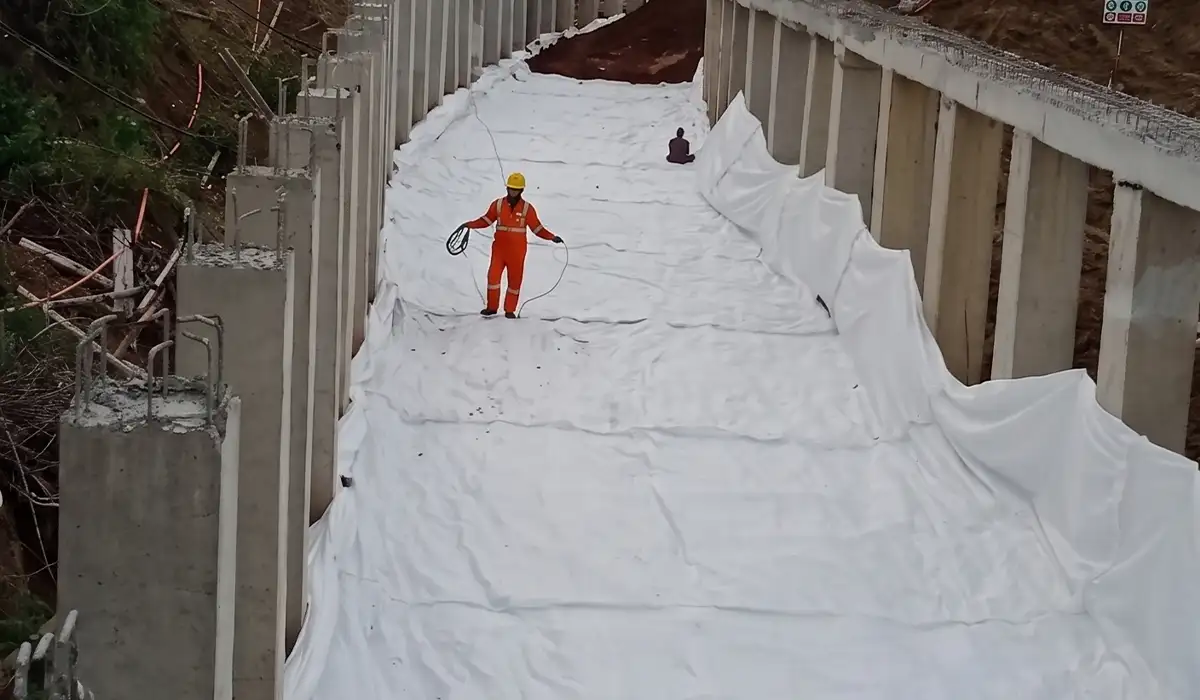
Background & Challenges in the Field
Bekasi, with its massive infrastructure development, often faces geotechnical challenges, one of which is keeping slopes stable in high embankment or new excavation areas. The biggest challenge on this Bekasi geocomposite slope reinforcement project was not just holding back the soil mass, but fighting an enemy that often goes unseen: water infiltration.
When heavy rain falls, water soaking into the slope changes the soil from unsaturated to saturated. What does that mean technically? An increase in pore water pressure (hydrostatic pore water pressure). If you understand soil mechanics, you know that rising pore water pressure instantly reduces the soil’s effective stress, which causes its shear strength to plummet. When the soil’s shear strength can no longer resist the driving force (overturning moment) of the slope mass above it, a fatal slope failure or landslide occurs.
Conventional methods often separate the reinforcement element (such as building a rigid concrete retaining wall) from the drainage element. Unfortunately, separating these two works often makes construction take much longer, leaves the structure rigid against local ground movement, and costs a considerable amount. The project team realized they needed a modern material that could do two essential jobs at once: structurally resist tensile loads and quickly drain infiltrating water.
Technical Solution: Why 105/15 kN Uniaxial Geocomposite?

To address this geotechnical complexity, Uniaxial Geocomposite with a 105/15 kN specification was chosen as the most efficient way forward. But why is this material so highly recommended?
Geocomposite is a heavy-duty hybrid material in the world of geosynthetics. In this project, the material is a precise combination of a structural reinforcement element (such as high-tenacity polymer/PET fibers) bonded to a Nonwoven Geotextile. Joining the two in the factory creates one advanced product that meets every geotechnical function requirement: separator, filter, drainage and reinforcement all at once.
Using the Uniaxial type on this slope project is very appropriate and efficient. Unlike the Biaxial type, which spreads tensile strength equally in all directions, the Uniaxial type is specially designed through one-directional molecular stretching, giving it very high tensile strength in one main direction (Machine Direction / MD) and less in the transverse direction (Cross Direction / CD).
The figure 105/15 kN means this geocomposite can resist a tensile force of 105 kN per meter in the main direction (deliberately installed in line with the thrust or potential sliding of the slope), and 15 kN per meter in the transverse direction to keep the material intact during installation.
How Does Geocomposite Slope Reinforcement Secure the Slope?
Installing Geocomposite in the field provides three working mechanisms that fundamentally save the slope from failure:
- Increasing Slope Stability (Reinforcement)
Thanks to its extreme tensile strength in the main direction (105 kN/m) and very low elongation, the material takes over the shear stress within the soil mass and converts it into tensile resistance. Interlocking, or frictional bonding between soil particles and the geocomposite grid structure, ensures the slope is locked into a single, intact and very stable mass. As a result, lateral deformation or downslope soil movement can be kept within safe limits. - Actively Controlling Pore Water Pressure
This is the life-saving feature of the Nonwoven Geotextile layer within the geocomposite. Instead of letting rainwater become trapped in the soil and trigger a slip surface, the geocomposite provides a planar drainage path (carrying water along the plane of the material). As rainwater seeps in, it is filtered and channeled safely out of the slope system without carrying soil particles with it (the filtration function). With water drained quickly, pore water pressure automatically drops, and the soil’s shear strength remains optimal even when the slope is hit by extreme weather. - Helping Distribute Loads on the Slope
On slopes in infrastructure areas, both dead loads (the weight of the soil itself) and live loads from structures above are often uneven and concentrated at certain points. Multiple layers of geocomposite in the embankment work like an elastic cushioning mat. The material distributes these vertical loads evenly over a much wider area of subgrade below. This effectively prevents local shear failure and minimizes uneven settlement (differential settlement).
Project Results and Benefits
Applying 105/15 kN Uniaxial Geocomposite in Bekasi was a great success, delivering results in line with the geotechnical design expectations. The measurable benefits include:
- Extreme Weather Safety: The slope has proven stable with no soil cracking or excessive movement even after cycles of heavy rain, demonstrating the effectiveness of the pore water pressure control provided by the material’s nonwoven layer.
- Construction Speed: Geocomposite is very practical to install: it only needs to be laid layer by layer following the soil compaction levels, with no additional heavy fabrication equipment, which drastically shortened the timeline compared with casting a retaining wall.
- Guaranteed Long-Term Stability: The polymer base material has outstanding resistance to biological and chemical degradation in the soil, maintaining its reinforcement performance (long-term design strength) for decades to come.
Conclusion
Building safe slopes in the modern era is no longer about how thick the concrete you pour is, but about how well you understand soil stress behavior and the movement of water within it. This Bekasi case study is real proof that high-tech materials such as 105/15 kN Uniaxial Geocomposite can deliver an all-in-one solution: strong in carrying loads, smart in controlling infiltrating water, and highly efficient in terms of cost and operating time.
Other Articles
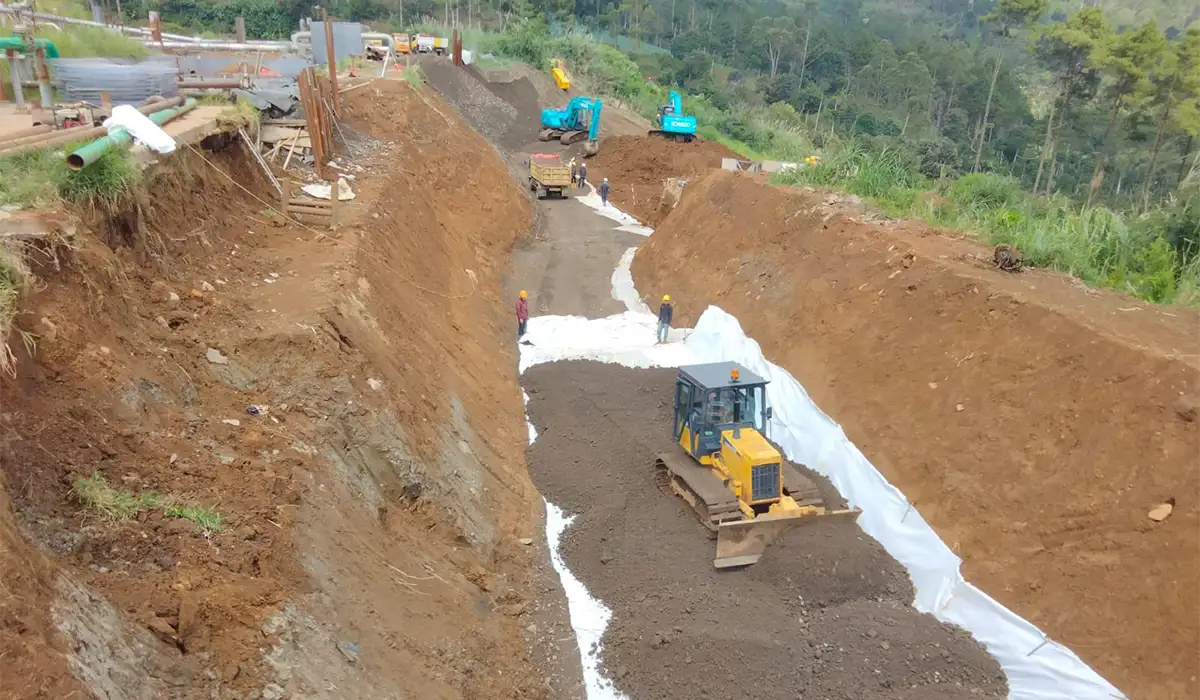
Geocomposite Access Road on Soft Soil in Tasikmalaya
Background: The Challenge of Building on “Unstable” Ground Have you ever imagined how difficult it is to build a smooth, durable access road in hilly terrain with high rainfall? That was the main challenge faced on this geocomposite access road project in Tasikmalaya, West Java. The area is known for its dynamic ground contours and […]

Geocomposite Unpaved Road Stabilization in West Java
Background: Extreme Challenges in the Field This geocomposite unpaved road project in West Java has topography and weather that seriously test the durability of road infrastructure. High annual rainfall drastically increases the moisture content of the subgrade. As a result, the soil’s California Bearing Ratio (CBR) drops to a very critical level (below 3%). This […]