


Geomembrane Drilling Pond: 53,000 m2 HDPE Lining in Dieng
Background: Challenges at Dieng’s High Altitude
The Dieng area has mountainous terrain with extreme temperatures and fairly high rainfall. During the drilling preparation phase (usually for geothermal exploitation), the contractor needs a very large water supply and a safe place to contain fluids or drilling mud, which is where a geomembrane drilling pond comes in.
The main challenge is the highly porous native soil. If water or drilling waste is stored directly on the ground without proper insulation, the fluid seeps straight into the soil (seepage). This not only wastes operational water but can also pollute the ecosystem and the groundwater used by local residents. What is needed is a high-performance waterproof layer that resists extreme weather, chemicals and mechanical abrasion.
Technical Solution: HDPE Geomembrane 1.5mm for the Drilling Pond
To meet this challenge, HDPE Geomembrane 1.5mm was chosen as the best containment solution. Why 1.5mm thick? On heavy-duty projects such as drilling, a 1.5mm thickness offers the perfect balance between flexibility to follow the pond contours and maximum puncture resistance against gravel or massive water pressure.
Installing 53,047 m2 of material is no ordinary job. The technical team had to apply very strict operating standards:
- Subgrade Preparation
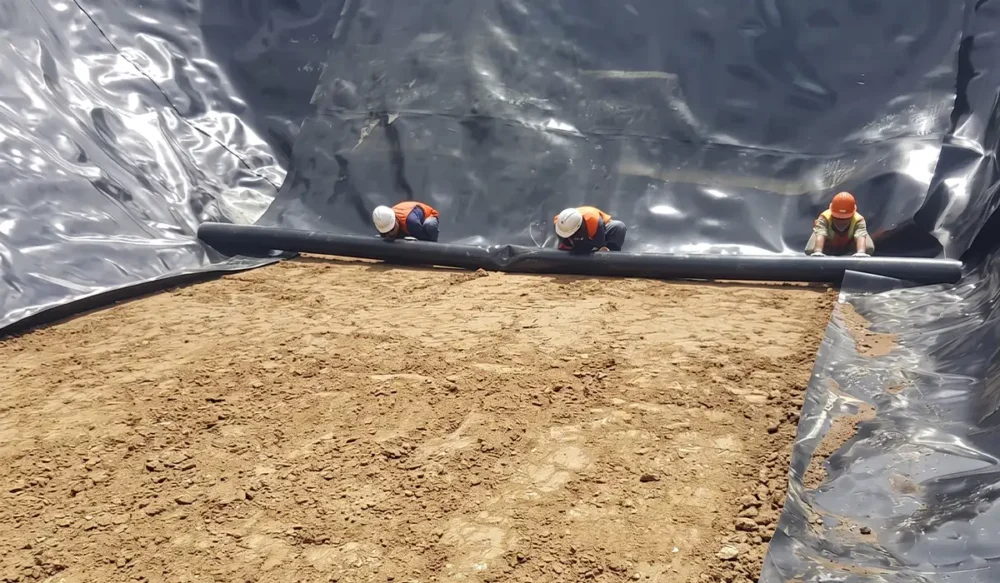
Before the geomembrane sheets are rolled out, the team must make sure the subgrade is compacted, level and free of sharp objects such as tree roots, angular stones or debris. The soil is compacted to the required compaction specification to prevent settlement when the pond is full. - Anchor Trench Construction
To stop this 5-hectare geomembrane from shifting or slipping under the water load, the team built an anchor trench around the pond rim. The geomembrane edge is laid into the trench, which is then backfilled and recompacted. - Deployment
Given the size of the area, geomembrane rolls weighing hundreds of kilograms were deployed using heavy equipment (an excavator with a spreader bar). The sheets were laid systematically with an overlap of about 10-15 cm at the seams, taking water flow direction into account and minimising cross seams. - High-Tech Welding
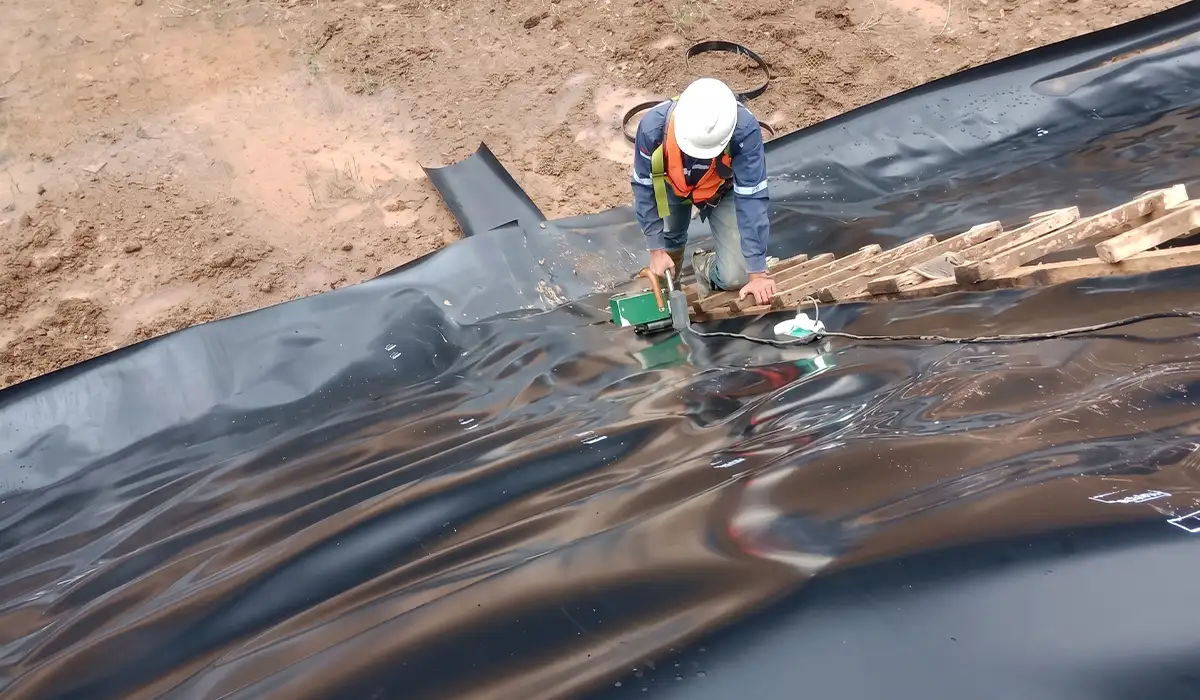
This is the most crucial phase. The technical team used an automatic Hot Wedge Welder to join the main panels. The machine melts the surfaces of both geomembrane layers at a precise temperature (usually 350°C – 420°C depending on humidity and Dieng’s cold temperatures) and presses them with double pressure rollers. The result is a double-track seam with an air channel in the middle for testing. In corners and around complex pipe bends, the team used Extrusion Welding. - Quality Control (Leak Testing)
You certainly don’t want even a pinhole leak in an area of 53,047 m2, do you? That is why every metre of seam was tested rigorously. The air channel in the hot wedge seams was injected with high-pressure air (Air Pressure Test). If the pressure did not drop within 5-10 minutes, the seam passed. Extrusion seams were tested using the Vacuum Box Test or Spark Test.
Functions & Final Results
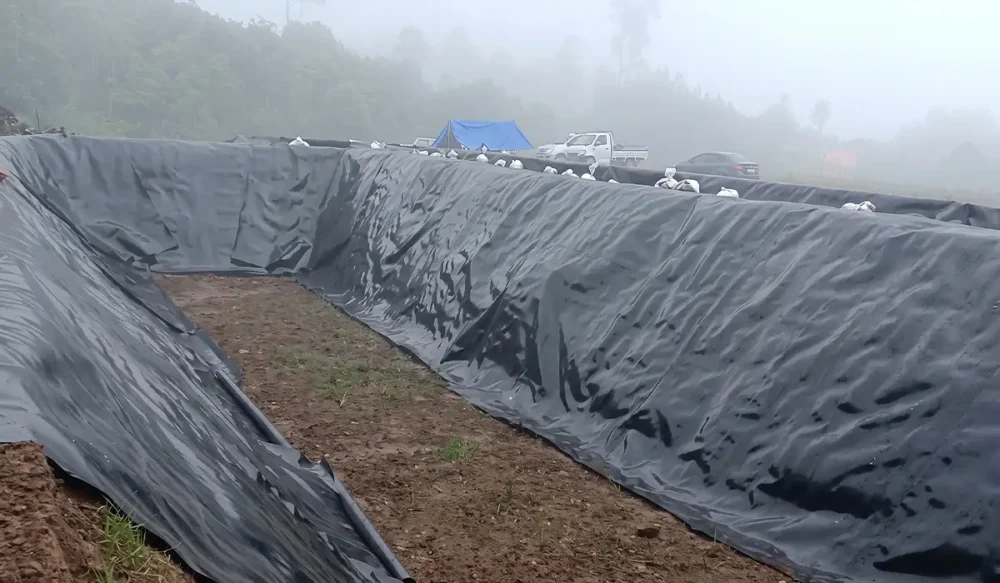
With 53,047 m2 of HDPE Geomembrane 1.5mm installed, the drilling preparation pond in Dieng is ready for operation, delivering three vital functions:
- Blocking Environmental Pollution (Zero Seepage)
The impermeable HDPE completely stops water and chemical fluids from seeping into the soil pores. This drastically reduces, and even eliminates, the risk of contaminating the soil and the underground springs used by communities around the drilling area. - A Giant Multi-Purpose Reservoir
The geomembrane pond now serves as a massive water reserve. Throughout drilling, this supply is relied on continuously for mixing drilling mud, dust control spraying, cleaning heavy equipment and workers’ utilities. - Locking In Water Quality and Volume
Unlike ordinary earthen ponds, where water quickly turns muddy and volume drops through seepage, the geomembrane lining keeps the water clean and its volume stable even in hot weather, sharply improving drilling project efficiency.
Conclusion
Building foundation infrastructure for a drilling project requires sound technical calculation and the right choice of materials. The installation of 53,047 m2 of HDPE Geomembrane 1.5mm in Dieng proves that a modern geosynthetic approach not only supports an efficient, reliable water supply for drilling operations, but above all protects the surrounding ecosystem from industrial impact.
Other Articles

1.5mm HDPE Geomembrane for a Geothermal Drilling Pond
Background: Why Is a Drilling Pond So Crucial? Drilling projects, especially geothermal ones (geothermal) such as those in the Patuha area, require massive volumes of water. This water is used not only to cool the drill bit, but also as the main ingredient for making drilling mud. A geomembrane drilling pond keeps that water safely […]

Fire Hydrant Tank Geomembrane in Tangerang
Problem Background: An Invisible Threat to the Water Tank This project is located in a strategic area of Tangerang that needed a large-capacity water reservoir dedicated to its hydrant system. Building an open or semi-open water storage tank in direct contact with the soil carries a high risk, because soil has a certain permeability (ability […]
