


Retention Pond Geomembrane Installation in Palu

Background: Why Is a Retention Pond Urgent?
When a prominent private university in Palu decided to expand its campus, one technical consequence was unavoidable: a drastic reduction in natural water infiltration areas. The construction of academic buildings, dormitories, roads, and parking areas transformed the natural ground into an impervious surface, creating the need for a retention pond geomembrane system.
Under basic hydrological principles, when heavy rain falls, water can no longer infiltrate the soil freely. The result? Surface runoff increases sharply and risks overloading the existing drainage system, potentially causing standing water and even localized flooding within the campus.
Meanwhile, soil characteristics and geological conditions in Palu require extra care in groundwater management. Rainwater allowed to seep uncontrollably below the ground (uncontrolled seepage) is more than a surface-water problem. This uncontrolled seepage can change soil moisture levels and erode the subgrade bearing capacity of the surrounding area. Naturally, this presents a latent threat to campus-building foundations worth billions of rupiah.
To mitigate these risks, the university’s planning consultant designed vital hydrological infrastructure: a large retention pond covering 9,528 square meters. The pond was designed as a “balancing reservoir” that temporarily stores stormwater overflow, prevents localized flooding, and allows the water to be released slowly into the municipal drainage system.
However, simply excavating the soil to create a pond would not be enough. If this huge pond were left as natural soil (an unlined pond), the stored water would seep back into the ground on a massive scale, triggering the same soil-instability problem the project was intended to prevent.
An absolutely watertight physical barrier was required. The developer recognized the need for an industrial-grade impermeable liner capable of withstanding hydrostatic water pressure and Palu’s intense direct sunlight (UV) without degrading for decades. These urgent technical and environmental needs prompted the use of geosynthetic technology in the project.
Project Challenges
Building a retention pond on a campus in Palu presented distinct technical challenges. First, the 9,528-square-meter area demanded exceptional material consistency. Second, the subgrade conditions and intense direct sunlight in Palu required a material that was not only impermeable but also resistant to ultraviolet (UV) radiation and temperature fluctuations for decades.
If water seeped out, the retention pond volume would become unstable, while the soil structure around the campus could erode and endanger nearby building foundations.
Technical Solution: Why Use a 1.5 mm Retention Pond Geomembrane?
To meet these challenges, a HDPE Geomembrane (High-Density Polyethylene) with a thickness of 1.5 mm was selected as the primary solution. Why was this specification chosen?
- Balance of Flexibility and Mechanical Strength: A thickness of 1.5 mm offers the ideal balance for a large retention pond project. It is thick enough to provide high tensile strength and puncture resistance, yet remains sufficiently flexible to follow ground contours and simplify on-site welding.
- HDPE Molecular Structure: Unlike other liner materials, HDPE has densely packed molecular chains. This gives it nearly zero permeability, making it completely impermeable to water and chemical liquids.
- Extreme Environmental Resistance (ESCR): High-quality HDPE offers very high Environmental Stress Crack Resistance and is reinforced with carbon black, making it resistant to degradation from Palu’s intense solar UV exposure.
Installation Execution and Methodology
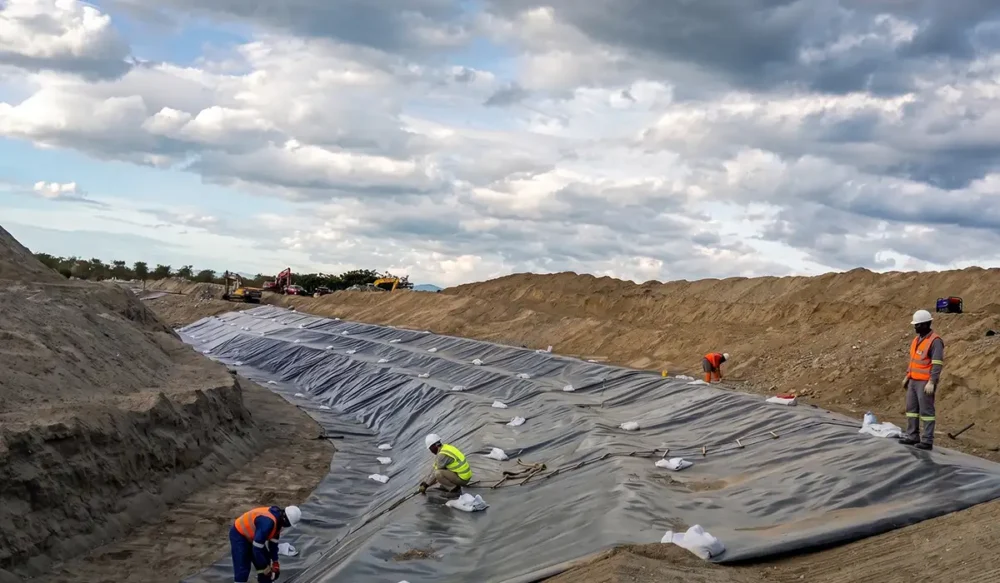
You may wonder how a nearly 1-hectare “plastic carpet” can be installed without even the smallest leak. The process requires extreme precision and is divided into several critical phases:
- Subgrade Preparation
The geomembrane cannot simply be rolled out. The team ensured that the subgrade was properly compacted and free from sharp materials such as angular gravel, tree roots, or debris. A smooth surface is essential to prevent puncturing from below under the water load. - Panel Deployment
HDPE geomembrane rolls were transported and deployed using heavy equipment with exceptional care to prevent overstressing the material. The panel layout was designed to minimize the number of welded seams, particularly around pond corners and slopes that are vulnerable to tensile forces. - Welding Process
This was the most technical and decisive phase. Two primary methods were used:
- Double-Track Hot Wedge Welding: Used to join long, straight main panels. The welding machine heats both overlapping geomembrane edges and automatically presses them together. This method creates two weld lines (a double seam) with an air channel in the center.
- Extrusion Welding: Used for detailed areas, complex corners, or patching repairs. HDPE resin rod is melted and applied directly over the seam edges to bond the material.
- Strict Quality Control and Testing
There are no assumptions in geosynthetic installation; everything must be tested.
- Non-Destructive Testing: The air channel in each hot wedge weld was inspected using an Air Pressure Test by pumping pressurized air into the channel to detect even the smallest leak along the seam. Extrusion welds were tested using a Vacuum Box Test.
- Destructive Testing: Weld samples were cut out and periodically tested on site with a tensiometer to ensure that their Peel Strength and Shear Strength met the strict requirements of GRI-GM13.
Final Results
The use of 9,528 m2 of 1.5mm HDPE geomembrane successfully created a fully watertight, functional retention pond system for the university in Palu. Water management now operates optimally: during heavy rainfall, the pond safely stores runoff, prevents potential localized flooding, and maintains the stability of the campus ecosystem.
This project provides clear evidence that selecting the right geosynthetic material and applying installation methods that meet international standards can deliver long-term environmental protection.
Other Articles

1mm Circular Pond Geomembrane in Pasuruan & Sumbawa
Project Background Intensive fish and shrimp farming today is under heavy pressure to produce maximum harvest biomass on limited land. To meet this challenge, the circular pond system lined with a circular pond geomembrane has become a favorite among modern farmers. The round design allows the hydrodynamics, or water circulation, to work far better than […]
