


Geotextile Tube Retaining Wall in Cilacap

Project Background and Challenges
The project area in Cilacap has challenging geotechnical characteristics, which made a geotextile tube retaining wall the preferred option. Dominated by soft clay and silt with a high moisture content, the subgrade’s load-bearing strength (bearing capacity) at this site is very low.
The main challenge was the need to build a retaining wall quickly, both for emergency mitigation and as a permanent structure, to curb erosion and stabilize the surrounding area.
With conventional methods such as concrete retaining walls (gravity or cantilever walls), the contractor would have to carry out extensive subgrade improvement (soil improvement), such as piling or replacing the soil (soil replacement). This is not only very costly but also slows construction. In addition, concrete walls are rigid. When the soft soil beneath them consolidates or shifts even slightly, the concrete structure takes large bending stresses, triggering serious cracks that compromise the integrity of the embankment.
Technical Solution: The Geotextile Tube Retaining Wall
To overcome the bearing capacity problem, the team decided to use Geotextile Tube. You may already know that the main function of a geotube is dewatering: filtering industrial sludge or sediment by separating solid particles from water. On this Cilacap project, however, an engineering twist was applied: this dewatering material was turned into solid gravity retaining units.
So how was it carried out on site?
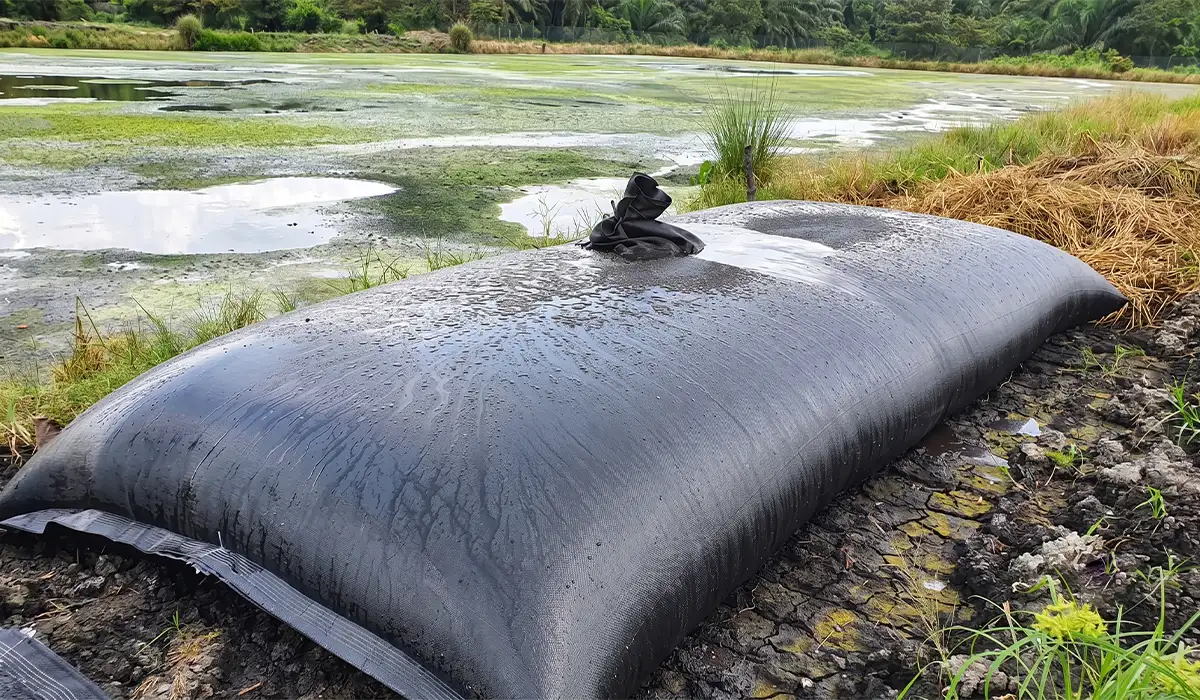
The filling method is exactly the same as conventional dewatering. The Geotextile Tube is laid out in the designated area, in this case directly on the planned alignment of the retaining embankment. The fill material (usually a mixture of water and sand or local sediment drawn up with a dredge pump) is then pumped hydraulically into the tube through a filling port.
This is where the engineering does its work. The high-strength woven geotextile (high-tensile) used in PETRA products has a precisely engineered pore opening size (AOS – Apparent Opening Size). These pores keep the solids inside the tube while letting the pumping water drain out.
The key difference from ordinary dewatering lies in the final stage. In dewatering projects the tube is cut open and removed (dismantled) to dispose of the solids (dry cake), but on this embankment project there was no dismantling. The fully filled geotextile tube, with consolidated sediment inside, was simply left in place. This giant tube, now dense and heavy, immediately took on a new role as a gravity retaining wall structure.
Why Is a Geotextile Tube Better Than Concrete on Soft Soil?
From a soil mechanics perspective, using Geotextile Tube as a retaining embankment in Cilacap offers several decisive advantages over concrete:
- Extreme Structural Flexibility: Unlike rigid concrete, Geotextile Tube is flexible. When uneven subgrade settlement occurs in the Cilacap area, these giant tubes “adjust” to the settlement profile without being damaged or bursting. Structural stability is maintained even as the shape adapts slightly to the base contour.
- Hydrostatic Pressure Dissipation: One of the greatest enemies of concrete walls is the build-up of groundwater pressure (hydrostatic pressure) behind the wall. The permeable Geotextile Tube material naturally lets water pass through the structure without carrying soil particles, eliminating dangerous hydrostatic pressure build-up.
- Using In-Situ Material: Instead of bringing in thousands of cubic metres of concrete from outside (batching plant), Geotextile Tube can be filled with sediment or sand already available around the site (in-situ material). This cuts logistics costs drastically.
- Installation Speed: Hydraulic pumps can fill a geotube in a relatively short time. For emergency embankments, this speed is key. There is no curing time as there is with concrete.
Project Results and Performance
Implementing Geotextile Tube on the Cilacap project successfully created a stable, robust retaining wall. Placing the tubes directly and leaving them in place (non-dismantled) made the project budget more efficient while accelerating construction progress on difficult ground.
This system proves that with the right geosynthetic engineering, we can achieve a retaining embankment that is not only adaptive to extreme soft soil movement but also far more economical. For emergency or permanent retaining walls on swampland, coastal areas or soft soil, this PETRA innovation is the most logical and technically sound answer.
Other Articles

Geotextile Tube Dewatering of Pond Sludge in Sumatra
Problem Background: Critical Pond Capacity Every industrial facility that produces liquid waste relies on temporary holding ponds so the solids in the water can settle out. Over time, these solids accumulate as thick sludge at the bottom of the pond, a problem that geotextile tube dewatering is designed to solve. At a processing facility in […]
Palm Oil Effluent Treatment: Geotube Dewatering Case Study
Project Background & Challenges At a palm oil mill in West Kalimantan, management faced a capacity crisis at their wastewater treatment plant (WWTP). Their anaerobic and aerobic ponds were filling with sediment at an extremely fast rate, making geotube dewatering for palm oil mill effluent (POME) an urgent need. POME is a liquid waste with […]