


Geotextile Tube Dewatering of Pond Sludge in Sumatra

Problem Background: Critical Pond Capacity
Every industrial facility that produces liquid waste relies on temporary holding ponds so the solids in the water can settle out. Over time, these solids accumulate as thick sludge at the bottom of the pond, a problem that geotextile tube dewatering is designed to solve.
At a processing facility in Sumatra, the volume of liquid waste entering the holding pond had increased significantly. The wastewater pond was starting to reach its maximum capacity. Left unchecked, the sludge would overflow, pollute the surrounding soil and water sources and, of course, violate environmental regulations.
This situation called for immediate dewatering. However, using mechanical heavy equipment such as an excavator or manual dredging was not a wise choice. Besides being slow and messy, the very high water content of the sludge makes it extremely heavy and bulky, which makes it hard to move.
Operational Challenges
In this project, the field team faced several technical challenges that had to be resolved in a short time:
- Limited Space: There was not enough free land to build a new sludge holding pond. The solution had to work in a limited area.
- High Water Content: The waste had a very high water percentage. Moving waste while wet is basically “moving water”, which is highly inefficient.
- Logistics Costs: The larger the volume and weight of wet waste, the higher the cost of transporting it to a further treatment facility or landfill.
- Environmental Standards: Separating water from sludge must not pollute the surrounding environment. The separated water (effluent) had to be clean enough to be discharged back.
Technical Solution: Geotextile Tube Dewatering with CT-90

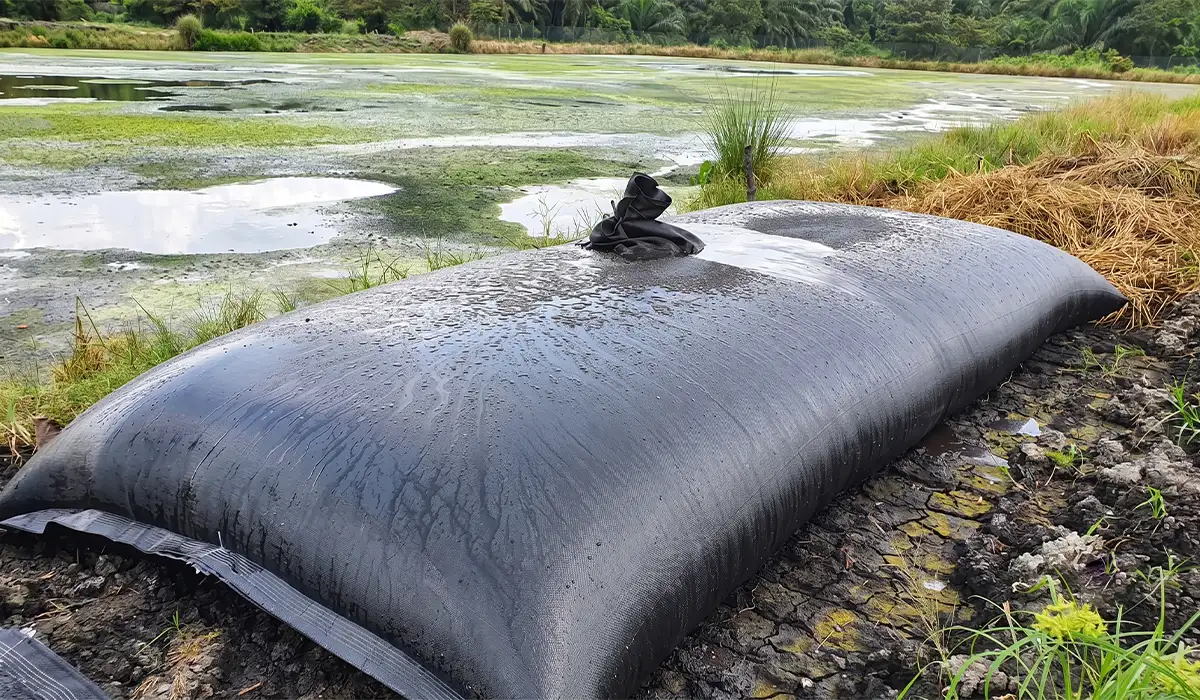
To meet these challenges, the project chose an advanced geosynthetics technology: Geotextile Tube CT-90. It is a giant tube made from high-tensile woven geotextile specifically designed for dewatering applications.
How does it work technically? The process is divided into three main phases:
- Filling Phase (Filling)
Sludge from the pond is pumped using a dredge pump or a submersible pump. Before it enters the Geotextile Tube CT-90, the liquid sludge is dosed with a polymer flocculant (if needed). The polymer binds small solid particles (colloids) into larger clumps (floc). The sludge mixture is then fed into the tube through a filling port. - Dewatering Phase (Dewatering Process)
This is where the specification of the Geotextile Tube CT-90 really shines. The woven material has a very precise pore size (Apparent Opening Size / AOS). These pores retain the solid particles inside the tube so they are not carried out, while the water in the sludge mixture seeps out through the geotextile pores under hydrostatic pressure. This filtered water (effluent) is usually clear enough to be returned to the drainage system or water treatment pond. - Consolidation Phase (Consolidation)
Once the tube is full, pumping stops and the tube is left to stand. The remaining water continues to drip out. This consolidation process drastically reduces the volume of liquid waste in the pond. Over time, the sludge inside the tube dries, compacts and forms a solid filter cake.

Project Results: Maximum Efficiency and Cost Savings
Using Geotextile Tube CT-90 on this wastewater pond project in Sumatra had an outstanding technical and economic impact. These are the measurable results achieved:
- More Efficient Waste Management
Continuously pumping sludge into the tubes quickly brought the main pond’s capacity back to normal without stopping plant operations. Dewatering runs passively and continuously. - Significant Volume Reduction
The geotextile tubes proved extremely effective at separating water from solids. The total waste volume shrank drastically because the water that made up most of the waste’s weight had been removed. - Solid Particle Retention
Geotextile Tube CT-90 successfully contained sediment and contaminants inside the tube. Its strong woven fabric withstands high pressure without tearing, keeping the work area clean. - Lower Hauling Costs
This is the biggest financial win of the project. Because the volume and weight of the sludge were significantly reduced (leaving only dry solids), the cost of transport to the disposal or further treatment site became much lower. Fewer truck trips were needed, which automatically reduced carbon emissions and the company’s logistics fuel costs.
Conclusion
If you are planning maintenance of a holding pond or looking for a solution to industrial sludge build-up, this Sumatra case study proves that mechanical methods are not the only way out. Using high-quality materials such as Geotextile Tube CT-90 offers a dewatering solution that is not only innovative and fast, but also environmentally friendly. This approach is a win-win strategy between environmental compliance and keeping your project’s maintenance budget efficient.
Other Articles

Palm Oil Effluent Treatment: Geotube Dewatering Case Study
Project Background & Challenges At a palm oil mill in West Kalimantan, management faced a capacity crisis at their wastewater treatment plant (WWTP). Their anaerobic and aerobic ponds were filling with sediment at an extremely fast rate, making geotube dewatering for palm oil mill effluent (POME) an urgent need. POME is a liquid waste with […]