


Palm Oil Effluent Treatment: Geotube Dewatering Case Study
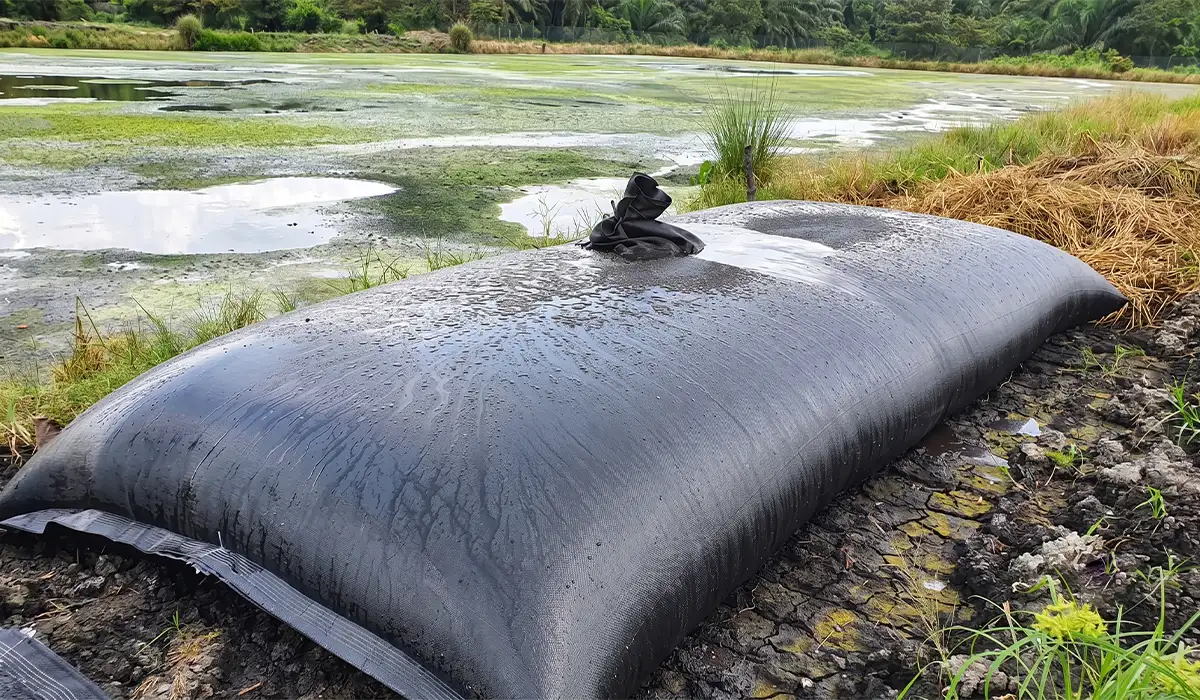
Project Background & Challenges
At a palm oil mill in West Kalimantan, management faced a capacity crisis at their wastewater treatment plant (WWTP). Their anaerobic and aerobic ponds were filling with sediment at an extremely fast rate, making geotube dewatering for palm oil mill effluent (POME) an urgent need.
POME is a liquid waste with very high organic content (BOD/COD) and Total Suspended Solids (TSS). When the effluent enters a pond, its solid particles naturally settle and form a thick layer of sludge on the pond bottom.
The main challenges facing the mill were:
- Loss of Active Pond Volume: Sludge deposits took up more than 40% of the pond capacity, leaving the Retention Time (the time the effluent stays in the pond to be treated by bacteria) far from optimal.
- Expensive Dredging: Heavy equipment such as amphibious excavators is extremely costly to rent. On top of that, where do you dispose of such an enormous volume of wet sludge?
- Limited Land (Drying Beds): Manual drying beds take up a huge amount of land and depend heavily on the weather (sunshine). In West Kalimantan, where rainfall is fairly high, this conventional method is clearly ineffective.
The Geotube Dewatering Solution from Petra Nusa Elshada
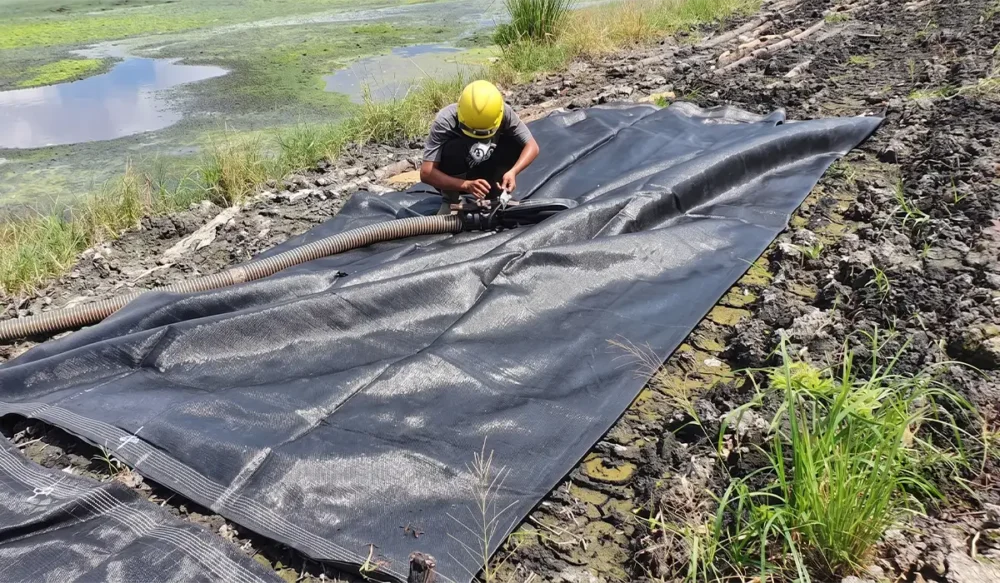
To meet these challenges, the team implemented solid-liquid separation technology (solid-liquid separation) using Geotube CT 50.
If you are not yet familiar with it, a Geotube is a giant tube-shaped bag made from high-capacity woven geotextile. The CT 50 type is specifically designed with high tensile strength and a very precise pore size (Apparent Opening Size/AOS).
In this project, Geotube CT 50 performed a dual function:
- As a Sediment Trap: Preventing solid particles from travelling further into the downstream ponds (aerobic/facultative ponds).
- As a Dewatering Unit: Draining and squeezing the water out of the wet sludge so that the volume of solid waste shrinks dramatically.
Technical Details & How It Works
How can a fabric-like material actually drain sludge from a pond? The technical process runs in a very systematic cycle. Here are the operational stages of POME dewatering on this West Kalimantan project:
A. Pumping Stage (Sludge Pumping)
The sludge on the pond bottom is extracted with a submersible pump or a dedicated sludge pump. Instead of dumping it on open land, the liquid sludge, which still contains 80-90% water, is pumped hydraulically straight into the filling port of the Geotube CT 50 bag. Sometimes a flocculant polymer is injected into the inlet pipe to help bind fine particles into larger clumps (floc).
B. Dewatering Stage (Filtration & Draining)
Once the sludge fills the Geotube, hydraulic pressure inside forces the liquid out. This is where the magic of Geotube CT 50 happens. The geotextile acts as a giant filter. The liquid wastewater (effluent) seeps out through the Geotube’s microscopic pores, while the solids (palm oil sludge) are retained inside the bag. The clear liquid that seeps out is then returned to the WWTP for further treatment, or discharged into waterways once it meets quality standards.
C. Consolidation Stage (Compaction)
After pumping stops, the Geotube is left to rest (an operational rest phase). The remaining water keeps dripping out by gravity. Within a few weeks, the volume of sludge inside the Geotube CT 50 shrinks dramatically (by as much as 70-80% of its original wet volume) and turns into a solid cake or dry soil (compost).
Results & Benefits
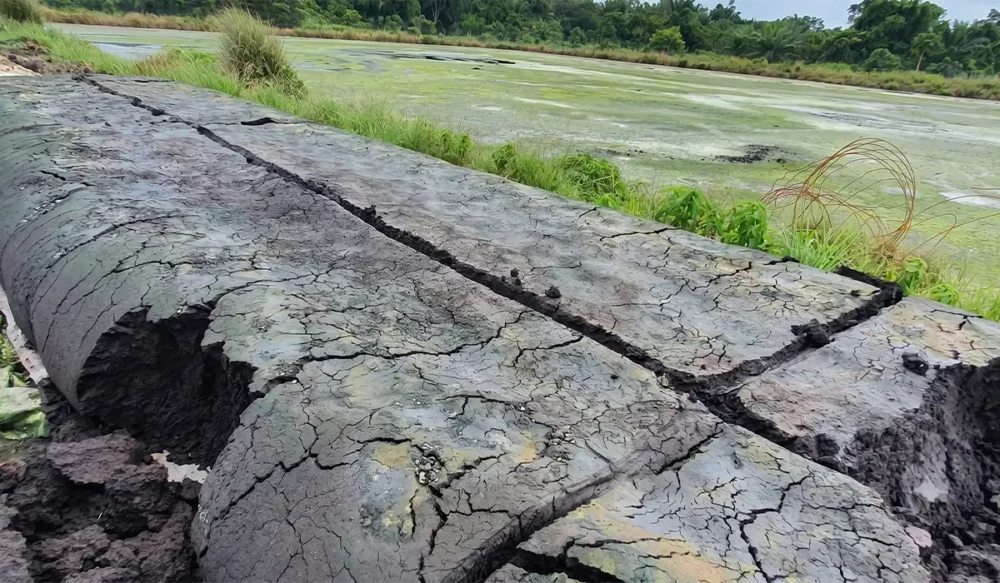
Using Geotube CT 50 in the POME wastewater ponds in West Kalimantan delivered significant results for the mill’s operations:
- Restored Pond Capacity
The wastewater ponds regained their active volume. Biological processes in the ponds returned to normal because they were no longer blocked by sediment. - Outstanding Land Efficiency
Geotube bags can be stacked vertically. The mill no longer needs to clear hectares of land just to build sludge drying beds. - Solid Waste with Economic Value
Dried POME sludge inside the Geotube is rich in nutrients. Once the bag is cut open, the solid sludge is easily hauled by dump truck and applied directly to the plantation as high-quality organic fertiliser. - Environmentally Friendly & Weatherproof
Because drying takes place inside the Geotube, heavy rain in West Kalimantan will not liquefy the sludge or wash it back into the environment. The system is closed and very safe.
Conclusion
For palm oil mill operators, leaving wastewater ponds full of sediment is like sitting on an operational time bomb. This West Kalimantan case study proves that a Dewatering and Sediment Trap system using Geotube CT 50 is the most sensible, efficient and modern engineering solution. It not only solves the pond capacity problem, but also turns a waste burden into an easy-to-handle by-product (fertiliser).
Other Articles

Geotextile Tube Dewatering of Pond Sludge in Sumatra
Problem Background: Critical Pond Capacity Every industrial facility that produces liquid waste relies on temporary holding ponds so the solids in the water can settle out. Over time, these solids accumulate as thick sludge at the bottom of the pond, a problem that geotextile tube dewatering is designed to solve. At a processing facility in […]
