


Concrete Curing Geotextile Project in Tangerang
Background
Imagine you have just finished pouring a 400 square meter concrete floor or road. It looks smooth and perfect, doesn’t it? Yet the biggest challenge, and the reason a concrete curing geotextile matters, really begins the moment the concrete has been poured.
In civil engineering, curing is a crucial phase that determines whether a structure will reach its design compressive strength or end in structural failure. On our project in Tangerang, the contractor team faced quite scorching weather. High ambient temperatures and wind exposure can trigger extreme evaporation of water from the concrete mix.
Why is this dangerous? As concrete hardens, hydration takes place, an exothermic chemical reaction between cement and water. If the water in the concrete evaporates faster than the hydration reaction needs, the concrete becomes prematurely “thirsty”. The result? Internal stress rises sharply and causes plastic shrinkage cracking (plastic shrinkage cracking). Over a 400m2 area, relying on continuous manual watering is very inefficient and prone to human error. This is where geosynthetic materials come in.
Technical Solution: 150gsm Non-Woven Concrete Curing Geotextile
Many people try wet burlap sacks or plain PVC plastic sheets for curing. However, for this medium to large-scale project in Tangerang, we decided to apply Non Woven Geotextile with a weight of 150gsm.
Made from Polyester (PET) or Polypropylene (PP) fibers, this material is mechanically processed by needle-punching, creating a three-dimensional structure that resembles the pores of a giant sponge. The 150gsm weight is the sweet spot: not so thin that it dries quickly, and not so thick that it is hard to handle on site.
Here is the technical explanation of why Non Woven Geotextile is a brilliant engineering solution in the field:
- Keeping the Concrete Surface Extremely Moist
The main function of non-woven geotextile in this project is to hold water (water retention). The needle-punched fibers can store a significant volume of water within their polymer matrix. Once laid and wetted, the material locks in moisture right on top of the concrete surface while hydration is taking place. - Absorbing and Spreading Water Evenly Across the Whole Area
Unlike burlap sacks, which may distribute water unevenly, geotextile has good capillary properties. Water sprayed at one point is absorbed and distributed evenly across the whole material. This ensures that no part of the 400m2 concrete area suffers from local dry spots. - Reducing Overly Rapid Evaporation
Direct sunlight in the Tangerang area drives high evaporation. The geotextile acts as a thermal and moisture barrier. It blocks direct UV radiation and wind sweeping across the surface, drastically cutting the evaporation rate of the water needed for hydration. - Controlling the Surface Drying Rate
The key to strong concrete is slow, steady drying. With geotextile, extreme temperature changes between day and night (thermal shock) can be dampened. The hydration temperature drops very slowly, giving the cement crystals time to bind the aggregate perfectly. - Reducing the Risk of Shrinkage Cracks (Shrinkage Cracking)
Because moisture is maintained and the drying rate is controlled, tensile stress on the concrete surface as it shrinks is kept to a minimum. Throughout this project, incidents of hairline cracks and plastic shrinkage cracks were reduced to zero. - Significantly Improving Concrete Surface Quality
The outcome of this consistent wet curing is not only about internal strength, but also surface aesthetics and durability. Concrete cured with non-woven geotextile has a much denser surface that does not produce dust (dusting), resists abrasion and does not peel easily (flaking).
Implementation in the Field
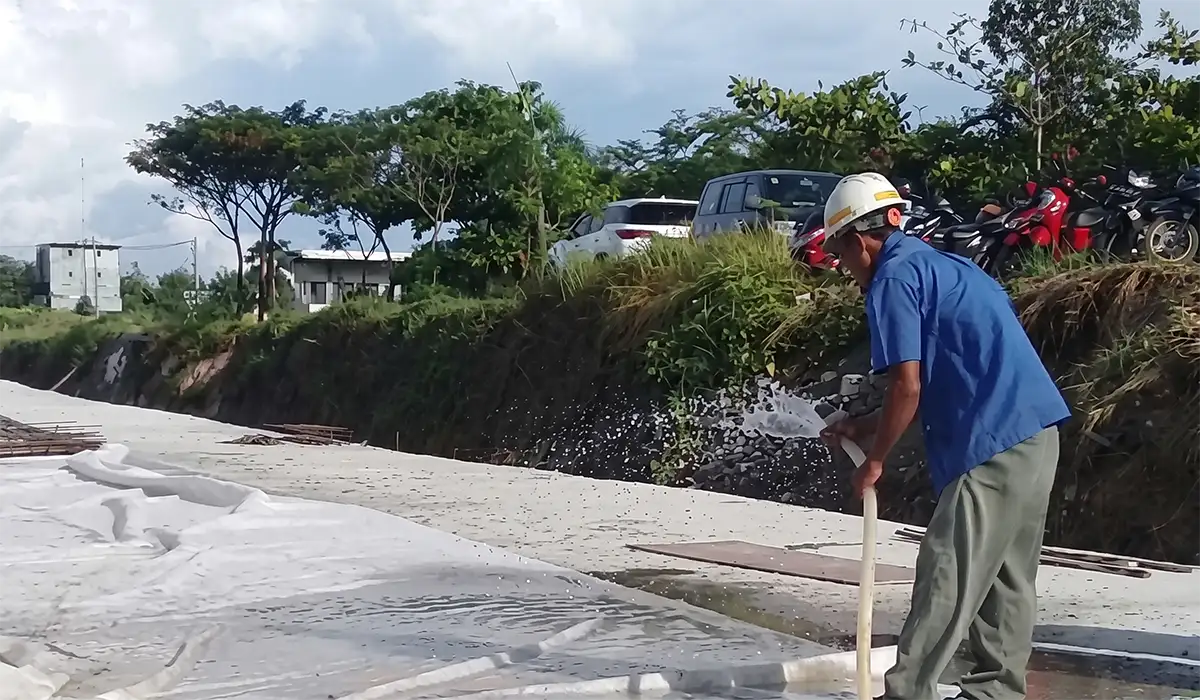
At the Tangerang project site, installation took place shortly after the concrete began setting (initial hardening) and the surface no longer left a mark when touched. The field team rolled out 150gsm Non Woven Geotextile over the 400m2 area. Make sure there is an overlap of about 10-15 cm between sheets to prevent wind gaps.
Once fully laid, the geotextile was sprayed with a water hose until saturated. During the curing period (ideally 7 to 14 days), the team only needed to monitor the geotextile’s moisture and re-wet it periodically. Thanks to the water retention of this 150gsm material, watering frequency can be reduced by up to 50% compared with traditional methods, a big saving on water and labor costs!
Final Result
Using 400m2 of 150gsm Non Woven Geotextile on this Tangerang project delivered results beyond expectations. Field quality tests showed that the concrete reached its target compressive strength with no sign of structural cracking. The surface was smooth, dense and ready for the next construction stage without any additional repair work.
Other Articles
Geotextile Concrete Curing Project in Depok
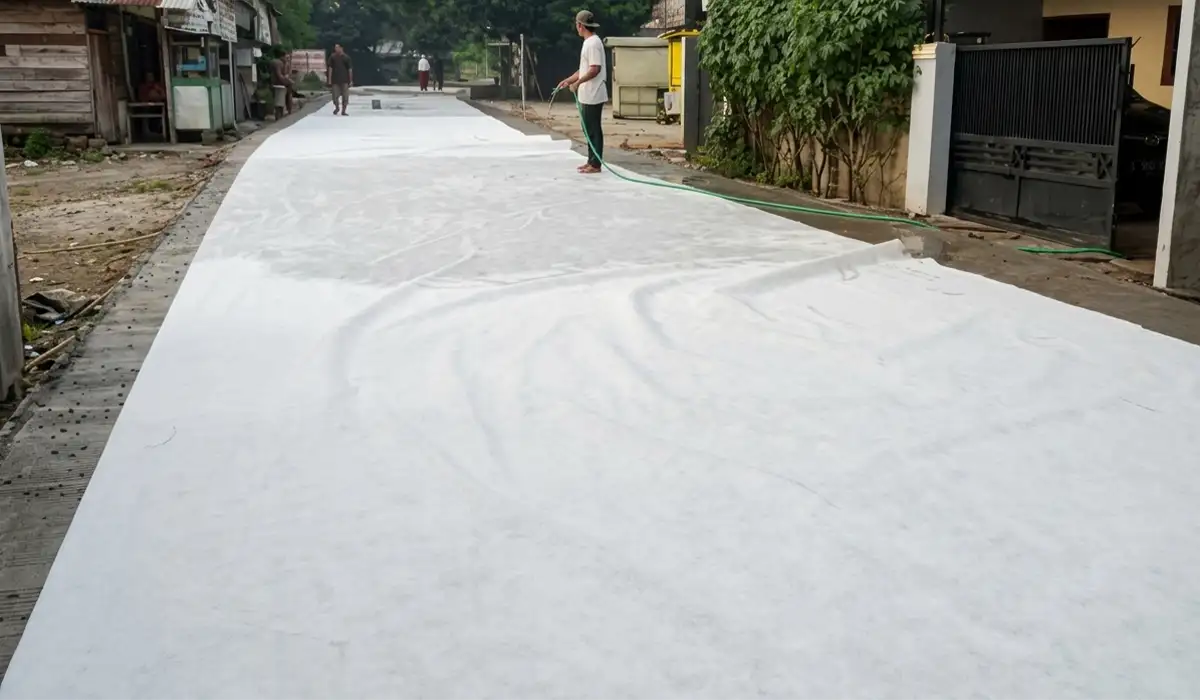
Background: Hydration Challenges and Extreme Weather This geotextile concrete curing project is located in Depok, an area with fairly challenging weather. During the day, temperatures can be scorching, humidity fluctuates drastically, and gusts of wind speed up evaporation. If you work in civil engineering, you know that cement needs water to undergo a chemical reaction […]
Non-Woven Geotextile Project on Dieng Subgrade
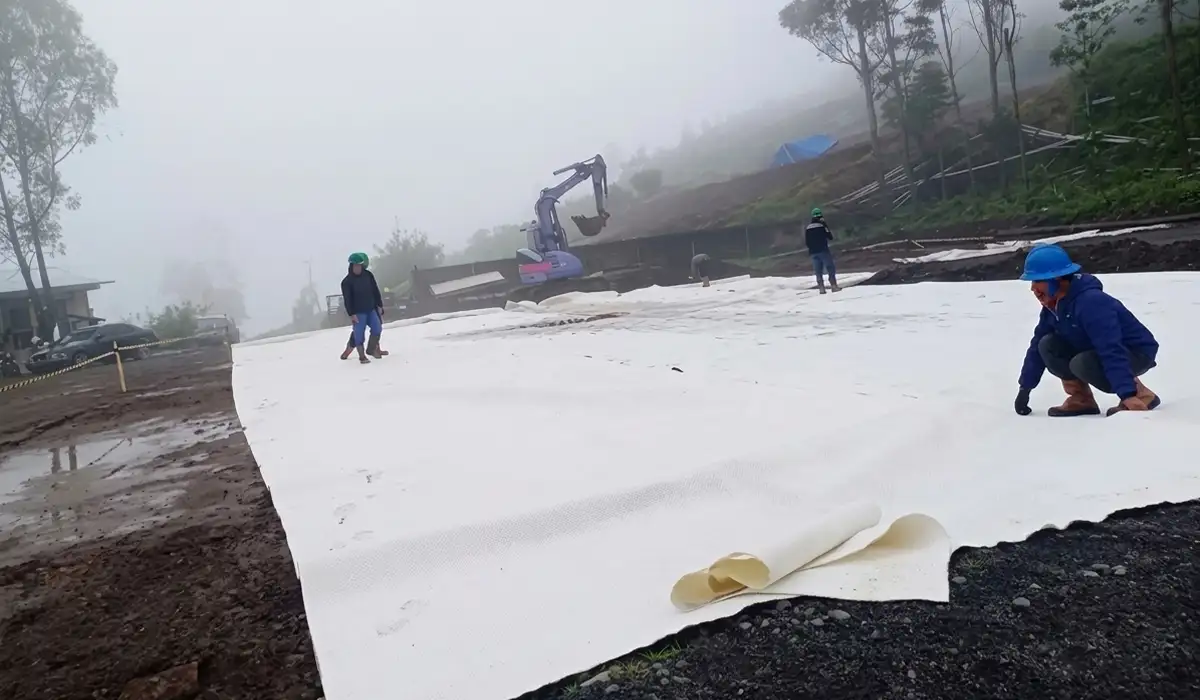
Background & Challenges The Dieng Plateau has extraordinary natural beauty, but from a geotechnical point of view, the area poses a big challenge for any non-woven geotextile project. The subgrade (subgrade) in volcanic areas often has a high water content. When heavy rain falls, this subgrade becomes fully saturated. If aggregate material (crushed stone/gravel) is […]