


Non-Woven Geotextile Separator for a Karawang Road
Background
Karawang has long been known as one of the industrial lifelines of West Java. With thousands of factories and logistics warehouses operating every day, the access roads in this area carry extreme operational loads. Heavy vehicles such as tronton trucks, dump trucks and trailers pass nonstop, 24/7, which is why this project turned to a non-woven geotextile separator.
However, there is one geographical constraint that is often a nightmare for engineers in the field: the soil in most of Karawang is dominated by clay with low bearing capacity (CBR / California Bearing Ratio value). This clay is very sensitive to changes in moisture content. In the dry season it shrinks and cracks. But when the rainy season arrives, it becomes very soft, holds a lot of water and loses its bearing capacity drastically.
Challenges in the Field
Before this repair project, the existing access road suffered severe, recurring damage. The conventional method of simply placing aggregate (crushed stone/sand-gravel) on the subgrade proved ineffective and only burned through the maintenance budget.
There is a technical phenomenon known as the pumping effect. Picture this: when the wheels of a truck carrying dozens of tons run over the road surface, that dynamic load is transmitted downward. Because the subgrade is soft and saturated, the hard, sharp aggregate is pushed down into the mud, while the fine mud is pumped up to fill the voids in the aggregate.
The result?
- Intermixing that destroys the structure of the road foundation.
- Water ponding on the road because the internal drainage is clogged with mud.
- A sharp rise in pore water pressure in the soil under traffic, triggering localized road subsidence (rutting).
Technical Solution: A Non-Woven Geotextile Separator

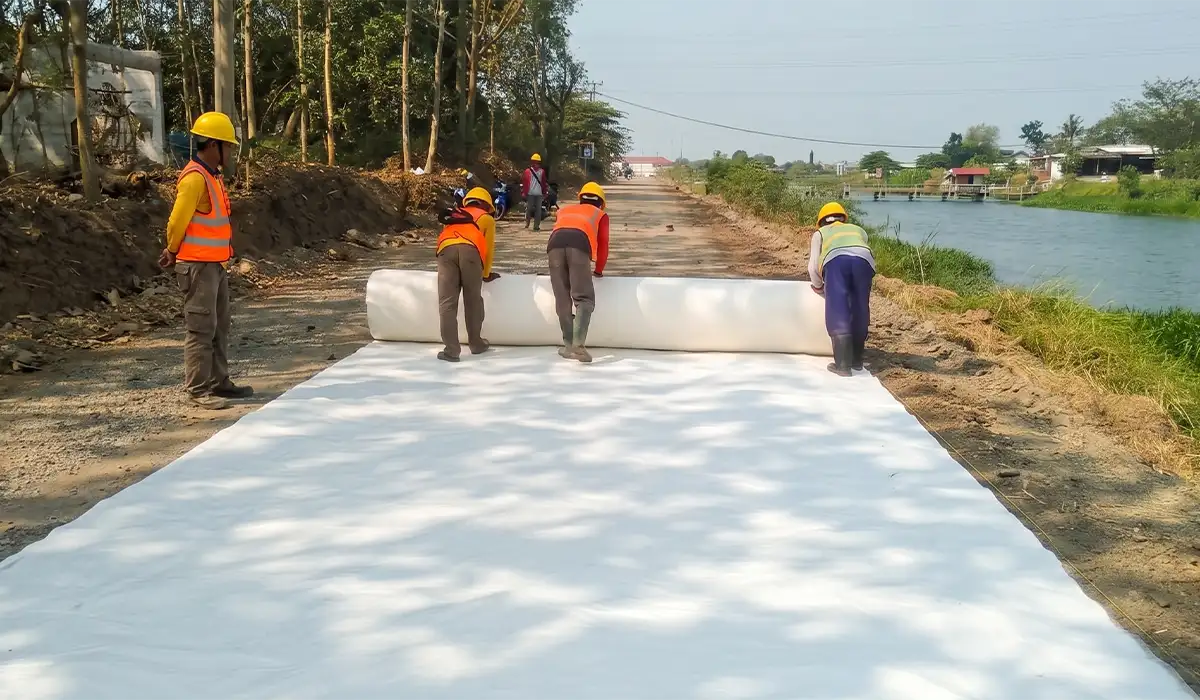
To break this cycle of damage, the engineering team decided to abandon the conventional method and switch to a geotechnical engineering material. The choice fell on 400gsm Non Woven Geotextile, laid over the entire 8,000 m² road area.
Why Non Woven Geotextile, and why specifically 400gsm?
Non Woven Geotextile is made from polymer fibers (usually Polyester or Polypropylene) bonded together through needle-punching. This process creates a material that resembles a thick carpet: porous and flexible, yet with very high tensile strength and puncture resistance. Choosing a 400gsm weight (fairly thick and heavy) is crucial here. High-grade aggregate is usually sharp-edged. A 400gsm geotextile can withstand the pressure and abrasion of that sharp aggregate without tearing during compaction with heavy equipment (compactors).
The Geotextile sheets were laid directly on the leveled subgrade, before the subbase aggregate was dumped and compacted.
Results and Performance in the Field

Using 400gsm Non Woven Geotextile over this 8,000 m² area technically changed the structural behavior of the road. These are the functions and real results that were felt immediately:
- A Perfect Separator
The main function of the geotextile in this project is to act as a separation layer. The sheet physically blocks the soft subgrade from mixing with the road aggregate above it. - Locking the Aggregate in Place
With no mud working its way up, the voids between the aggregate stones stay clean. This keeps the aggregate in position and preserves the friction between stones (interlocking), so the road foundation stays solid. - Load Distribution & Stable Bearing Capacity
The geotextile works like a “load-bearing blanket”. When a truck passes, stress concentrated under a single wheel is spread more evenly over a wider area of subgrade. As a result, the road’s bearing capacity becomes much more stable and the risk of rutting (sunken wheel tracks) is minimized. - Preventing Loss of Fines (Filtration)
The pore structure of Non Woven Geotextile is designed to work like a filter. It holds back fine soil particles so they are not washed up into the upper layers, while still letting water through. - Lowering Pore Water Pressure
This is a very important technical point. The permeable nature of non-woven geotextile allows water trapped in subgrade compressed by traffic loads to escape (drain) quickly through the geotextile’s pores. This instantly reduces excess pore water pressure, so the subgrade does not lose its shear strength. - No More Ponding on the Road
With the planar and vertical drainage provided by the geotextile, water is no longer trapped inside the pavement structure. It can flow easily into the side drains, so the road stays free of the stubborn puddles that often damage asphalt layers.
Conclusion
This road repair project in Karawang is clear proof that investing early in the right material saves a much larger budget in the future. By applying 400gsm Non Woven Geotextile as a separator and filter, the road layers are protected from fundamental damage. Ultimately, the road’s service life is much longer, maintenance frequency drops drastically, and the logistics route can operate at full speed without interruption.
Other Articles

Non-Woven Geotextile for Stronger Toll Roads
Project Background: Why Use Geotextile for Toll Roads on Unstable Subgrade Every toll road project inevitably faces one troublesome natural enemy that makes geotextile for toll roads essential: water and unstable subgrade conditions. Imagine building a road on clay or silty soil. During heavy rainfall, the groundwater table rises. If the aggregate base course (crushed […]