


Non-Woven Geotextile for Stronger Toll Roads

Project Background: Why Use Geotextile for Toll Roads on Unstable Subgrade
Every toll road project inevitably faces one troublesome natural enemy that makes geotextile for toll roads essential: water and unstable subgrade conditions.
Imagine building a road on clay or silty soil. During heavy rainfall, the groundwater table rises. If the aggregate base course (crushed stone) is placed directly on this subgrade without protection, a destructive phenomenon that engineers call the pumping effect occurs.
The pumping effect occurs when dynamic loads from passing vehicle wheels press on the road structure. This pressure forces water and fine mud particles from the subgrade upward into the voids of the aggregate layer above. At the same time, the aggregate stones sink into the mud. The result? The structural integrity of the road foundation breaks down, and the road becomes wavy, cracks and eventually subsides.
This is where the toll road engineering team realized they needed high-quality geosynthetics that could act as both a separating barrier and a water filter.
Technical Solution: 150 gsm Polyester (PET) Non-Woven Geotextile
To overcome this subgrade challenge, the project chose polyester (PET) non-woven geotextile with a weight of 150 gsm (grams per square meter).
Why this specification? Let us look at the technical details:
- Polyester (PET) Material
PET offers excellent tensile strength and resistance to creep under constant long-term loads. This makes it ideal for toll roads that carry continuous static and dynamic traffic loads. - 150 gsm Weight
A weight of 150 gsm is the sweet spot for road projects on medium to soft soil. The material is thick enough to withstand sharp aggregate stones (puncture resistance), while still offering very high permittivity (the ability to let water pass through).
Physically, the material does not look like a woven sack; it resembles a white carpet or felt whose fibers are bonded by a mechanical needle-punching process. This random structure gives it outstanding hydraulic performance.
How Does This Material Work Beneath the Road Surface?
Using 150 gsm PET non-woven geotextile on this toll road project delivers three main technical functions that work simultaneously:
1. Separation (Separation)
The geotextile is spread directly over the subgrade before the aggregate sub-base course is placed. It acts as a complete separator that prevents these two different material layers from mixing. With the geotextile in place, the aggregate layer keeps the thickness, shape and volume specified by the design consultant. The aggregate does not sink into the soft soil, so the bearing capacity of the road remains 100% stable over time.
2. Filtration (Filtration)
This is the main advantage of the non-woven type. The material has a microscopic pore structure. When groundwater rises due to hydrostatic pressure, the geotextile lets the water pass (drainage and water circulation are not obstructed), while fine soil particles and mud are retained. This filtration keeps the road base dry and free of mud, without losing the friction between the stones (interlocking effect).
3. Subgrade Reinforcement (Subgrade Reinforcement)
Although its main functions are separation and filtration, the 150 gsm PET geotextile layer also adds strength to the subgrade. When wheel loads press the road downward, the geotextile responds by distributing the stress (load) horizontally over a wider area. This prevents localized settlement (subsidence at a single point) and increases the CBR (California Bearing Ratio) of the pavement system as a whole.
Final Result: A Durable and Efficient Toll Road
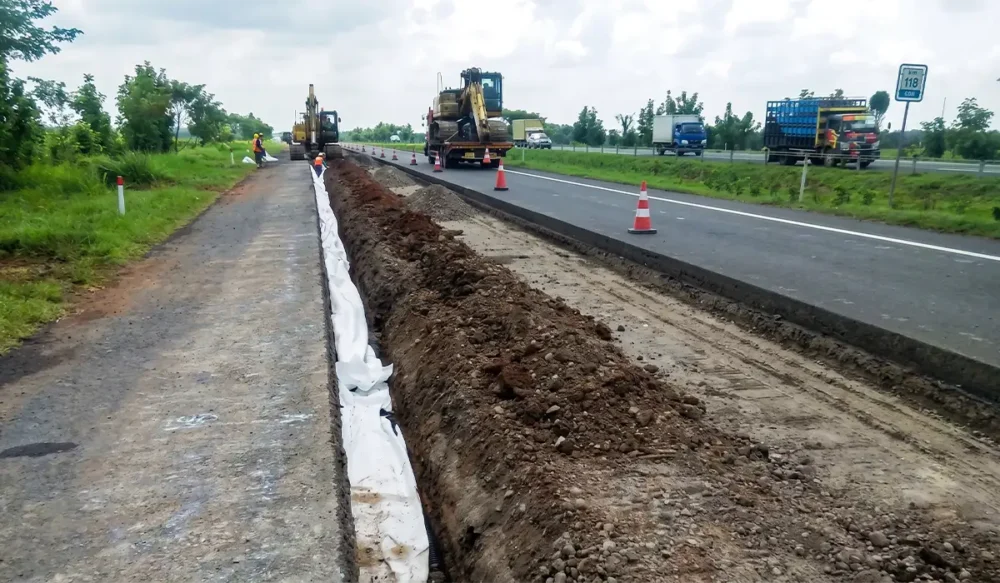
With 150 gsm PET non-woven geotextile installed along the pavement route, the results were significant.
First, the contractor saved cost and time because there was no need to excavate the subgrade deeply to place extra aggregate (to compensate for the soft soil). Second, in terms of maintenance, the road structure has proven far more durable, less prone to cracking and free from subsurface water accumulation.
So if you are planning an asphalt road, concrete road or even an industrial parking area, make sure you do not skip this subgrade protection stage. Non-woven geotextile is no longer just an add-on; it is a modern structural standard that helps your construction project stand the test of time.
Other Articles
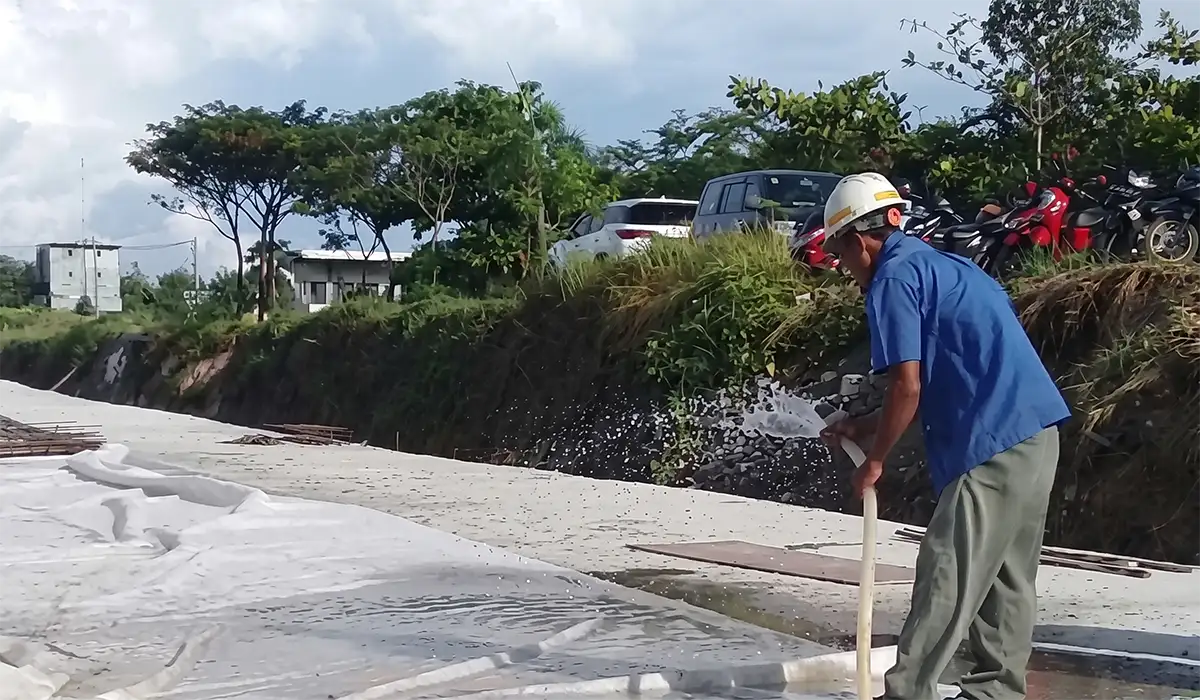
Concrete Curing Geotextile Project in Tangerang
Background Imagine you have just finished pouring a 400 square meter concrete floor or road. It looks smooth and perfect, doesn’t it? Yet the biggest challenge, and the reason a concrete curing geotextile matters, really begins the moment the concrete has been poured. In civil engineering, curing is a crucial phase that determines whether a […]

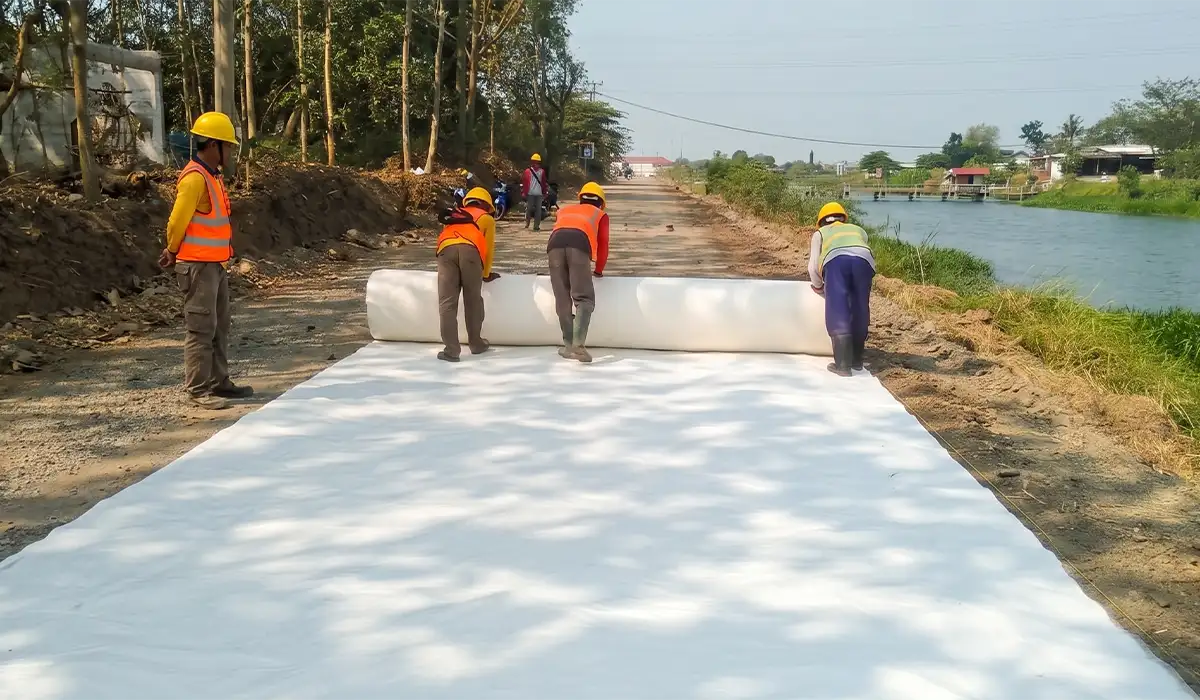
Non-Woven Geotextile Separator for a Karawang Road
Background Karawang has long been known as one of the industrial lifelines of West Java. With thousands of factories and logistics warehouses operating every day, the access roads in this area carry extreme operational loads. Heavy vehicles such as tronton trucks, dump trucks and trailers pass nonstop, 24/7, which is why this project turned to […]