


Geopipe Sleeve for Ground Anchor Cable Protection

Background
If you work in civil or geotechnical engineering, you know the challenge of building on hilly terrain such as Pesanggrahan, and why ground anchor cable protection matters. Retaining walls there carry not only dead loads but also live loads and pore water pressure (hydrostatic pressure) from the soil behind them.
Concrete is very strong in compression but rather weak in tension. Left to hold back a slope on its own, a wall can suffer overturning or sliding. This is where steel cables (strands) are embedded into the hard soil stratum behind the wall. The cables are pulled taut (tensioning) and locked off at the wall face. The effect? The wall is effectively “tied” firmly into the hillside. These strands carry the full tensile load of the retaining wall.
Ground Anchor Cable Protection Challenges on Site
Although steel strands have exceptional tensile strength, burying them in direct contact with the soil is a serious mistake. Why?
- Free Length Without Friction
For the steel cable to be tensioned and apply full tension to the wall, part of its length (usually the section nearest the wall) must not bond to the soil or the grouting cement. If the cable is gripped by the soil, the pull will never reach the wall. - Chemical Corrosion from the Soil
Soil contains moisture, groundwater and varying levels of acidity (pH). Steel exposed directly to soil over long periods suffers extreme corrosion, loses strength and can eventually snap without warning (catastrophic failure). - Minor Ground Movement
Soil is a dynamic material. Small shifts or settlement can cause mechanical friction that damages the steel wires of the strand.
A robust casing (sleeve) or protective conduit is therefore required.
Technical Solution: 100mm CSW Geopipe as a Flexible Protector
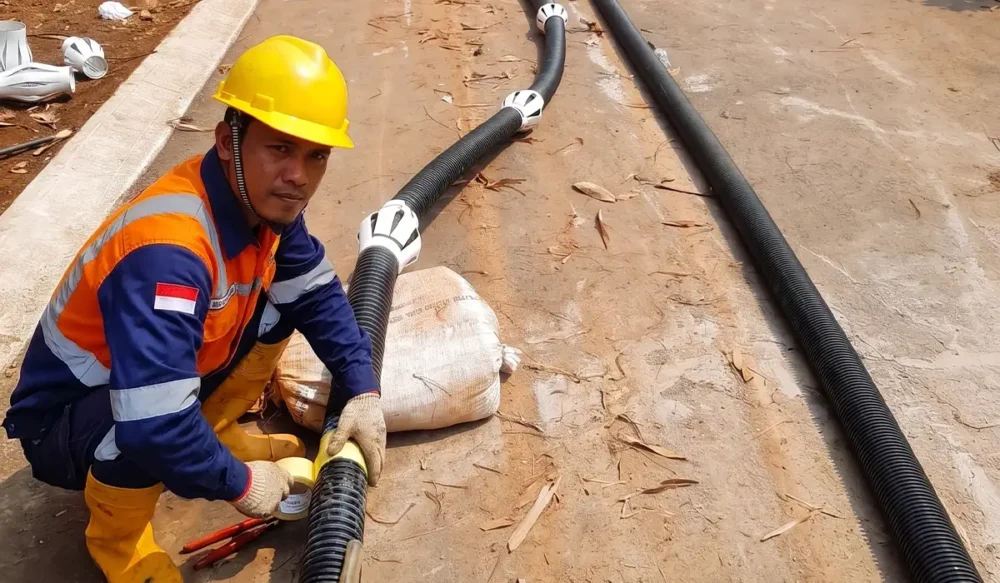
To meet the challenges of the Pesanggrahan project, 100mm Corrugated Single Wall (CSW) pipe, commonly called Geopipe, was selected as the protective sleeve for the steel cables. The choice was backed by sound calculations and technical reasoning.
Why CSW Geopipe?
- Critical High Flexibility
Unlike rigid PVC pipe, which cracks easily when the soil deforms, Geopipe is made from High-Density Polyethylene (HDPE) with a ribbed, wave-shaped profile (corrugated). This profile provides outstanding flexibility. When the steel cable is installed at a particular inclination, or when minor movement occurs in the ground, Geopipe bends along the path without kinking or cracking. This flexibility makes Geopipe ideal as a safe sleeve that does not restrict the mechanical movement of the steel strand itself. - Environmental Resistance
The HDPE material in Geopipe is highly resistant to chemical corrosion from soil, acids and sulphates that typically damage steel. Geopipe isolates the steel strand 100% from groundwater, so the cable’s service life matches that of the concrete wall (up to 50-100 years). - Perfect Load Distribution
Although the pipe looks flexible, its corrugated form provides high ring stiffness. When soil is backfilled and compacted around it, the corrugated wall distributes earth pressure across its entire surface. As a result, the pipe does not flatten (collapse), and the steel cable inside can still move freely in the unbonded zone during stressing (tensioning).
Final Results
Using 100mm CSW Geopipe on the Pesanggrahan project sped up ground anchor installation. The contractor team had no difficulty inserting the steel cables because the 100mm diameter provides ample space, and the pipe bends easily to follow the borehole.
After stressing, not a single cable jammed because of soil collapsing inside the borehole, proving that the Geopipe sleeve performed perfectly. The retaining wall now stands firm and safe from landslides, with its steel cables fully protected from rust and mechanical abrasion.
If you are working on road infrastructure, hillside housing or deep building basements, adding extra protection to tension elements with geosynthetic materials such as Geopipe is a long-term investment you should not overlook.

