


HDPE Fitting Project for a Leak-Free Biogas System

Project Challenges
Running a biogas facility in a region like West Kalimantan brings complex geographical and chemical challenges, which shaped this HDPE fitting project. Soil in this region is often peat or soft soil that is prone to settlement (soil settlement). With rigid pipes such as steel or standard PVC, even slight ground movement can crack the pipe or break its joints.
The second, equally daunting challenge is the nature of biogas itself. Raw biogas from anaerobic digestion is dominated by methane (CH4) and carbon dioxide (CO2), but it also carries highly damaging “stowaways”: hydrogen sulfide (H2S) and water vapour. When H2S mixes with condensed water inside the pipe, it forms highly corrosive sulfuric acid. Steel pipes can be destroyed by corrosion within months, causing leaks of methane, which is highly flammable and harmful to the ozone layer.
Technical Solution: Integrating HDPE Geopipe and Fittings
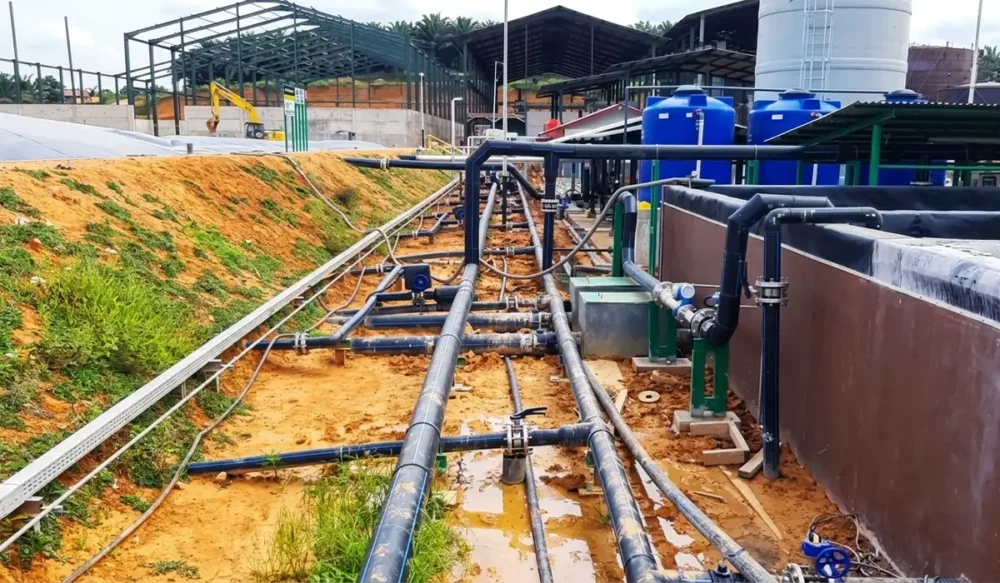
To meet these extreme challenges, the engineering team chose a piping system based on High-Density Polyethylene (HDPE). The materials supplied included HDPE Geopipe and a range of high-pressure HDPE fittings.
Let’s break down the technical functions of these materials in the field:
1. Conveying Biogas from the Anaerobic Digester
The main function of the HDPE Geopipe in this project is to act as the “artery” that carries the biogas. The pipe moves raw gas from the digester dome to the scrubber (gas purification) unit and finally to the gas engine or flare stack. The very smooth inner surface of HDPE pipe (with a very low roughness value) minimises flow resistance (friction loss), so gas pressure from the digester stays stable all the way to the end point.
2. Keeping the System Gas-Tight (100% Leak-Free)
In a biogas system, the tolerance for leaks is zero. This is where HDPE fittings play a crucial role. HDPE joints do not use glue or mechanical threads that are prone to leaking; instead they use Butt Fusion or Electrofusion technology.
This process melts the ends of the pipe and fitting with heat (around 200–220°C) and then fuses them under pressure. The result? The joint becomes a homogeneous, monolithic structure. In other words, the joint is as strong as, or even stronger than, the pipe body itself. This guarantees a truly gas-tight pipeline that prevents methane from escaping into the open air.
3. Resistant to Corrosion and Active Chemicals
As mentioned above, H2S is the main enemy of biogas piping. HDPE has a very dense polymer chain structure that is chemically inert. It does not react at all to sulfuric acid from condensed H2S gas, or to other organic acids carried from the waste. Unlike metal, which needs periodic anti-rust coating, HDPE Geopipe and fittings never rust, drastically cutting repair costs.
4. Easier Installation in Difficult Terrain
The flexible, tough (toughness) mechanical properties of HDPE are a major advantage when installing in Kalimantan’s dynamic soils. When the ground moves or settles, HDPE pipe can bend and follow the contours without stress cracking. HDPE is also much lighter than steel pipe. This makes mobilising material to remote sites in West Kalimantan and handling by technicians much faster and more efficient.
5. Supporting High-Level Operational Safety
Working with pressurised methane means putting worker safety first (Health, Safety, and Environment). HDPE Geopipe and fittings are designed with a Standard Dimension Ratio (SDR) that withstands gas pressure consistently. The material is UV resistant (thanks to its carbon black content), so the pipe will not become brittle even when exposed directly to the scorching equatorial sun for decades.
HDPE Fitting Project Results and Impact
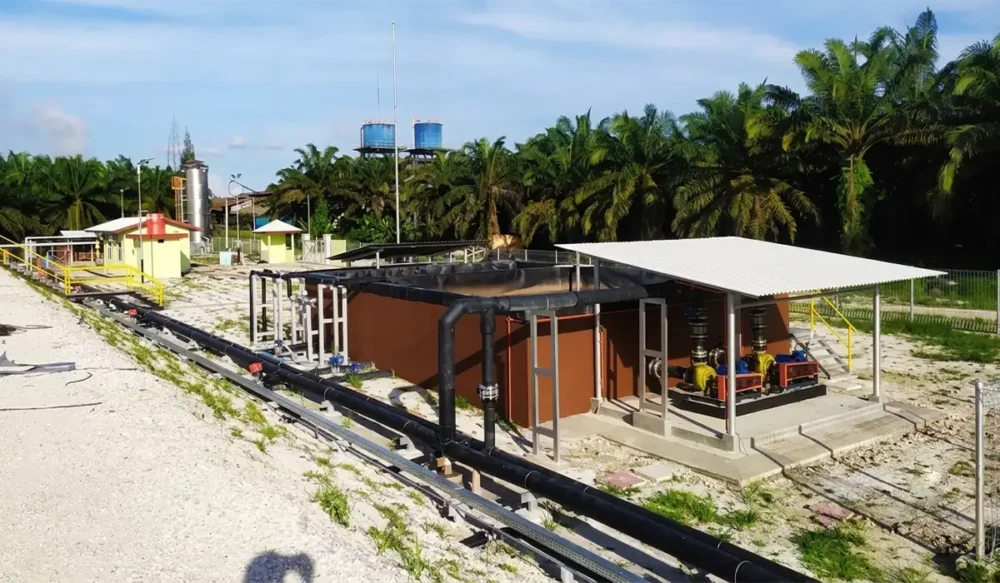
The initial investment in HDPE material has proven highly cost-effective because its design life can exceed 50 years. With a leak-free system, the volume of methane captured and converted into electricity is far more optimal, while the environment is protected from greenhouse gas emissions.
Using HDPE Geopipe and HDPE fittings in this Biogas System installation project in West Kalimantan has given the operator peace of mind. The system has successfully created a gas distribution line that is safe, reliable and maintenance-free.

