


Woven Geotextile for a Settlement-Free Warehouse in Jember
Project Background & Challenges
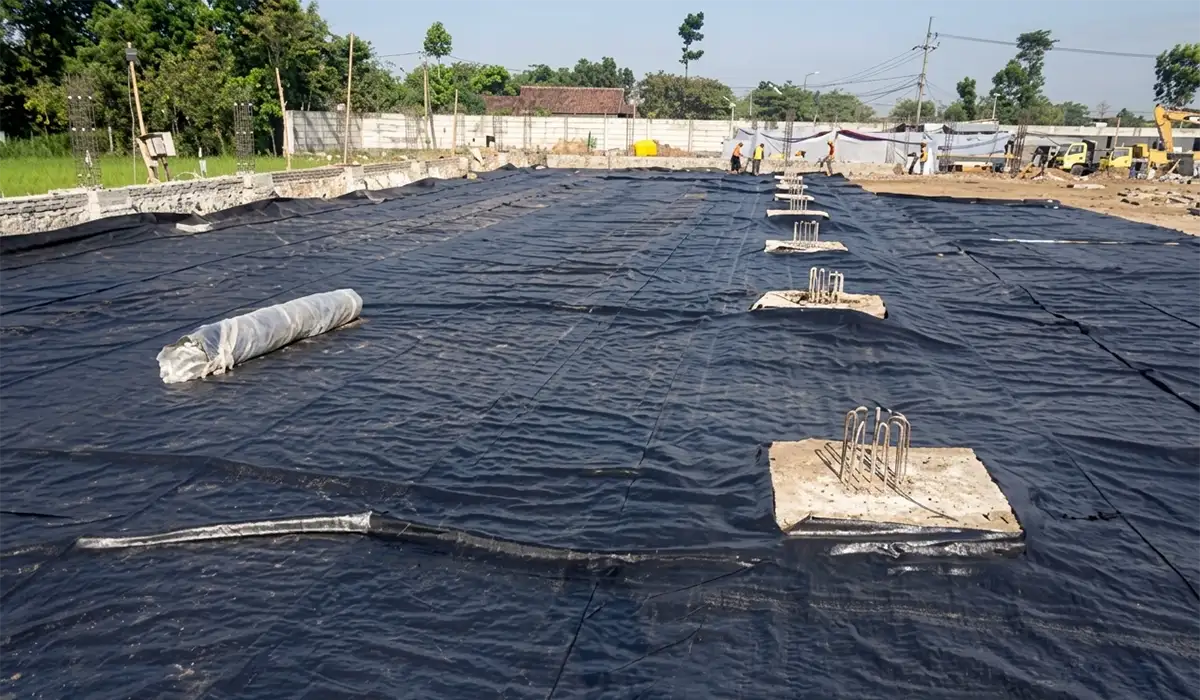
Jember is a fast-growing area with steadily increasing logistics demand. On this woven geotextile warehouse project, the contractor faced an area of 8,400 m² that required very thorough subgrade preparation.
The main technical challenge in building a warehouse floor (slab-on-grade) is the extremely high live load and dead load. Fully loaded vertical racks create very high point loads. At the same time, the subgrade in parts of the site often has a less than ideal California Bearing Ratio (CBR) or is sensitive to changes in moisture content.
If the foundation aggregate layer (crushed stone/sand-gravel) is laid directly on the subgrade without protection, the dynamic movement of forklifts or logistics trucks triggers a pumping effect. The soft, wet subgrade is pushed upwards, while expensive aggregate sinks and mixes with mud. The end result? The bearing capacity collapses and the foundation fails.
Technical Solution: Why Woven PP Geotextile 200 gsm?
To prevent this failure without excavation and soil replacement, which would cost enormous amounts of money and time, geosynthetics were chosen as the engineering intervention. The material used on this project was Woven Geotextile made of Polypropylene (PP) weighing 200 grams per square metre (gsm).
You may ask: why was this specification chosen technically?
The woven material is produced by interlacing slit film polymer tapes, resulting in a high Tensile Modulus at low strain. This means the material is very stiff and does not stretch easily, making it ideal for reinforcement. Polypropylene was also chosen because it is chemically inert: resistant to soil acidity and alkalis, and it will not rot due to soil microorganisms.
How the Material Works on Site
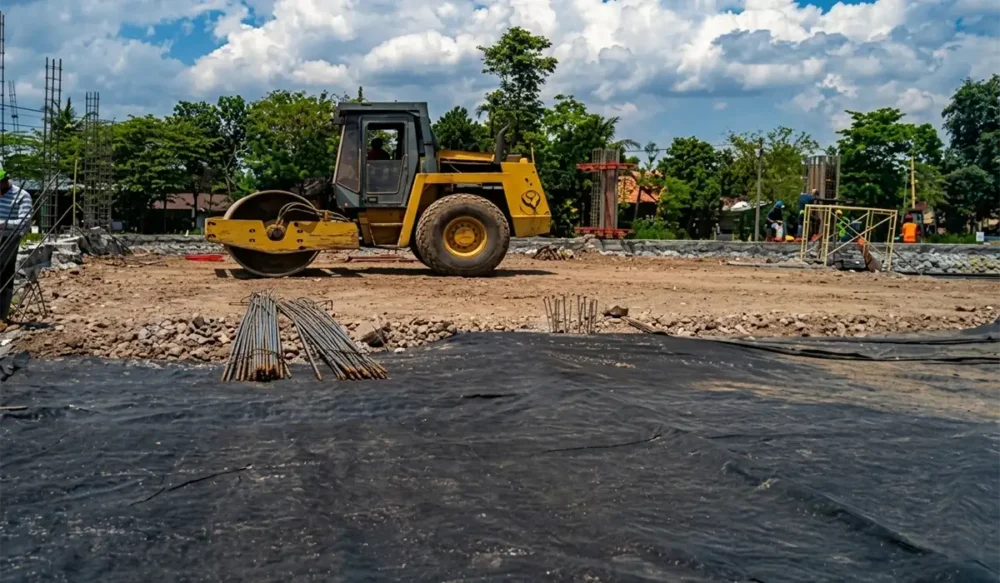
The 8,400 m² of Woven Geotextile 200 gsm laid on this project is not just a “carpet” under the ground; it performs 4 structural technical functions at the same time:
1. Separation (Separation) for Structural Integrity
Woven geotextile acts as a permeable physical barrier (letting water through while retaining particles). It prevents the coarse-graded foundation aggregate from mixing with fine particles from the subgrade. By keeping the aggregate layer clean and at full thickness, the original stiffness design of the road and warehouse floor is maintained throughout the life of the project.
2. Load Distribution (Load Distribution)
This is one of its main mechanical advantages. When heavy equipment wheels or rack loads press on the surface, the woven geotextile works through the membrane effect. Vertical stress from above is spread horizontally over a wider area through the tensile weave of the geosynthetic. As the load-spreading area widens, the specific pressure on the subgrade drops drastically, preventing shear failure in the soil.
3. Reducing Differential Settlement (Differential Settlement)
Differential settlement is a warehouse’s worst enemy. It occurs when one part of the floor sinks more than another, cracking the concrete floor and tilting the structure. By laying precisely overlapped woven sheets, the geotextile creates a bridging effect over soil of uneven density, so any settlement that occurs is uniform settlement and does not damage the warehouse floor slab.
4. Extending Service Life (Service Life Extension)
In life-cycle cost terms, the 8,400 m² of Woven PP Geotextile 200 gsm protects the investment in the pavement above it. Aggregate is not lost into the mud, and the concrete floor avoids fatigue cracking. As a result, routine maintenance can be kept to a minimum, and the warehouse’s service life can be extended by a decade or more beyond a standard design without geosynthetics.
Project Results
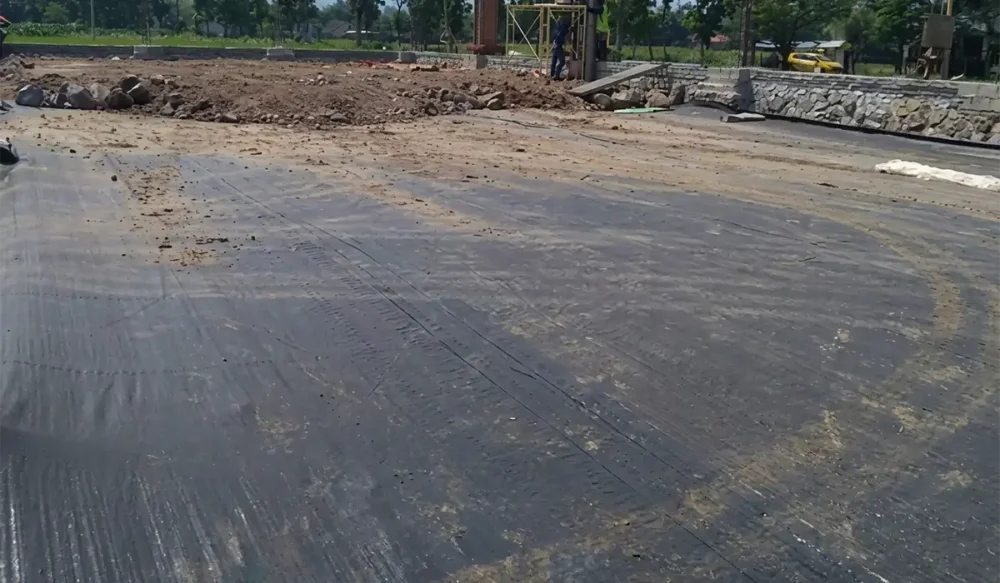
Installation of 8,400 m² of Woven PP Geotextile 200 gsm in Jember was completed with high efficiency. The geotextile sheets were quickly laid over the compacted subgrade, giving an immediately stable working platform for dump trucks delivering aggregate, even before final compaction was finished.
With this geosynthetic intervention, the contractor not only saved 20-30% of crushed stone/base aggregate volume but also significantly shortened the project schedule. The logistics warehouse now has a firmly locked, stable subgrade foundation, ready for even the busiest warehouse operations.
If you are facing soil stabilisation challenges on a road, factory or warehouse project, don’t let subgrade problems damage your superstructure. Using the right geosynthetics is the best technical investment you can make.
Other Articles

Woven Geotextile Road Reinforcement Case Study
Background Tanjung Batu, in East Kalimantan, is a strategic area undergoing rapid infrastructure and logistics growth. This woven geotextile road reinforcement case study starts there: as an economic artery, the area’s roads must operate 24/7 and withstand the continuous axle load of heavy vehicles. However, like most of Kalimantan, Tanjung Batu has fairly challenging geology. […]
Woven Geotextile Access Road Case Study in Muaro Jambi
Project Background Muaro Jambi is a regency in Jambi Province that plays a strategic role in plantations, industry and inter-regional logistics. Behind its great economic potential, however, the area faces fairly complex geotechnical challenges. Most of the subgrade (subgrade) in Muaro Jambi is soft soil (soft soil) with low bearing capacity, a California Bearing Ratio […]