


Geocell 15cm as a Retaining Wall in Tangerang

Background: Erosion and Lateral Pressure
Tangerang has fairly high rainfall. On this geocell retaining wall project, the technical team faced two main problems that had to be solved quickly. First, the embankment slope was highly vulnerable to surface erosion. Free-flowing rainwater could easily scour the outer soil layer (topsoil) and damage the slope profile already formed.
Second, there was a threat from within: high active earth pressure (lateral earth pressure). On steep slopes or embankments, the soil mass tends to move downwards and outwards. Without a retaining or reinforcement system to distribute this load, the main retaining wall at the bottom must carry extreme loads that risk deformation or even total collapse. You certainly don’t want a structure built with so much effort to end in failure, do you?
Technical Solution: How the 15cm Geocell Cellular Confinement System Works
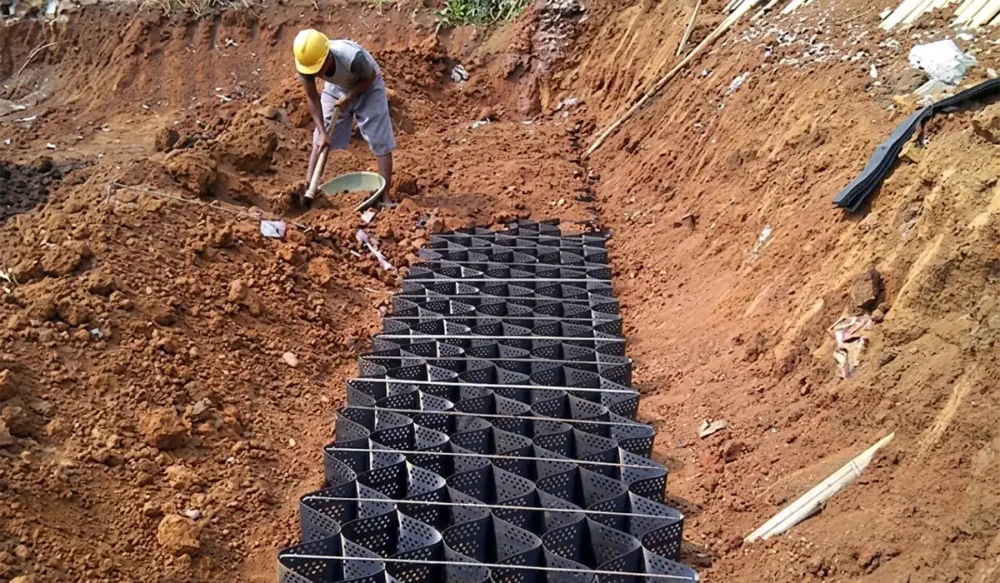
To meet these challenges, the team decided to apply 15cm Geocell. For those who want to dig deeper into the technical side, geocell is not just an ordinary plastic net. It is a three-dimensional cellular confinement system shaped like a honeycomb.
When geocell panels are stretched over a slope or retaining wall area and filled with material (local soil, gravel or concrete), a remarkable mechanical interaction takes place. The cell walls apply hoop stress to the infill. The result? Material that was loose and easily displaced is transformed into a single rigid, highly stable mass.
1. Soil Mechanics Engineering and Improved Stability
Geotechnically, using 15cm geocell on this Tangerang project had a very significant structural impact:
- Increased Shear Strength of the Fill: By confining fill within the cells, geocell artificially adds cohesion (apparent cohesion) to the soil. This dramatically increases soil shear strength, so the slope does not slide easily even under heavy loads above it.
- Reduced Movement and Deformation: Thanks to 3D interlocking, soil particle movement is tightly locked. The risk of differential settlement and lateral deformation is kept to a minimum.
- Reduced Lateral Pressure on the Main Structure: Because the soil mass inside the geocell is stiffer and carries its own weight (thanks to vertical loads being spread widely), the active earth pressure pushing outwards is greatly reduced. This lightens the load on the retaining structure below.
- Higher Safety Factor: The combination of higher shear strength and lower lateral pressure ultimately raises the Safety Factor (SF) of the whole slope structure to a very safe level in line with civil engineering standards.
2. Integrated Surface Erosion Protection
Besides its structural role, 15cm geocell also acts as an excellent protective shield:
- Prevents Soil from Being Washed Away by Rain: The geocell walls work as a series of micro check-dams. When heavy rain falls on Tangerang, the kinetic energy of runoff is immediately broken up by the cell walls.
- Reduces Material Loss: Because the flow velocity is dampened, soil particles are not easily carried away. The fill stays safely in place.
- Maintains Long-Term Slope Geometry: With erosion and internal movement eliminated, the slope keeps a precise, neat shape for years to come, drastically cutting maintenance costs.
Results: Fast and Robust Construction
One of the most tangible benefits for contractors on this Tangerang project was operational efficiency. Geocell is very light when folded, so mobilisation costs are very low.
During installation, geocell only needs to be stretched out, staked and filled with local soil using standard heavy equipment. There is no waiting for concrete curing or hauling excavated material off site. This measurably speeds up construction, allowing the project to finish before the rainy season arrives.
Ultimately, using 15cm geocell proves that a modern materials approach not only solves soil mechanics problems but also provides an efficient, economical and environmentally friendly solution.
Other Articles


Geocell Warehouse Access Road for Heavy Trucks in Banten
Background: Why Do Warehouse Roads Fail So Often? Before discussing the solution, you need to understand the root of the problem. This geocell warehouse access road in Banten was designed to carry static and dynamic loads from fully loaded heavy trucks and trailers. The main problems that typically occur in such conditions include: Excessive load […]

Geocell Cut Slope Protection in Cilegon
Project Background & Challenges This project in Cilegon involved a cut slope to clear land for a new industrial facility, which called for geocell cut slope protection. The problem was that the resulting slope was fairly steep, with surface soil of sandy clay that is very sensitive to water. In the rainy season, Cilegon often […]